NAG-000154 · Accepted whole
A higher-dimensional boundary distinction
3 Reduction, formal models and residual geometry
Open in the English reader · PDF page 497
Statement · exact TeX
\begin{proposition}[\bi{A higher-dimensional boundary distinction}{高维中的 boundary 区别}]\label{fnd:bidiscboundary}
\bi{Let $K$ be nontrivially valued and $X=\mathcal M(K\langle T,S\rangle)$. Its Shilov boundary consists of the Gauss point $\zeta_{1,1}$, but its analytic boundary contains every weighted Gauss point $\zeta_{1,\rho}$ with $\rho\in|K^\times|$, $0<\rho<1$.}
{设 $K$ nontrivially valued,$X=\mathcal M(K\langle T,S\rangle)$。其 Shilov boundary 只有 Gauss point $\zeta_{1,1}$,但其 analytic boundary 包含每个 weighted Gauss point $\zeta_{1,\rho}$,其中 $\rho\in|K^\times|$、$0<\rho<1$。}
\end{proposition}
Full selected proof · exact TeX
\begin{proof}
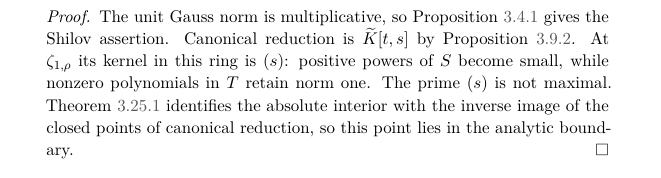
\bi{The unit Gauss norm is multiplicative, so Proposition~\ref{new:shilov_singleton} gives the Shilov assertion. Canonical reduction is $\widetilde K[t,s]$ by Proposition~\ref{fnd:gradedgauss}. At $\zeta_{1,\rho}$ its kernel in this ring is $(s)$: positive powers of $S$ become small, while nonzero polynomials in $T$ retain norm one. The prime $(s)$ is not maximal. Theorem~\ref{fnd:strictabsoluteinteriorreduction} identifies the absolute interior with the inverse image of the closed points of canonical reduction, so this point lies in the analytic boundary.}
{单位 Gauss 范数具有乘性,因此 Proposition~\ref{new:shilov_singleton} 给出 Shilov 边界的断言。由 Proposition~\ref{fnd:gradedgauss},典范约化为 $\widetilde K[t,s]$。在 $\zeta_{1,\rho}$ 处,其核为 $(s)$:$S$ 的正次幂变小,而 $T$ 的非零约化多项式保持范数一。素理想 $(s)$ 不是极大理想。Theorem~\ref{fnd:strictabsoluteinteriorreduction} 将绝对内部识别为典范约化闭点集的原像,因此该点位于解析边界。}
\end{proof}
Typeset reader excerpt
Typed proof inputs
- NAG-000189 · selected whole (accepted native whole)
- NAG-000657 · selected whole (earlier candidate whole in this reviewer batch)
- NAG-001635 · selected whole (earlier candidate whole in this reviewer batch)
Reader cross-references
Proof map
Verified map inputs · NAG-000154
AND · joint registered proof inputs
- NAG-000189 · Result 3.9.2 · accepted whole Exact source window 64–65
- In the nontrivially valued bidisc at the original value-group radii, the unit Gauss norm is multiplicative, the canonical reduction is the polynomial plane, and the nonmaximal prime (s) is detected by the strict reduction criterion.
- NAG-000657 · Result 3.4.1 · accepted whole Exact source window 64–65
- In the nontrivially valued bidisc at the original value-group radii, the unit Gauss norm is multiplicative, the canonical reduction is the polynomial plane, and the nonmaximal prime (s) is detected by the strict reduction criterion.
- NAG-001635 · Closed reduction points and absolute interior · accepted whole Exact source window 64–65
- In the nontrivially valued bidisc at the original value-group radii, the unit Gauss norm is multiplicative, the canonical reduction is the polynomial plane, and the nonmaximal prime (s) is detected by the strict reduction criterion.
NAG-000154 · A higher-dimensional boundary distinction · Chapter argument