NAG-000160 · Accepted whole
Result 4.1.1
Open in the English reader · PDF page 626
Statement · exact TeX
\begin{theorem}\label{fnd:classification}
\bi{Every point of $\mathbb A^{1,\an}_K$ is either $\zeta_{a,r}$ for some $a,r$, or the limit of the seminorms of a decreasing sequence of closed discs with empty intersection. The four types are:}
{$\mathbb A^{1,\an}_K$ 的每个 point 或为某个 $\zeta_{a,r}$,或为一列 intersection 为空的 decreasing closed discs 的 seminorms 的 limit。四类如下:}
\begin{enumerate}
\item \bi{Type I: $r=0$, an evaluation at $a\in K$.}{Type I:$r=0$,即在 $a\in K$ 的 evaluation。}
\item \bi{Type II: $r>0$ and $r\in|K^\times|$.}{Type II:$r>0$ 且 $r\in|K^\times|$。}
\item \bi{Type III: $r>0$ and $r\notin|K^\times|$.}{Type III:$r>0$ 且 $r\notin|K^\times|$。}
\item \bi{Type IV: the empty-intersection case.}{Type IV:上述 empty-intersection 情形。}
\end{enumerate}
\end{theorem}
Full selected proof · exact TeX
\begin{proof}
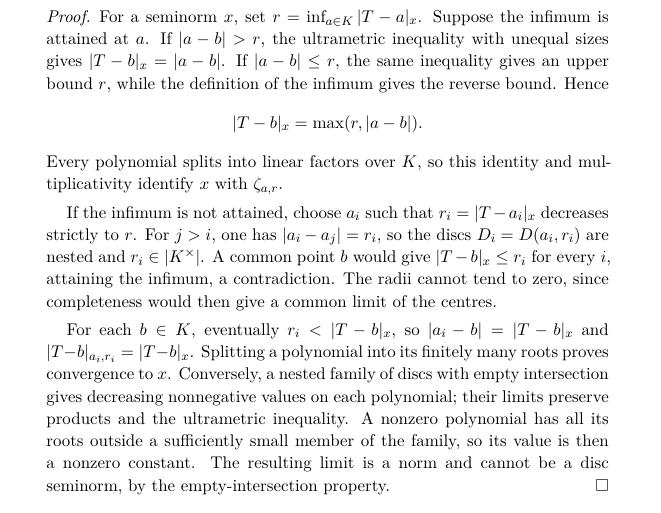
\bi{For a seminorm $x$, set $r=\inf_{a\in K}|T-a|_x$. Suppose the infimum is attained at $a$. If $|a-b|>r$, the ultrametric inequality with unequal sizes gives $|T-b|_x=|a-b|$. If $|a-b|\leq r$, the same inequality gives an upper bound $r$, while the definition of the infimum gives the reverse bound. Hence}
{对 seminorm $x$,令 $r=\inf_{a\in K}|T-a|_x$。若 infimum 在 $a$ 达到,则当 $|a-b|>r$ 时,利用 unequal sizes 的 ultrametric equality 得 $|T-b|_x=|a-b|$。当 $|a-b|\leq r$ 时,同一 inequality 给出 upper bound $r$,而 infimum 的定义给出反向 bound。因此}
\[
 |T-b|_x=\max(r,|a-b|).
\]
\bi{Every polynomial splits into linear factors over $K$, so this identity and multiplicativity identify $x$ with $\zeta_{a,r}$.}
{每个 polynomial 都在 $K$ 上分解为 linear factors,故此恒等式与 multiplicativity 将 $x$ 识别为 $\zeta_{a,r}$。}

\bi{If the infimum is not attained, choose $a_i$ such that $r_i=|T-a_i|_x$ decreases strictly to $r$. For $j>i$, one has $|a_i-a_j|=r_i$, so the discs $D_i=D(a_i,r_i)$ are nested and $r_i\in|K^\times|$. A common point $b$ would give $|T-b|_x\leq r_i$ for every $i$, attaining the infimum, a contradiction. The radii cannot tend to zero, since completeness would then give a common limit of the centres.}
{若 infimum 未达到,选择 $a_i$,使 $r_i=|T-a_i|_x$ 严格下降到 $r$。对 $j>i$,有 $|a_i-a_j|=r_i$,所以 discs $D_i=D(a_i,r_i)$ nested,且 $r_i\in|K^\times|$。若存在 common point $b$,则对所有 $i$ 都有 $|T-b|_x\leq r_i$,从而 infimum 达到,矛盾。Radii 不可能趋于零,否则 completeness 会使 centres 收敛到 common point。}

\bi{For each $b\in K$, eventually $r_i<|T-b|_x$, so $|a_i-b|=|T-b|_x$ and $|T-b|_{a_i,r_i}=|T-b|_x$. Splitting a polynomial into its finitely many roots proves convergence to $x$. Conversely, a nested family of discs with empty intersection gives decreasing nonnegative values on each polynomial; their limits preserve products and the ultrametric inequality. A nonzero polynomial has all its roots outside a sufficiently small member of the family, so its value is then a nonzero constant. The resulting limit is a norm and cannot be a disc seminorm, by the empty-intersection property.}
{对每个 $b\in K$,最终有 $r_i<|T-b|_x$,因此 $|a_i-b|=|T-b|_x$,且 $|T-b|_{a_i,r_i}=|T-b|_x$。将 polynomial 分解为有限个 roots,得到向 $x$ 的 convergence。反之,empty-intersection nested discs 对每个 polynomial 给出 decreasing nonnegative values,其 limits 保持 products 与 ultrametric inequality。Nonzero polynomial 的所有 roots 都位于某个足够小的 member 之外,因此其 value 从那时起为非零常数。所得 limit 为 norm,且由 empty-intersection property,它不可能是 disc seminorm。}
\end{proof}
Typeset reader excerpt
Typed proof inputs
- BASE-RINGS · standing context or base
- BASE-RINGS · standing context or base (requires)
- NAG-000182 · selected whole
- NAG-000182 · selected whole (requires)
Proof map
Verified map inputs · NAG-000160
Registered proof input
- NAG-000182 · Multiplicativity of the weighted Gauss norm · accepted whole
Standing context and base inputs
BASE-RINGS