NAG-000635 · Accepted whole
Result 3.2.1
3 Reduction, formal models and residual geometry
Open in the English reader · PDF page 494
Statement · exact TeX
\begin{proposition}\label{new:reductionanticont}
\bi{For $\widetilde f_1,\ldots,\widetilde f_m\in\widetilde A$ represented by $f_i\in A^\circ$, one has}
{设 $\widetilde f_1,\ldots,\widetilde f_m\in\widetilde A$ 由 $f_i\in A^\circ$ 表示,则}
\[
 \operatorname{red}^{-1}V(\widetilde f_1,\ldots,\widetilde f_m)
 =\{x:|f_i(x)|<1\text{ for every }i\}.
\]
\bi{This set is ordinary open. In particular, when $\widetilde A$ is noetherian, reduction is anticontinuous: inverse images of Zariski closed subsets are open.}
{该集合是 ordinary open。特别地,当 $\widetilde A$ noetherian 时,reduction 是 anticontinuous:Zariski closed subsets 的 inverse images 为 open。}
\end{proposition}
Full selected proof · exact TeX
\begin{proof}
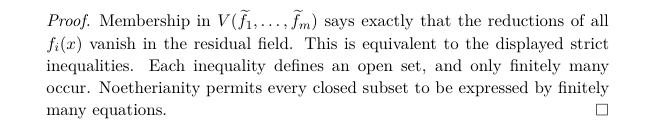
\bi{Membership in $V(\widetilde f_1,\ldots,\widetilde f_m)$ says exactly that the reductions of all $f_i(x)$ vanish in the residual field. This is equivalent to the displayed strict inequalities. Each inequality defines an open set, and only finitely many occur. Noetherianity permits every closed subset to be expressed by finitely many equations.}
{属于 $V(\widetilde f_1,\ldots,\widetilde f_m)$,恰好表示所有 $f_i(x)$ 在 residual field 中的 reductions 为零。这等价于上述 strict inequalities。每个 inequality 定义 open set,且只出现有限个。Noetherianity 使每个 closed subset 都能由有限个 equations 表示。}
\end{proof}
Standing context 1 · exact TeX
\bi{Let $A^\circ$ be the ring of power-bounded elements and $A^{\circ\circ}$ the ideal of topologically nilpotent elements. If $a\in A^\circ$, the boundedness of the sequence $a^m$ and Lemma~\ref{new:seminormcontractive} imply $|a(x)|\leq1$. If $a\in A^{\circ\circ}$, then $a^m\to0$, which implies $|a(x)|<1$. Thus evaluation induces a homomorphism}
{令 $A^\circ$ 为 power-bounded elements 的 ring,$A^{\circ\circ}$ 为 topologically nilpotent elements 的 ideal。若 $a\in A^\circ$,由序列 $a^m$ bounded 及 Lemma~\ref{new:seminormcontractive} 得 $|a(x)|\leq1$。若 $a\in A^{\circ\circ}$,则 $a^m\to0$,从而 $|a(x)|<1$。因此 evaluation 诱导 homomorphism}
\[
 \widetilde A=A^\circ/A^{\circ\circ}
 \longrightarrow\widetilde{\mathcal H(x)}.
\]
\bi{Its prime kernel defines $\operatorname{red}(x)\in\Spec\widetilde A$. When a formal model with ring of definition $A_0\subset A^\circ$ is chosen, the same construction on $A_0$ gives specialization to its special fibre. The model reduction and the canonical reduction need not have identical coordinate rings.}
{其 prime kernel 定义 $\operatorname{red}(x)\in\Spec\widetilde A$。若选择 ring of definition 为 $A_0\subset A^\circ$ 的 formal model,在 $A_0$ 上作相同构造便得到到其 special fibre 的 specialization。Model reduction 与 canonical reduction 的 coordinate rings 未必相同。}
Typeset reader excerpt
Typed proof inputs
- BASE-RINGS · standing context or base (elementary project base)
- BASE-TOPOLOGY · standing context or base (elementary project base)
- NAG-000655 · selected whole (sealed native whole)
- BASE-RINGS · standing context or base
- BASE-RINGS · standing context or base (requires)
- BASE-TOPOLOGY · standing context or base
- BASE-TOPOLOGY · standing context or base (requires)
- NAG-000655 · selected whole
- NAG-000655 · selected whole (requires)
Reader cross-references
Proof map
Verified map inputs · NAG-000635
Registered proof input
- NAG-000655 · Result 1.6.1 · accepted whole Exact source window 22–23
Standing context and base inputs
BASE-RINGSExact source window 22–23BASE-TOPOLOGYExact source window 22–23