NAG-001377 · Accepted whole
A finite tensor product need not be complete
1 Valued fields, Banach algebras and analytic points
Open in the English reader · PDF page 64
Statement · exact TeX
\begin{example}[\bi{A finite tensor product need not be complete}{Finite tensor product 未必 complete}]\label{fnd:banachtensorcounterexample}
\bi{Suppose $0<|\pi|<1$ in $K$. Put $A=K\langle T\rangle$, $M=A/(T)$, and $N=c_0(K)$ with its supremum norm. Give $N$ the $A$-action}
{假设 $K$ 中有 $0<|\pi|<1$。令 $A=K\langle T\rangle$、$M=A/(T)$,并给 $N=c_0(K)$ 配备 supremum norm。在 $N$ 上定义 $A$-action:}
\[
 f(T)(x_n)_{n\geq1}=(f(\pi^n)x_n)_{n\geq1}.
\]
\bi{Then $N$ is a Banach $A$-module, but $M\otimes_A N\ne0$ and $M\widehat\otimes_A N=0$.}
{则 $N$ 是 Banach $A$-module,但 $M\otimes_A N\ne0$ 而 $M\widehat\otimes_A N=0$。}
\end{example}
Full selected proof · exact TeX
\begin{proof}
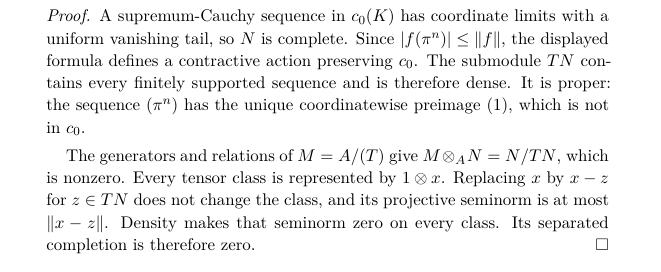
\bi{A supremum-Cauchy sequence in $c_0(K)$ has coordinate limits with a uniform vanishing tail, so $N$ is complete. Since $|f(\pi^n)|\leq\|f\|$, the displayed formula defines a contractive action preserving $c_0$. The submodule $TN$ contains every finitely supported sequence and is therefore dense. It is proper: the sequence $(\pi^n)$ has the unique coordinatewise preimage $(1)$, which is not in $c_0$.}
{Supremum-Cauchy sequence 的坐标具有 limits,且其 tails uniformly 趋于零,故 $N$ complete。由于 $|f(\pi^n)|\leq\|f\|$,所列公式定义一个保持 $c_0$ 的 contractive action。Submodule $TN$ 包含所有 finitely supported sequences,故 dense;它却不是全体,因为 $(\pi^n)$ 唯一的 coordinatewise preimage 为不属于 $c_0$ 的 $(1)$。}

\bi{The generators and relations of $M=A/(T)$ give $M\otimes_A N=N/TN$, which is nonzero. Every tensor class is represented by $1\otimes x$. Replacing $x$ by $x-z$ for $z\in TN$ does not change the class, and its projective seminorm is at most $\|x-z\|$. Density makes that seminorm zero on every class. Its separated completion is therefore zero.}
{由 $M=A/(T)$ 的 generators 与 relations 得到 $M\otimes_A N=N/TN$,它非零。每个 tensor class 均可由 $1\otimes x$ 表示。将 $x$ 换成 $x-z$,其中 $z\in TN$,不改变此 class,而 projective seminorm 不超过 $\|x-z\|$。由 density,每个 class 的 seminorm 都为零,故其 separated completion 为零。}
\end{proof}
Typeset reader excerpt
Typed proof inputs
- NAG-000182 · selected whole (accepted actual proof input)
- NAG-000232 · selected whole (accepted actual proof input)
- BASE-LINEAR · standing context or base
- BASE-LINEAR · standing context or base (requires)
- BASE-REAL · standing context or base
- BASE-REAL · standing context or base (requires)
- BASE-RINGS · standing context or base
- BASE-RINGS · standing context or base (requires)
- BASE-TOPOLOGY · standing context or base
- BASE-TOPOLOGY · standing context or base (requires)
- NAG-000182 · selected whole
- NAG-000182 · selected whole (requires)
- NAG-000232 · selected whole
- NAG-000232 · selected whole (requires)
Proof map
Verified map inputs · NAG-001377
AND · joint registered proof inputs
- NAG-000182 · Multiplicativity of the weighted Gauss norm · accepted whole
- Actual Tate Gauss norm, ordinary unit radius coefficient series
- NAG-000232 · Substitution · accepted whole
- Contractive evaluation at π^n with |π^n|≤1
Standing context and base inputs
BASE-LINEARBASE-REALBASE-RINGSBASE-TOPOLOGY
NAG-001377 · A finite tensor product need not be complete · Chapter argument