NAG-001438 · Accepted whole
The completed tensor product of two quotient presentations
2 Analytic spaces, morphisms and fibres
Open in the English reader · PDF page 172
Statement · exact TeX
\begin{theorem}[\bi{The completed tensor product of two quotient presentations}{两个商表示的完备张量积}]\label{fnd:strictpresentationpushout}
\bi{Let}
{设}
\[
 \begin{aligned}
 B&=A\{\rho^{-1}X\}/I,\\
 C&=A\{\sigma^{-1}Y\}/J,\\
 H&=A\{\rho^{-1}X,\sigma^{-1}Y\}/(I,J).
 \end{aligned}
\]
\bi{where $(I,J)$ denotes the sum of the two extended ideals. Use the stated quotient norms on $B,C,H$, and the projective seminorm on $B\otimes_A C$. The multiplication of the two canonical maps into $H$ induces an isometric algebra isomorphism}
{其中 $(I,J)$ 表示两个延伸理想之和。给 $B,C,H$ 配备所列商范数,并给 $B\otimes_A C$ 配备 projective seminorm。将两个到 $H$ 的典范映射的像相乘,诱导等距代数同构}
\[
 B\widehat\otimes_A C\ \xrightarrow{\ \sim\ }\ H.
\]
\bi{This is a statement about the separated completion; it does not assert that the algebraic tensor product is already complete or has definite projective seminorm. The isomorphism commutes with the two maps from $B,C$.}
{这里的结论涉及分离完备化;并未断言代数张量积已经完备,也未断言其 projective seminorm 正定。该同构与从 $B,C$ 出发的两个映射相容。}
\end{theorem}
Full selected proof · exact TeX
\begin{proof}
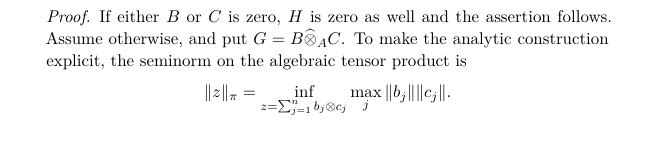
\bi{If either $B$ or $C$ is zero, $H$ is zero as well and the assertion follows. Assume otherwise, and put $G=B\widehat\otimes_A C$. To make the analytic construction explicit, the seminorm on the algebraic tensor product is}
{若 $B$ 或 $C$ 为零,则 $H$ 也为零,结论成立。以下设二者均非零,记 $G=B\widehat\otimes_A C$。为明确其解析构造,代数张量积上的半范数为}
\[
 \|z\|_\pi=
 \inf_{z=\sum_{j=1}^n b_j\otimes c_j}
       \max_j\|b_j\|\|c_j\|.
\]
\bi{Multiplying two finite tensor expressions and taking infima gives $\|zz'\|_\pi\leq\|z\|_\pi\|z'\|_\pi$. Thus its seminorm-zero subspace is an ideal, multiplication descends to the separated quotient and extends continuously to $G$. The maps $b\mapsto b\otimes1$ and $c\mapsto1\otimes c$ are contractive. The unit has norm at most one; if $G\ne0$, submultiplicativity then forces its norm to be one. The construction also gives a commutative unital Banach algebra when nonzero.}
{将两个有限张量表达式相乘并取下确界,得到 $\|zz'\|_\pi\leq\|z\|_\pi\|z'\|_\pi$。因此半范数为零的子空间是理想,乘法可下降到分离商,并连续延伸到 $G$。映射 $b\mapsto b\otimes1$ 与 $c\mapsto1\otimes c$ 均为 contractive。单位元的范数至多为一;若 $G\ne0$,次乘性又迫使其范数等于一。因此当它非零时,该构造给出交换含幺 Banach 代数。}

\bi{The canonical maps $B\to H$ and $C\to H$ are contractive: the maps from their coefficient algebras preserve their weights and then pass to quotient norms. Their product is an $A$-balanced bilinear map with bound one. On a finite tensor expression its image consequently has norm at most $\max_j\|b_j\|\|c_j\|$. Taking the infimum and then completing gives a contractive algebra homomorphism $\mu:G\to H$.}
{典范映射 $B\to H$ 与 $C\to H$ 为 contractive:从其系数代数出发的映射保持权重,再传到商范数。将两者的像相乘,得到界为一的 $A$-平衡双线性映射。故一个有限张量表达式的像的范数至多为 $\max_j\|b_j\|\|c_j\|$。取下确界后再完备化,即得到 contractive 代数同态 $\mu:G\to H$。}

\bi{In the other direction, let $\bar X_i\in B$ and $\bar Y_j\in C$ denote the variable classes. Their powers satisfy}
{反方向,记变量的像为 $\bar X_i\in B$ 与 $\bar Y_j\in C$。其幂满足}
\[
 \|\bar X_i^n\otimes1\|_G\leq\rho_i^n,
 \qquad \|1\otimes\bar Y_j^n\|_G\leq\sigma_j^n
 \qquad(n\geq0).
\]
\bi{The two maps from $A$ agree by the balancing relation. Proposition~\ref{fnd:powerboundedsubstitution}, with all bounds equal to one, therefore defines a contractive map from $A\{\rho^{-1}X,\sigma^{-1}Y\}$ to $G$, sending the variables to these tensors. If $G=0$, the zero map has the same properties directly. Its restriction to the first coefficient algebra factors through $B$, as can first be checked on polynomials and then on convergent series. Its restriction to the second factors through $C$. It therefore kills $I$ and $J$ and induces a contractive map $\nu:H\to G$.}
{由平衡关系,从 $A$ 出发的两个映射相同。因此在所有界均为一时应用 Proposition~\ref{fnd:powerboundedsubstitution},得到从 $A\{\rho^{-1}X,\sigma^{-1}Y\}$ 到 $G$ 的 contractive 映射,将变量送到上述张量。若 $G=0$,零映射直接具有同样的性质。其在第一组系数代数上的限制通过 $B$ 分解,这可先对多项式核对,再推广到收敛级数;同理,第二组限制通过 $C$ 分解。因此该映射零化 $I$ 和 $J$,诱导 contractive 映射 $\nu:H\to G$。}

\bi{The composite $\mu\nu$ fixes every coefficient and variable, hence fixes the dense polynomial image in $H$ and is the identity. Likewise $\nu\mu$ fixes the images of $B$ and $C$, since each is a quotient of a coefficient algebra with dense polynomial image. It fixes every pure tensor and hence the dense algebraic tensor image in $G$. It is therefore the identity. Two inverse contractive maps are isometric, proving the assertion.}
{复合 $\mu\nu$ 固定每个系数和变量,因而固定 $H$ 中稠密的多项式像,所以为恒等映射。同理,$\nu\mu$ 固定 $B$ 和 $C$ 的像,因为它们各自都是系数代数的商,多项式像在其中稠密。于是它固定每个纯张量,从而固定 $G$ 中稠密的代数张量像,故也是恒等映射。互逆的两个 contractive 映射必为等距同构,结论得证。}
\end{proof}
Standing context 1 · exact TeX
\section{\bi{Iterated quotients and elementary Laurent diagrams}{迭代商与 elementary Laurent 图表}}\label{fnd:r1intersectioninterfaces}

\bi{The preceding quotient construction permits a direct comparison of presentations. We first show that adjoining a second block of variables commutes with taking a quotient, with equality of the resulting norms. We then identify the coefficient Laurent sequence with a sequence of finite modules over explicit strict affinoid quotient algebras. These are statements about Banach algebras and modules; identifying them with sections on analytic domains requires the geometric localization theorem.}
{前面的商构造使我们能够直接比较不同表示。先证明添入第二组变量与取商相容,并且所得范数相等;随后将系数 Laurent 序列识别为一列显式 strict affinoid 商代数上的有限模。这里的结论属于 Banach 代数与模的范畴;将它们识别为解析域上的截面,还需要几何局部化定理。}

\bi{Throughout this section, $K$ is complete for its fixed real-valued non-Archimedean absolute value, which may be trivial, and $A$ is a strict $K$-affinoid algebra with the norm conventions of Lemma~\ref{fnd:strictweightedquotient}. All displayed radii belong to $|K^\times|$. A relation quotient is either a strict affinoid algebra or the zero algebra with its zero norm. The latter is allowed in this section as a separate case; it does not satisfy the normalization $\|1\|=1$ in Definition~\ref{fnd:banachalgebra}. Every unital module over it is zero. All quotients below use the actual algebraic ideals or submodules, and their indicated quotient norms.}
{本节中,$K$ 关于固定的实值非阿基米德绝对值完备,允许赋值平凡;$A$ 为 strict $K$-affinoid algebra,采用 Lemma~\ref{fnd:strictweightedquotient} 的范数约定。所有出现的半径均属于 $|K^\times|$。关系商可能是 strict affinoid algebra,也可能是配备零范数的零代数;本节将后者作为独立情形允许在内,它并不满足 Definition~\ref{fnd:banachalgebra} 中的归一化 $\|1\|=1$。零代数上的每个含幺模均为零。以下各商均使用实际的代数理想或子模,并配备指定的商范数。}
Standing context 2 · exact TeX
\begin{definition}\label{fnd:normstrictconvention}
\bi{For a bounded linear map $u:E\to F$, give $\operatorname{im}u$ both its induced norm from $F$ and its quotient seminorm from $E$. The map is norm-strict, or admissible, when these are uniformly equivalent. Since $u$ is bounded, the additional requirement is a constant $C>0$ such that every $y\in\operatorname{im}u$ has a lift $x$ with $\|x\|\leq C\|y\|$. The constant may be enlarged by any fixed factor greater than one to approximate an unattained infimum.}
{对 bounded linear map $u:E\to F$,在 $\operatorname{im}u$ 上同时考虑来自 $F$ 的 induced norm 与来自 $E$ 的 quotient seminorm。当两者 uniformly equivalent 时,称该 map 为 norm-strict,或 admissible。由于 $u$ 已 bounded,额外条件等价于存在常数 $C>0$,使每个 $y\in\operatorname{im}u$ 都有 lift $x$ 满足 $\|x\|\leq C\|y\|$。当 infimum 不取到时,可将常数乘以任意固定的大于一的因子。}
\end{definition}
Standing context 3 · exact TeX
% v0.29 R1.1; proof and scope review are recorded separately.
\section{\bi{Strict quotient presentations and finite modules}{Strict 商表示与有限模}}\label{fnd:r1quotientbridge}
\bi{The coefficient construction is useful for localization only after its relation quotients are controlled. In this section the new radii lie in the value group. This allows the finite-module theorem over strict affinoids to control the actual images of the relation maps. No statement about a structure sheaf is used.}
{系数构造要用于局部化,还须控制加入关系后的商。本节新增变量的半径均位于值群中,因此可以利用 strict affinoid 上的有限模定理控制关系映射的实际像。这里不使用结构层的任何结论。}

\bi{Fix a complete real-valued non-Archimedean field $K$, allowing the trivial absolute value. A nonzero algebra below carries the submultiplicative norm and norm-admissibility convention of Definition~\ref{fnd:banachalgebra}. We also allow a relation ideal to be the whole algebra: its quotient is the zero ring with its zero norm, and every unital module over it is zero. Statements about such a quotient have this explicit degenerate interpretation; the normalization $\|1\|=1$ is required only for nonzero algebras.}
{固定一个关于实值非阿基米德绝对值完备的域 $K$,允许平凡绝对值。下文的非零代数采用 Definition~\ref{fnd:banachalgebra} 中的次乘范数与范数 admissibility 约定。也允许关系理想为整个代数:相应商是配备零范数的零环,其所有幺模均为零。涉及这种商的陈述均按此明确的退化意义理解;$\|1\|=1$ 的归一化只要求于非零代数。}
Standing context 4 · exact TeX
\section{\bi{The ground field and convergence}{Ground field 与 convergence}}\label{fnd:valuedfields}
\begin{definition}\label{fnd:fieldconventions}
\bi{Throughout the foundations, $K$ is a field complete for a real-valued non-Archimedean absolute value. We permit the trivial absolute value unless a statement explicitly excludes it. Set}
{基础篇中,$K$ 是关于 real-valued non-Archimedean absolute value 完备的 field。除非明确排除,否则允许 trivial absolute value。记}
\[
\begin{gathered}
v(a)=-\log|a|,\qquad \Gamma=v(K^\times),\\
K^\circ=\{a\in K:|a|\leq1\},\qquad K^{\circ\circ}=\{a\in K:|a|<1\},\\
\widetilde K=K^\circ/K^{\circ\circ}.
\end{gathered}
\]
\bi{A complete extension $L/K$ always carries an absolute value restricting to the specified one on $K$. We do not rescale it when changing the ground field.}
{Complete extension $L/K$ 始终配备限制为指定 $K$ 上 absolute value 的 absolute value。改变 ground field 时不重新缩放它。}
Typeset reader excerpt
Typed proof inputs
- BASE-LINEAR · standing context or base (selected rule)
- BASE-REAL · standing context or base (selected rule)
- BASE-RINGS · standing context or base (selected rule)
- BASE-SETS · standing context or base (selected rule)
- BASE-TOPOLOGY · standing context or base (selected rule)
- NAG-001398 · selected whole (selected rule)
- NAG-001414 · selected whole (selected rule)
- NAG-001421 · selected whole (selected rule)
- NAG-001434 · selected whole (selected rule)
- BASE-LINEAR · standing context or base
- BASE-LINEAR · standing context or base (requires)
- BASE-REAL · standing context or base
- BASE-REAL · standing context or base (requires)
- BASE-RINGS · standing context or base
- BASE-RINGS · standing context or base (requires)
- BASE-SETS · standing context or base
- BASE-SETS · standing context or base (requires)
- BASE-TOPOLOGY · standing context or base
- BASE-TOPOLOGY · standing context or base (requires)
- NAG-001398 · selected whole
- NAG-001398 · selected whole (requires)
- NAG-001414 · selected whole
- NAG-001414 · selected whole (requires)
- NAG-001421 · selected whole
- NAG-001421 · selected whole (requires)
- NAG-001434 · selected whole
- NAG-001434 · selected whole (requires)
Reader cross-references
Proof map
Verified map inputs · NAG-001438
No addressable selected proof input is recorded in this projection.
NAG-001438 · The completed tensor product of two quotient presentations · Chapter argument