NAG-001455 · Accepted whole
A maximal point detects the Gauss norm
1 Valued fields, Banach algebras and analytic points
Open in the English reader · PDF page 79
Statement · exact TeX
\begin{lemma}[\bi{A maximal point detects the Gauss norm}{由极大点检测 Gauss 范数}]\label{fnd:tategaussmaximalpoint}
\bi{For every $h\in R_n$ there is a maximal ideal $\mathfrak m\subset R_n$ such that, for the extending absolute value on the finite field $R_n/\mathfrak m$,}
{对每个 $h\in R_n$,都存在极大理想 $\mathfrak m\subset R_n$,使有限域扩张 $R_n/\mathfrak m$ 上的延拓绝对值满足}
\[
 |h\bmod\mathfrak m|=\|h\|.
\]
\end{lemma}
Full selected proof · exact TeX
\begin{proof}
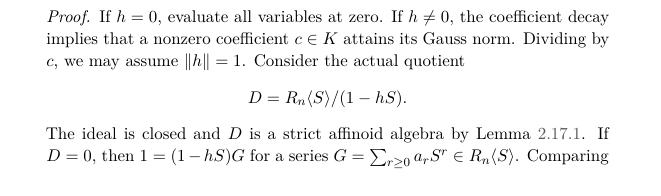
\bi{If $h=0$, evaluate all variables at zero. If $h\ne0$, the coefficient decay implies that a nonzero coefficient $c\in K$ attains its Gauss norm. Dividing by $c$, we may assume $\|h\|=1$. Consider the actual quotient}
{若 $h=0$,取所有变量均为零的取值点。若 $h\ne0$,由系数衰减性,存在非零系数 $c\in K$ 达到其 Gauss 范数。用 $c$ 除去 $h$ 后,可设 $\|h\|=1$。考虑实际的商}
\[
 D=R_n\langle S\rangle/(1-hS).
\]
\bi{The ideal is closed and $D$ is a strict affinoid algebra by Lemma~\ref{fnd:strictweightedquotient}. If $D=0$, then $1=(1-hS)G$ for a series $G=\sum_{r\geq0}a_rS^r\in R_n\langle S\rangle$. Comparing coefficients gives $a_0=1$ and $a_r=ha_{r-1}$, hence $a_r=h^r$. Multiplicativity of the Gauss norm gives $\|a_r\|=1$ for every $r$, contradicting the coefficient decay required for $G$. Thus $D\ne0$.}
{由 Lemma~\ref{fnd:strictweightedquotient},该理想闭,且 $D$ 为 strict affinoid 代数。若 $D=0$,则存在级数 $G=\sum_{r\geq0}a_rS^r\in R_n\langle S\rangle$,使 $1=(1-hS)G$。比较系数得到 $a_0=1$、$a_r=ha_{r-1}$,所以 $a_r=h^r$。Gauss 范数的乘性给出每个 $r$ 都满足 $\|a_r\|=1$,与 $G$ 所需的系数衰减矛盾。因此 $D\ne0$。}

\bi{Theorem~\ref{fnd:strictpointunitcriterion} supplies a maximal residue field $L$ of $D$, finite over $K$, and a bounded evaluation $D\to L$. Its absolute value is contractive for the quotient norm by Lemma~\ref{new:seminormcontractive}. The relation $hS=1$ and the bounds $|h|\leq1$, $|S|\leq1$ force $|h|=1$. The image of $R_n$ in $L$ is a finite-dimensional $K$-algebra and a domain, hence a field by \cite[Tag 00GS(1), Lemma 10.36.19]{StacksAlg}. The kernel of $R_n\to L$ is therefore maximal. Uniqueness of extending absolute values in Lemma~\ref{fnd:finiteextensionnorms} identifies its residue absolute value with the restriction from $L$. Rescaling by $c$ proves the assertion.}
{由 Theorem~\ref{fnd:strictpointunitcriterion},$D$ 有一个有限于 $K$ 的极大剩余域 $L$,并有有界取值映射 $D\to L$。由 Lemma~\ref{new:seminormcontractive},其绝对值相对于商范数为压缩的。关系 $hS=1$ 及 $|h|\leq1$、$|S|\leq1$ 强迫 $|h|=1$。$R_n$ 在 $L$ 中的像是有限维 $K$-代数且为整环,故由 \cite[Tag 00GS(1), Lemma 10.36.19]{StacksAlg},它是域。因此 $R_n\to L$ 的核为极大理想。由 Lemma~\ref{fnd:finiteextensionnorms} 中绝对值延拓的唯一性,其剩余域绝对值等于从 $L$ 限制得到的绝对值。再乘回 $c$ 即得结论。}
\end{proof}
Typeset reader excerpt
Typed proof inputs
- BASE-LINEAR · standing context or base
- BASE-LINEAR · standing context or base (requires)
- BASE-REAL · standing context or base
- BASE-REAL · standing context or base (requires)
- BASE-RINGS · standing context or base
- BASE-RINGS · standing context or base (requires)
- BASE-SETS · standing context or base
- BASE-SETS · standing context or base (requires)
- BASE-TOPOLOGY · standing context or base
- BASE-TOPOLOGY · standing context or base (requires)
- NAG-000182 · selected whole
- NAG-000182 · selected whole (requires)
- NAG-000655 · selected whole
- NAG-000655 · selected whole (requires)
- NAG-001434 · selected whole
- NAG-001434 · selected whole (requires)
- NAG-001450 · selected whole
- NAG-001450 · selected whole (requires)
- NAG-001452 · selected whole
- NAG-001452 · selected whole (requires)
- STACKS-00GS(1)@NAG-001455 · named external application
- STACKS-00GS(1)@NAG-001455 · named external application (requires)
Reader cross-references
Proof map
Verified map inputs · NAG-001455
No addressable selected proof input is recorded in this projection.
NAG-001455 · A maximal point detects the Gauss norm · Chapter argument