fixed unit products two slot and assigned bounded map
Scope in the English reader · PDF page 202
Statement and full selected proof · exact TeX
\begin{proposition}[\bi{A standard refinement of a finite rational cover}{有限 rational 覆盖的标准加细}]\label{fnd:finiterationalstandardrefinement}
\bi{Let $\mathcal U=(U_i)_{1\leq i\leq n}$ be a finite cover of $\mathcal M(A)$, where}
{设 $\mathcal U=(U_i)_{1\leq i\leq n}$ 为 $\mathcal M(A)$ 的有限覆盖,其中}
\[
 U_i=\{x:|f^{(i)}_j(x)|\leq|f^{(i)}_0(x)|, 1\leq j\leq r_i\},
 \qquad (f^{(i)}_0,\ldots,f^{(i)}_{r_i})=A.
\]
\bi{Write $B_i$ for the associated rational presentation. Put}
{记相应 rational 表示为 $B_i$。令}
\[
 \Lambda=\prod_{i=1}^n\{0,\ldots,r_i\},\qquad
 \Lambda_0=\{\lambda\in\Lambda:\lambda_i=0\text{ for some }i\},
 \qquad F_\lambda=\prod_{i=1}^n f^{(i)}_{\lambda_i}.
\]
\bi{The tuple $(F_\lambda)_{\lambda\in\Lambda_0}$ generates the unit ideal. Its standard rational family $(S_\lambda)_{\lambda\in\Lambda_0}$ covers $\mathcal M(A)$. For any choice $i(\lambda)$ with $\lambda_{i(\lambda)}=0$, the point set of $S_\lambda$ is contained in $U_{i(\lambda)}$, and there is a unique bounded map $B_{i(\lambda)}\to S_\lambda$ over $A$. These maps give a compatible refinement of all finite intersection diagrams.}
{Tuple $(F_\lambda)_{\lambda\in\Lambda_0}$ 生成单位理想。其标准 rational 族 $(S_\lambda)_{\lambda\in\Lambda_0}$ 覆盖 $\mathcal M(A)$。任意选择满足 $\lambda_{i(\lambda)}=0$ 的 $i(\lambda)$,则 $S_\lambda$ 的谱点集合包含于 $U_{i(\lambda)}$,并且存在唯一的有界 $A$-代数映射 $B_{i(\lambda)}\to S_\lambda$。这些映射给出与全部有限交叠图表相容的加细。}
\end{proposition}
\begin{proof}
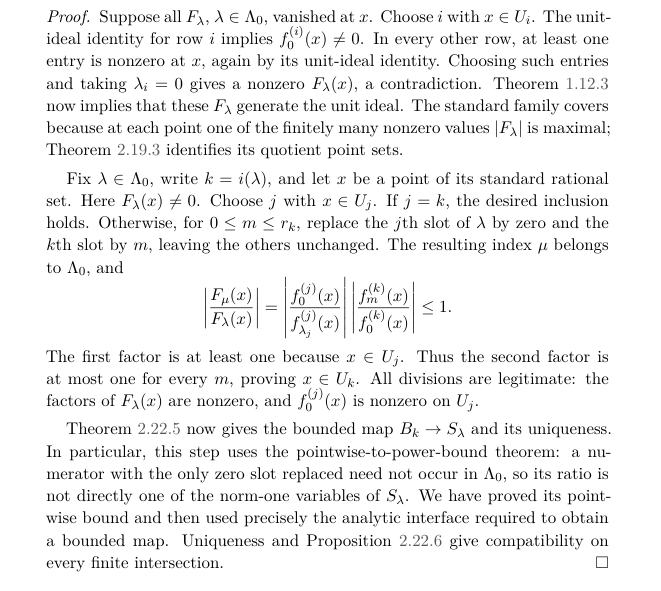
\bi{Suppose all $F_\lambda$, $\lambda\in\Lambda_0$, vanished at $x$. Choose $i$ with $x\in U_i$. The unit-ideal identity for row $i$ implies $f^{(i)}_0(x)\ne0$. In every other row, at least one entry is nonzero at $x$, again by its unit-ideal identity. Choosing such entries and taking $\lambda_i=0$ gives a nonzero $F_\lambda(x)$, a contradiction. Theorem~\ref{fnd:strictpointunitcriterion} now implies that these $F_\lambda$ generate the unit ideal. The standard family covers because at each point one of the finitely many nonzero values $|F_\lambda|$ is maximal; Theorem~\ref{fnd:strictrationalpointtopology} identifies its quotient point sets.}
{假设某个 $x$ 使所有 $\lambda\in\Lambda_0$ 对应的 $F_\lambda$ 为零。选取满足 $x\in U_i$ 的 $i$。由第 $i$ 行的单位理想恒等式,$f^{(i)}_0(x)\ne0$。对其余每一行,由相应的单位理想恒等式,都至少有一个条目在 $x$ 处非零。选择这样的条目,并取 $\lambda_i=0$,即得到非零的 $F_\lambda(x)$,矛盾。因此由 Theorem~\ref{fnd:strictpointunitcriterion},这些 $F_\lambda$ 生成单位理想。标准族构成覆盖,因为在每个点,有限个 $|F_\lambda|$ 中有一个非零最大值;Theorem~\ref{fnd:strictrationalpointtopology} 将对应商的谱点集合作出识别。}

\bi{Fix $\lambda\in\Lambda_0$, write $k=i(\lambda)$, and let $x$ be a point of its standard rational set. Here $F_\lambda(x)\ne0$. Choose $j$ with $x\in U_j$. If $j=k$, the desired inclusion holds. Otherwise, for $0\leq m\leq r_k$, replace the $j$th slot of $\lambda$ by zero and the $k$th slot by $m$, leaving the others unchanged. The resulting index $\mu$ belongs to $\Lambda_0$, and}
{固定 $\lambda\in\Lambda_0$,记 $k=i(\lambda)$,并取其标准 rational 集合中的一点 $x$。此时 $F_\lambda(x)\ne0$。选择 $x\in U_j$。若 $j=k$,所需包含已经成立。否则,对每个 $0\leq m\leq r_k$,将 $\lambda$ 的第 $j$ 个条目替换为零、第 $k$ 个条目替换为 $m$,其余条目不变。所得 $\mu$ 属于 $\Lambda_0$,且}
\[
 \left|\frac{F_\mu(x)}{F_\lambda(x)}\right|
 =\left|\frac{f^{(j)}_0(x)}{f^{(j)}_{\lambda_j}(x)}\right|
  \left|\frac{f^{(k)}_m(x)}{f^{(k)}_0(x)}\right|\leq1.
\]
\bi{The first factor is at least one because $x\in U_j$. Thus the second factor is at most one for every $m$, proving $x\in U_k$. All divisions are legitimate: the factors of $F_\lambda(x)$ are nonzero, and $f^{(j)}_0(x)$ is nonzero on $U_j$.}
{第一个因子因 $x\in U_j$ 而至少为一,故对每个 $m$,第二个因子至多为一,得到 $x\in U_k$。所有除法都有意义:$F_\lambda(x)$ 的各因子均非零,且 $f^{(j)}_0(x)$ 在 $U_j$ 上非零。}

\bi{Theorem~\ref{fnd:strictrationaldomainup} now gives the bounded map $B_k\to S_\lambda$ and its uniqueness. In particular, this step uses the pointwise-to-power-bound theorem: a numerator with the only zero slot replaced need not occur in $\Lambda_0$, so its ratio is not directly one of the norm-one variables of $S_\lambda$. We have proved its pointwise bound and then used precisely the analytic interface required to obtain a bounded map. Uniqueness and Proposition~\ref{fnd:strictrationalintersectionpresentation} give compatibility on every finite intersection.}
{现在由 Theorem~\ref{fnd:strictrationaldomainup},得到有界映射 $B_k\to S_\lambda$ 及其唯一性。特别地,这一步使用了逐点界转化为幂界的定理:将唯一的零条目替换后得到的分子,可能不属于 $\Lambda_0$,所以其比值并不直接对应 $S_\lambda$ 中某个范数至多为一的变量。这里先证明其逐点界,再调用所需的准确解析接口得到有界映射。由唯一性及 Proposition~\ref{fnd:strictrationalintersectionpresentation},得到每个有限交叠上的相容性。}
\end{proof}
- CLAUSE:NAG-001444:strict_actual_quotient_point_set · selected scope
- CLAUSE:NAG-001444:strict_actual_quotient_point_set · selected scope (requires)
- CLAUSE:NAG-001470:actual_fixed_strict_target_from_supplied_powers · typed target unresolved in this export
- CLAUSE:NAG-001470:actual_fixed_strict_target_from_supplied_powers · typed target unresolved in this export (requires)