NAG-001492 · Accepted whole
Uniform distinguished coordinates
1 Valued fields, Banach algebras and analytic points
Open in the English reader · PDF page 91
Statement · exact TeX
\begin{lemma}[\bi{Uniform distinguished coordinates}{统一的 distinguished 坐标}]\label{fnd:relativeuniformdistinguished}
\bi{Let $A\ne0$, let $n\geq1$, and suppose the coefficients of $F=\sum_{\nu\in\mathbb N^n}a_\nu T^\nu\in A\langle T_1,\ldots,T_n\rangle$ generate the unit ideal of $A$. There is an isometric $A$-algebra automorphism $\sigma$ and an integer $s\geq0$ such that $\sigma(F)$ is $T_n$-distinguished of some order at most $s$ at every maximal ideal of $A$. One may take}
{设 $A\ne0$、$n\geq1$,且 $F=\sum_{\nu\in\mathbb N^n}a_\nu T^\nu\in A\langle T_1,\ldots,T_n\rangle$ 的系数生成 $A$ 的单位理想。则存在等距的 $A$-代数自同构 $\sigma$ 与整数 $s\geq0$,使 $\sigma(F)$ 在 $A$ 的每个极大理想处都是阶数至多为 $s$ 的 $T_n$-distinguished 级数。可以取}
\[
 \sigma(T_i)=T_i+T_n^{t^{\,n-i}}\ (i<n),\qquad
 \sigma(T_n)=T_n,\qquad s=t^n-1
\]
\bi{for a sufficiently large integer $t\geq2$.}
{其中 $t\geq2$ 为充分大的整数。}
\end{lemma}
Full selected proof · exact TeX
\begin{proof}
\bi{Choose finitely many coefficients and an identity $\sum_{j=1}^rc_ja_{\nu(j)}=1$. Contractivity of maximal residue points gives}
{选择有限多个系数及恒等式 $\sum_{j=1}^rc_ja_{\nu(j)}=1$。极大剩余域点的压缩性给出}
\[
 \max_j|a_{\nu(j)}(x)|\geq\delta,
 \qquad \delta=(\max_j\|c_j\|)^{-1}>0
\]
\bi{for every maximal $x$. Choose $t\geq2$ so that $\|a_\nu\|<\delta$ whenever some component of $\nu$ is at least $t$. The substitutions defining $\sigma$ and its inverse, obtained by changing the plus signs to minus signs, are contractive on polynomials and hence on their completions. They are inverse by continuity, so both are isometric.}
{对每个极大点 $x$ 都成立。选择 $t\geq2$,使只要 $\nu$ 的某个分量至少为 $t$,就有 $\|a_\nu\|<\delta$。定义 $\sigma$ 的代换,以及将加号改为减号所得的逆代换,在多项式上均为压缩映射,故延拓到完成后仍压缩。由连续性可知二者互逆,所以均为等距映射。}

\bi{Fix $x$ and put $M=\|F_x\|\geq\delta$. Every exponent at which a coefficient has absolute value $M$ lies in the box $0\leq\nu_i<t$. The function}
{固定 $x$,令 $M=\|F_x\|\geq\delta$。所有达到系数绝对值 $M$ 的指数均在方盒 $0\leq\nu_i<t$ 中。函数}
\[
 w(\nu)=\sum_{i=1}^n\nu_i t^{\,n-i}
\]
\bi{takes distinct values on that box. Among the maximizing coefficients choose the unique exponent $\nu_*$ with largest $w(\nu_*)$, and set $s_x=w(\nu_*)\leq t^n-1$. Separate $F_x$ into the finite sum of its coefficients of absolute value $M$ and the remaining series. The remaining series has Gauss norm strictly less than $M$, since its coefficients tend to zero; its image under $\sigma$ has the same bound. In the finite sum, the unique term with largest $T_n$-degree after substitution contributes $a_{\nu_*}(x)T_n^{s_x}$, with constant leading coefficient, and all other contributions have degree less than $s_x$. Thus the coefficient of $T_n^{s_x}$ in $\sigma(F)_x$ is $a_{\nu_*}(x)$ plus a series of norm less than $M$; it is a unit by Lemma~\ref{fnd:tateunitconstantcriterion}. Its norm is $M$, all lower coefficients have norm at most $M$, and every higher coefficient has norm less than $M$. This proves the assertion uniformly in $x$.}
{在该方盒上取互不相同的值。在达到最大系数绝对值的指数中,取使 $w(\nu_*)$ 最大的唯一指数 $\nu_*$,并令 $s_x=w(\nu_*)\leq t^n-1$。将 $F_x$ 分成系数绝对值等于 $M$ 的有限和与剩余级数。由于系数趋于零,剩余级数的 Gauss 范数严格小于 $M$,其在 $\sigma$ 下的像也有相同界。在上述有限和中,代换后具有最大 $T_n$-次数的唯一项贡献 $a_{\nu_*}(x)T_n^{s_x}$,其首项系数为常数,其余贡献的次数都小于 $s_x$。所以 $\sigma(F)_x$ 的 $T_n^{s_x}$ 系数为 $a_{\nu_*}(x)$ 加上范数小于 $M$ 的级数,由 Lemma~\ref{fnd:tateunitconstantcriterion} 为单位元。该系数的范数为 $M$,所有低次系数的范数不超过 $M$,而每个高次系数的范数都小于 $M$。这就在所有 $x$ 处统一证明了结论。}
\end{proof}
Typeset reader excerpt
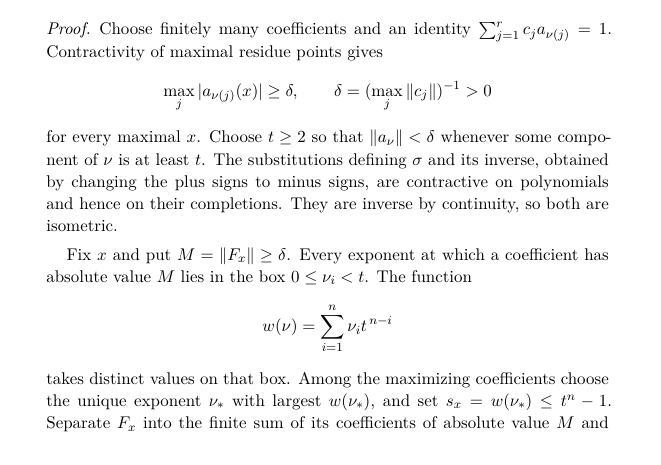
Typed proof inputs
- NAG-000655 · selected whole
- NAG-000655 · selected whole (requires)
- NAG-001398 · selected whole
- NAG-001398 · selected whole (requires)
- NAG-001452 · selected whole
- NAG-001452 · selected whole (requires)
- NAG-001491 · selected whole
- NAG-001491 · selected whole (requires)
Reader cross-references
Proof map
Verified map inputs · NAG-001492
AND · joint registered proof inputs
- NAG-000655 · Result 1.6.1 · accepted whole
- NAG-001398 · Bounded substitution criterion · accepted whole
- NAG-001452 · Maximal residue fields and the unit-ideal test · accepted whole
- NAG-001491 · Units in a field Tate algebra · accepted whole
NAG-001492 · Uniform distinguished coordinates · Chapter argument