NAG-001511 · Accepted whole
Extending dense image to a larger rational domain
2 Analytic spaces, morphisms and fibres
Open in the English reader · PDF page 223
Statement · exact TeX
\begin{theorem}[\bi{Extending dense image to a larger rational domain}{将稠密像延拓至较大的 rational 域}]\label{fnd:rationaldenseextension}
\bi{Assume that $K$ is complete and nontrivially valued. Let $\phi:A\to B$ be a bounded homomorphism of strict norm-admissible $K$-affinoids, and let $(g,f_1,\ldots,f_s)=A$. For $r\in\Gamma_K^{\mathrm{div}}$, set}
{设 $K$ 完备且赋值非平凡。设 $\phi:A\to B$ 为 strict norm-admissible $K$-affinoid 之间的有界同态,且 $(g,f_1,\ldots,f_s)=A$。对 $r\in\Gamma_K^{\mathrm{div}}$,令}
\[
 A_r=A\{r^{-1}T\}/(gT_i-f_i)_i,
 \qquad
 B_r=B\{r^{-1}T\}/(\phi(g)T_i-\phi(f_i))_i.
\]
\bi{Use their actual quotient norms and let $\phi_r:A_r\to B_r$ be the induced bounded map. If $\phi_{r_0}(A_{r_0})$ is dense in $B_{r_0}$ for some $r_0\in\Gamma_K^{\mathrm{div}}$, then there is a real $r_2>r_0$ such that $\phi_r(A_r)$ is dense in $B_r$ for every $r\in\Gamma_K^{\mathrm{div}}\cap[r_0,r_2]$. In particular, the conclusion holds at some strictly larger radius. Each such dense map has the Weierstrass quotient factorization of Proposition~\ref{fnd:strictdenserunge}.}
{给它们配备实际商范数,并记诱导的有界映射为 $\phi_r:A_r\to B_r$。若对某个 $r_0\in\Gamma_K^{\mathrm{div}}$,$\phi_{r_0}(A_{r_0})$ 在 $B_{r_0}$ 中稠密,则存在实数 $r_2>r_0$,使每个 $r\in\Gamma_K^{\mathrm{div}}\cap[r_0,r_2]$ 都满足 $\phi_r(A_r)$ 在 $B_r$ 中稠密。特别地,结论在某个严格较大的半径处成立。每个这样的稠密映射都具有 Proposition~\ref{fnd:strictdenserunge} 的 Weierstrass 商分解。}
\end{theorem}
Full selected proof · exact TeX
\begin{proof}
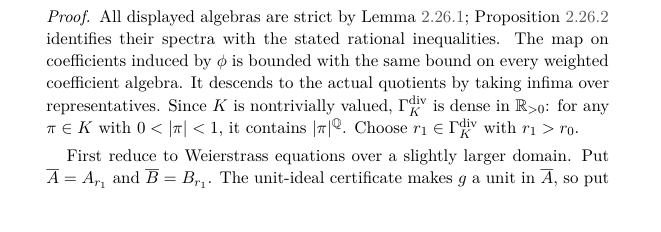
\bi{All displayed algebras are strict by Lemma~\ref{fnd:radicalradiusaffinoid}; Proposition~\ref{fnd:radicalrationalpresentation} identifies their spectra with the stated rational inequalities. The map on coefficients induced by $\phi$ is bounded with the same bound on every weighted coefficient algebra. It descends to the actual quotients by taking infima over representatives. Since $K$ is nontrivially valued, $\Gamma_K^{\mathrm{div}}$ is dense in $\mathbb R_{>0}$: for any $\pi\in K$ with $0<|\pi|<1$, it contains $|\pi|^{\mathbb Q}$. Choose $r_1\in\Gamma_K^{\mathrm{div}}$ with $r_1>r_0$.}
{由 Lemma~\ref{fnd:radicalradiusaffinoid},所列代数全部 strict;Proposition~\ref{fnd:radicalrationalpresentation} 将其谱识别为所述 rational 不等式定义的集合。由 $\phi$ 诱导的逐系数映射在各加权系数代数上具有同一有界常数,并在对代表元取下确界后下降到实际商。由于 $K$ 的赋值非平凡,$\Gamma_K^{\mathrm{div}}$ 在 $\mathbb R_{>0}$ 中稠密:任选满足 $0<|\pi|<1$ 的 $\pi\in K$,它包含 $|\pi|^{\mathbb Q}$。选择 $r_1\in\Gamma_K^{\mathrm{div}}$,使 $r_1>r_0$。}

\bi{First reduce to Weierstrass equations over a slightly larger domain. Put $\overline A=A_{r_1}$ and $\overline B=B_{r_1}$. The unit-ideal certificate makes $g$ a unit in $\overline A$, so put $u_i=f_i/g\in\overline A$. For every $r\leq r_1$ in the indicated group there are canonical isometric identifications}
{先在一个稍大的域上将关系化为 Weierstrass 方程。令 $\overline A=A_{r_1}$、$\overline B=B_{r_1}$。单位理想证书说明 $g$ 在 $\overline A$ 中为单位,故可令 $u_i=f_i/g\in\overline A$。对所述群中每个 $r\leq r_1$,均有典范等距识别}
\[
 A_r\simeq\overline A\{r^{-1}S\}/(S_i-u_i)_i,
 \qquad
 B_r\simeq\overline B\{r^{-1}S\}/(S_i-\phi(u_i))_i.
\]
\bi{For the first identification, the map from left to right sends $T_i$ to $S_i$. The map in the other direction first sends the radius-$r_1$ variable of $\overline A$ to the radius-$r$ variable $T_i$, and then sends $S_i$ to $T_i$. Both substitutions are contractive because $r\leq r_1$. They kill the actual relations; their composites fix coefficients and variables, so polynomial density makes them inverse. The proof for $B$ is identical, and the squares with $\phi_r$ commute. These arguments also cover zero quotients. If $\overline A=0$, then $\overline B=0$ and all the algebras at smaller radii vanish, so the conclusion already follows.}
{在第一个识别中,从左到右的映射将 $T_i$ 送到 $S_i$。反方向的映射先将 $\overline A$ 的半径 $r_1$ 变量送到半径 $r$ 的变量 $T_i$,再将 $S_i$ 送到 $T_i$。由于 $r\leq r_1$,两个代入均 contractive。它们零化实际关系,且复合固定系数与变量,由多项式稠密性可知互逆。对 $B$ 的证明相同,所得识别与 $\phi_r$ 构成交换方块。这些论证也包括零商。若 $\overline A=0$,则 $\overline B=0$,所有较小半径处的代数也都为零,结论已经成立。}

\bi{Replace $A,B$ by $\overline A,\overline B$ and use these identifications. Thus it suffices to treat the family $A_r=A\{r^{-1}T\}/(T_i-u_i)$ and the analogous family for $B$, for $r_0\leq r\leq r_1$. The image of $A$ is dense in each $A_r$, since polynomials in the variables reduce to elements of $A$. Density of $A_{r_0}\to B_{r_0}$ therefore implies density of the image of $A$ in $B_{r_0}$.}
{现在以 $\overline A,\overline B$ 替换 $A,B$,并使用上述识别。因此只需处理 $r_0\leq r\leq r_1$ 内的族 $A_r=A\{r^{-1}T\}/(T_i-u_i)$ 及 $B$ 上的相应族。$A$ 的像在每个 $A_r$ 中稠密,因为变量多项式可化为 $A$ 中的元素。因此 $A_{r_0}\to B_{r_0}$ 的稠密性推出 $A$ 在 $B_{r_0}$ 中的像稠密。}

\bi{Choose a relative presentation $\pi_0:E=A\langle X_1,\ldots,X_n\rangle\twoheadrightarrow B$ by Lemma~\ref{fnd:relativeaffinoidpresentation}. Replace the norm of $B$ by its quotient norm. This is a uniformly equivalent norm; the resulting coefficient and quotient norms at every radius are again uniformly equivalent to the original ones, so density is unchanged. Its kernel $I$ has finitely many generators $H_1,\ldots,H_q\in E$ by Theorem~\ref{fnd:strictfinitemodules}. The iterated quotient assertion of Lemma~\ref{fnd:radicalradiusaffinoid} gives isometric descriptions}
{由 Lemma~\ref{fnd:relativeaffinoidpresentation} 选择相对表示 $\pi_0:E=A\langle X_1,\ldots,X_n\rangle\twoheadrightarrow B$,并将 $B$ 的范数换成其商范数。这与原范数一致等价,所诱导的各半径处系数范数及商范数也与原范数一致等价,故稠密性不变。由 Theorem~\ref{fnd:strictfinitemodules},其核 $I$ 有有限个生成元 $H_1,\ldots,H_q\in E$。由 Lemma~\ref{fnd:radicalradiusaffinoid} 的迭代商断言,得到等距描述}
\[
 B_r\simeq E\{r^{-1}T\}/(H_1,\ldots,H_q,T_i-u_i)_i,
 \qquad
 A_r\langle X\rangle\twoheadrightarrow B_r,
\]
\bi{where the second map also induces the displayed norm as its actual quotient norm. In particular, the images $h_j^0$ of the $X_j$ have norm at most one. Choose $a_j\in A$ with $\|h_j^0-\phi(a_j)\|_{B_{r_0}}<1$; this is possible by the density just proved. The elements $F_j=X_j-a_j$ belong to $E\subset E\{r_1^{-1}T\}$. Apply Lemma~\ref{fnd:quotientradiuscontinuity} with coefficient algebra $E$ and the fixed polynomials $H_\nu$ and $T_i-u_i$. It gives some $r_2>r_0$, at most $r_1$, such that}
{其中第二个映射也以所列范数作为实际商范数。特别地,$X_j$ 的像 $h_j^0$ 的范数至多为一。由刚证明的稠密性,可选择 $a_j\in A$,使 $\|h_j^0-\phi(a_j)\|_{B_{r_0}}<1$。元素 $F_j=X_j-a_j$ 属于 $E\subset E\{r_1^{-1}T\}$。对系数代数 $E$ 及固定多项式 $H_\nu$、$T_i-u_i$ 应用 Lemma~\ref{fnd:quotientradiuscontinuity},得到某个 $r_0<r_2\leq r_1$,使}
\[
 \|h_j^0-\phi(a_j)\|_{B_r}<1
 \quad
 (r\in\Gamma_K^{\mathrm{div}}\cap[r_0,r_2]).
\]
\bi{For each such $r$, Lemma~\ref{fnd:affinoidgeneratorperturbation} says that substitution $X_j\mapsto\phi(a_j)$ makes $A_r\langle X\rangle\to B_r$ surjective. Every polynomial image is already in the image of $A_r$, so polynomial density proves that $\phi_r(A_r)$ is dense in $B_r$. Proposition~\ref{fnd:strictdenserunge} supplies its stated factorization. Finally, density of $\Gamma_K^{\mathrm{div}}$ gives a radius strictly between $r_0$ and $r_2$. The proof never changes the scalar field, uses no Gerritzen--Grauert theorem, and includes empty variable lists and actual zero quotients.}
{对每个这样的 $r$,由 Lemma~\ref{fnd:affinoidgeneratorperturbation},代入 $X_j\mapsto\phi(a_j)$ 使 $A_r\langle X\rangle\to B_r$ 满射。每个多项式的像已经属于 $A_r$ 的像,故多项式稠密性证明 $\phi_r(A_r)$ 在 $B_r$ 中稠密。Proposition~\ref{fnd:strictdenserunge} 给出所述分解。最后,由 $\Gamma_K^{\mathrm{div}}$ 的稠密性,可取严格介于 $r_0$ 与 $r_2$ 之间的半径。此证明全程保持原基域,不使用 Gerritzen--Grauert 定理,并包括空变量列及实际零商。}
\end{proof}
Typeset reader excerpt
Typed proof inputs
- NAG-001398 · selected whole (sealed native whole)
- NAG-001403 · selected whole (sealed native whole)
- NAG-001481 · selected whole (sealed native whole)
- NAG-001506 · selected whole (sealed native whole)
- NAG-001507 · selected whole (earlier whole in this proposal)
- NAG-001508 · selected whole (sealed native whole)
- NAG-001509 · selected whole (sealed native whole)
- NAG-001510 · selected whole (sealed native whole)
- NAG-001398 · selected whole
- NAG-001398 · selected whole (requires)
- NAG-001403 · selected whole
- NAG-001403 · selected whole (requires)
- NAG-001481 · selected whole
- NAG-001481 · selected whole (requires)
- NAG-001506 · selected whole
- NAG-001506 · selected whole (requires)
- NAG-001507 · selected whole
- NAG-001507 · selected whole (requires)
- NAG-001508 · selected whole
- NAG-001508 · selected whole (requires)
- NAG-001509 · selected whole
- NAG-001509 · selected whole (requires)
- NAG-001510 · selected whole
- NAG-001510 · selected whole (requires)
Reader cross-references
Proof map
Verified map inputs · NAG-001511
AND · joint registered proof inputs
- NAG-001398 · Bounded substitution criterion · accepted whole Exact source window 163–175
- NAG-001403 · Finite modules over strict affinoids · accepted whole Exact source window 176–177
- NAG-001481 · Relative strict presentations · accepted whole Exact source window 176–177
- NAG-001506 · Radii in the divisible closure of the value group · accepted whole Exact source window 160–183
- NAG-001507 · Power presentations for rational inequalities · accepted whole Exact source window 160–161
- NAG-001508 · Perturbing affinoid generators · accepted whole Exact source window 190–191
- NAG-001509 · Dense image and a Weierstrass factorization · accepted whole Exact source window 190–191
- NAG-001510 · Preserving a strict quotient-norm bound · accepted whole Exact source window 183–188
NAG-001511 · Extending dense image to a larger rational domain · Chapter argument