NAG-001523 · Accepted whole
Global matching elements generate the local modules
2 Analytic spaces, morphisms and fibres
Open in the English reader · PDF page 235
Statement · exact TeX
\begin{lemma}[\bi{Global matching elements generate the local modules}{整体匹配元素生成局部模}]\label{fnd:laurentgluinggenerators}
\bi{For a finite Laurent gluing datum set $N=\ker\delta$. The image of $N$ generates $N_+$ over $A_+$ and generates $N_-$ over $A_-$. Consequently a single finite list of elements of $N$ generates both local modules after restriction. Finiteness of $N$ over $A$ is not assumed here.}
{对有限模 Laurent 粘合数据,令 $N=\ker\delta$。$N$ 的像分别在 $A_+$ 上生成 $N_+$、在 $A_-$ 上生成 $N_-$。因此可在 $N$ 中选择同一个有限元素列,使其限制同时生成两个局部模。此处不预先假设 $N$ 在 $A$ 上有限。}
\end{lemma}
Full selected proof · exact TeX
\begin{proof}
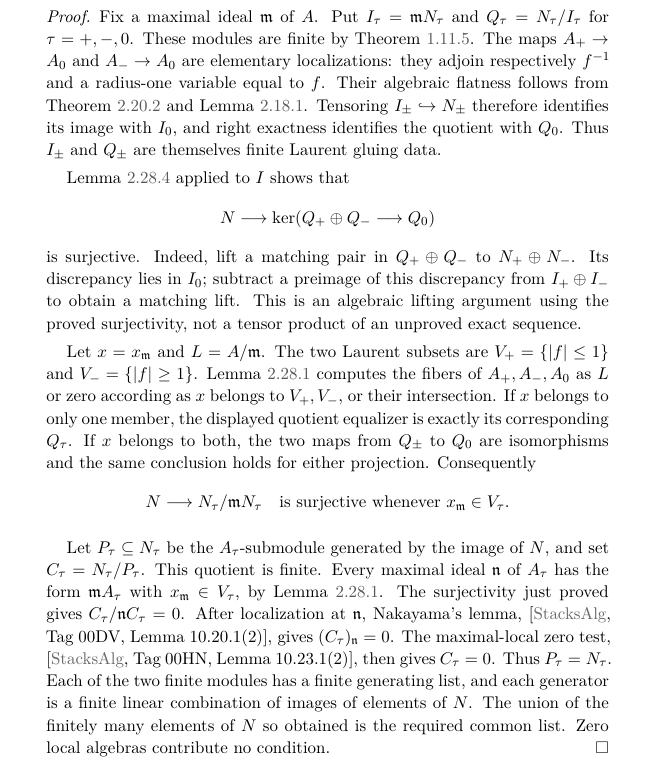
\bi{Fix a maximal ideal $\mathfrak m$ of $A$. Put $I_\tau=\mathfrak mN_\tau$ and $Q_\tau=N_\tau/I_\tau$ for $\tau=+,-,0$. These modules are finite by Theorem~\ref{fnd:strictfinitemodules}. The maps $A_+\to A_0$ and $A_-\to A_0$ are elementary localizations: they adjoin respectively $f^{-1}$ and a radius-one variable equal to $f$. Their algebraic flatness follows from Theorem~\ref{fnd:elementarystrictflatness} and Lemma~\ref{fnd:iteratedstrictquotients}. Tensoring $I_\pm\hookrightarrow N_\pm$ therefore identifies its image with $I_0$, and right exactness identifies the quotient with $Q_0$. Thus $I_\pm$ and $Q_\pm$ are themselves finite Laurent gluing data.}
{固定 $A$ 的一个极大理想 $\mathfrak m$。对 $\tau=+,-,0$,令 $I_\tau=\mathfrak mN_\tau$ 及 $Q_\tau=N_\tau/I_\tau$。由 Theorem~\ref{fnd:strictfinitemodules},这些模有限。映射 $A_+\to A_0$ 与 $A_-\to A_0$ 均为 elementary 局部化:前者添入 $f^{-1}$,后者添入一个等于 $f$ 的半径一变量。它们的代数平坦性来自 Theorem~\ref{fnd:elementarystrictflatness} 及 Lemma~\ref{fnd:iteratedstrictquotients}。因此对 $I_\pm\hookrightarrow N_\pm$ 张量后,其像与 $I_0$ 识别;由右正合性,相应商与 $Q_0$ 识别。故 $I_\pm$ 与 $Q_\pm$ 自身都是有限模 Laurent 粘合数据。}

\bi{Lemma~\ref{fnd:laurentgluingcoboundary} applied to $I$ shows that}
{将 Lemma~\ref{fnd:laurentgluingcoboundary} 应用于 $I$,可知}
\[
 N\longrightarrow \ker(Q_+\oplus Q_-\longrightarrow Q_0)
\]
\bi{is surjective. Indeed, lift a matching pair in $Q_+\oplus Q_-$ to $N_+\oplus N_-$. Its discrepancy lies in $I_0$; subtract a preimage of this discrepancy from $I_+\oplus I_-$ to obtain a matching lift. This is an algebraic lifting argument using the proved surjectivity, not a tensor product of an unproved exact sequence.}
{满射。具体而言,将 $Q_+\oplus Q_-$ 中的匹配元素提升到 $N_+\oplus N_-$;其差属于 $I_0$。从 $I_+\oplus I_-$ 中取该差的原像并减去,即得到匹配提升。这是使用已证满射性的代数提升,并非对一个尚未证明正合的序列取张量积。}

\bi{Let $x=x_{\mathfrak m}$ and $L=A/\mathfrak m$. The two Laurent subsets are $V_+=\{|f|\leq1\}$ and $V_-=\{|f|\geq1\}$. Lemma~\ref{fnd:rationalmaximalfibers} computes the fibers of $A_+,A_-,A_0$ as $L$ or zero according as $x$ belongs to $V_+,V_-$, or their intersection. If $x$ belongs to only one member, the displayed quotient equalizer is exactly its corresponding $Q_\tau$. If $x$ belongs to both, the two maps from $Q_\pm$ to $Q_0$ are isomorphisms and the same conclusion holds for either projection. Consequently}
{令 $x=x_{\mathfrak m}$ 且 $L=A/\mathfrak m$。两个 Laurent 子集分别为 $V_+=\{|f|\leq1\}$ 和 $V_-=\{|f|\geq1\}$。由 Lemma~\ref{fnd:rationalmaximalfibers},$A_+,A_-,A_0$ 的纤维分别依照 $x$ 是否属于 $V_+,V_-$ 及其交而为 $L$ 或零。若 $x$ 只属于一个成员,上述商的 equalizer 恰好是相应的 $Q_\tau$。若 $x$ 同时属于两者,则 $Q_\pm\to Q_0$ 均为同构,对任一投影都得到相同结论。因此}
\[
 N\longrightarrow N_\tau/\mathfrak mN_\tau
 \quad\text{is surjective whenever }x_{\mathfrak m}\in V_\tau.
\]

\bi{Let $P_\tau\subseteq N_\tau$ be the $A_\tau$-submodule generated by the image of $N$, and set $C_\tau=N_\tau/P_\tau$. This quotient is finite. Every maximal ideal $\mathfrak n$ of $A_\tau$ has the form $\mathfrak mA_\tau$ with $x_{\mathfrak m}\in V_\tau$, by Lemma~\ref{fnd:rationalmaximalfibers}. The surjectivity just proved gives $C_\tau/\mathfrak nC_\tau=0$. After localization at $\mathfrak n$, Nakayama's lemma, \cite[Tag 00DV, Lemma 10.20.1(2)]{StacksAlg}, gives $(C_\tau)_{\mathfrak n}=0$. The maximal-local zero test, \cite[Tag 00HN, Lemma 10.23.1(2)]{StacksAlg}, then gives $C_\tau=0$. Thus $P_\tau=N_\tau$. Each of the two finite modules has a finite generating list, and each generator is a finite linear combination of images of elements of $N$. The union of the finitely many elements of $N$ so obtained is the required common list. Zero local algebras contribute no condition.}
{令 $P_\tau\subseteq N_\tau$ 为 $N$ 的像生成的 $A_\tau$-子模,并令 $C_\tau=N_\tau/P_\tau$。该商有限。由 Lemma~\ref{fnd:rationalmaximalfibers},$A_\tau$ 的每个极大理想 $\mathfrak n$ 都写为 $\mathfrak mA_\tau$,其中 $x_{\mathfrak m}\in V_\tau$。刚证明的满射性给出 $C_\tau/\mathfrak nC_\tau=0$。在 $\mathfrak n$ 处局部化后,由 Nakayama 引理,即 \cite[Tag 00DV, Lemma 10.20.1(2)]{StacksAlg},得到 $(C_\tau)_{\mathfrak n}=0$。再由极大局部化零模判据 \cite[Tag 00HN, Lemma 10.23.1(2)]{StacksAlg},得到 $C_\tau=0$。因此 $P_\tau=N_\tau$。两个有限模各有有限生成列,每个生成元又是 $N$ 中元素的像的有限线性组合。将这样出现的有限多个 $N$ 中元素合在一起,就得到所需的共同生成列。零的局部代数不增加任何条件。}
\end{proof}
Standing context 1 · exact TeX
\section{\bi{Finite modules and Laurent descent}{有限模与 Laurent 下降}}\label{fnd:finitemodulelaurentdescent}

\bi{Tate exactness concerns the localizations of a module that is already defined over the original algebra. For coherence we must also construct a global module from finite modules given separately on a covering. The additional analytic step is a bounded lifting argument for arbitrary finite Laurent gluing data. We then use maximal residue fields to obtain generators and apply the lifting argument once more to the relations. This reconstructs the method of Kiehl's theorem as developed in \cite[\S9.4.3, Lemmas 5--6, pp.~378--382]{BGR84}, with the finite-module norms and the restricted site specified explicitly.}
{Tate 正合性处理的是已经定义在原代数上的模的局部化。凝聚性还要求从覆盖各部分分别给出的有限模构造整体模。额外的解析步骤,是对任意有限模 Laurent 粘合数据证明有界提升。随后借助极大剩余域取得生成元,并对关系模再次应用提升论证。下面重构 \cite[\S9.4.3, Lemmas 5--6, pp.~378--382]{BGR84} 所展开的 Kiehl 定理的方法,同时明确有限模范数及所用的受限 site。}

\bi{Unless an additional hypothesis is stated, $K$ is a complete real-valued non-Archimedean field, its valuation may be trivial, and $A$ is a strict $K$-affinoid algebra with a norm-admissible Banach norm. Relation ideals are actual ideals; their closedness and the canonical norms of finite modules are supplied by Theorem~\ref{fnd:strictfinitemodules}. The zero algebra and its zero module are allowed separately. Radii belong to $|K^\times|$ and can be scaled to one. Ordinary tensor products in this section are algebraic tensor products. A completed-tensor assertion is made only after its finite-module comparison has been established.}
{除非另行声明,$K$ 是完备的实值非阿基米德域,允许赋值平凡;$A$ 为配备 norm-admissible Banach 范数的 strict $K$-affinoid 代数。关系理想均指实际理想;其闭性及有限模的 canonical 范数由 Theorem~\ref{fnd:strictfinitemodules} 给出。零代数及其零模作为独立情形允许在内。半径属于 $|K^\times|$,可缩放为一。本节的普通张量积均为代数张量积;只有在建立相应有限模比较之后,才作出完备张量积的断言。}
Standing context 2 · exact TeX
\begin{definition}[\bi{Finite Laurent gluing data}{有限模 Laurent 粘合数据}]\label{fnd:laurentfinitegluingdatum}
\bi{For the next three results fix $f\in A$ and use the following actual quotient algebras with their quotient norms:}
{在下面三个结果中固定 $f\in A$,并使用下列实际商代数及其商范数:}
\[
 \begin{aligned}
 A_+&=A\{T\}/(T-f),& A_-&=A\{U\}/(1-fU),\\
 A_0&=A\{T,U\}/(T-f,TU-1).
 \end{aligned}
\]
\bi{A finite Laurent gluing datum means finite modules $N_+$ over $A_+$ and $N_-$ over $A_-$, together with an $A_0$-linear isomorphism between $A_0\otimes_{A_+}N_+$ and $A_0\otimes_{A_-}N_-$. Denote the common module by $N_0$, the two maps by $\rho_+,\rho_-$, and their difference by $\delta$. Equip the finite modules with canonical norms. A morphism of such data is a pair of local module maps commuting with the given overlap isomorphisms.}
{有限模 Laurent 粘合数据是指 $A_+$ 上的有限模 $N_+$、$A_-$ 上的有限模 $N_-$,以及 $A_0\otimes_{A_+}N_+$ 与 $A_0\otimes_{A_-}N_-$ 之间的一个 $A_0$-线性同构。将共同的模记作 $N_0$,将两个映射记作 $\rho_+,\rho_-$,其差记作 $\delta$。给各有限模配备 canonical 范数。这类数据之间的态射,是与给定交叠同构交换的一对局部模映射。}
\end{definition}

\bi{The gluing isomorphism and its inverse are bounded by Theorem~\ref{fnd:strictfinitemodules}. Thus boundedness follows from the finite canonical module structure.}
{由 Theorem~\ref{fnd:strictfinitemodules},粘合同构及其逆有界。因此有界性由有限 canonical 模结构推出。}
Typeset reader excerpt
Typed proof inputs
- NAG-001403 · selected whole (sealed native whole)
- NAG-001437 · selected whole (sealed native whole)
- NAG-001447 · selected whole (sealed native whole)
- NAG-001519 · selected whole (separately routed pending exact whole prerequisite)
- NAG-001522 · selected whole (sealed native whole)
- STACKS-00DF · named external application (exact existing frozen Stacks consumer)
- STACKS-00DV · named external application (exact existing frozen Stacks consumer)
- STACKS-00HN · named external application (exact existing frozen Stacks consumer)
- APP-STACKS-00DF@NAG-001523:exact-original-358-site-4 · named external application
- APP-STACKS-00DF@NAG-001523:exact-original-358-site-4 · named external application (requires)
- APP-STACKS-00DV@NAG-001523:exact-original-358-site-7 · named external application
- APP-STACKS-00DV@NAG-001523:exact-original-358-site-7 · named external application (requires)
- APP-STACKS-00HN@NAG-001523:exact-original-358-site-8 · named external application
- APP-STACKS-00HN@NAG-001523:exact-original-358-site-8 · named external application (requires)
- NAG-001403 · selected whole
- NAG-001403 · selected whole (requires)
- NAG-001437 · selected whole
- NAG-001437 · selected whole (requires)
- NAG-001447 · selected whole
- NAG-001447 · selected whole (requires)
- NAG-001519 · selected whole
- NAG-001519 · selected whole (requires)
- NAG-001522 · selected whole
- NAG-001522 · selected whole (requires)
Reader cross-references
Proof map
Verified map inputs · NAG-001523
AND · joint registered proof inputs
- NAG-001403 · Finite modules over strict affinoids · accepted whole
- NAG-001437 · Adjoining variables after a quotient · accepted whole
- NAG-001447 · Elementary flatness and strict finite-module exactness · accepted whole
- NAG-001519 · Maximal fibers of a rational localization · accepted whole
- NAG-001522 · Bounded lifting for arbitrary finite Laurent data · accepted whole
Unlinked source pointers
These pointers have no operative linked edge in this map.
APP-STACKS-00DF@NAG-001523:exact-original-358-site-4APP-STACKS-00DV@NAG-001523:exact-original-358-site-7APP-STACKS-00HN@NAG-001523:exact-original-358-site-8STACKS-00DFSTACKS-00DVSTACKS-00HN
NAG-001523 · Global matching elements generate the local modules · Chapter argument