NAG-001556 · Accepted whole
A free extension for finitely many radii
1 Valued fields, Banach algebras and analytic points
Open in the English reader · PDF page 105
Statement · exact TeX
\begin{lemma}[\bi{A free extension for finitely many radii}{适配有限多个半径的自由扩张}]\label{fnd:finitebatchradiuschoice}
\bi{Let $s_1,\ldots,s_m>0$ be any finite list and put $\Gamma_K^{\mathrm{div}}=\{t>0:t^n\in|K^\times|\text{ for some }n\geq1\}$. There exist a finite tuple $r=(r_1,\ldots,r_d)$ free over $K$, a common integer $N\geq1$, elements $c_j\in K^\times$ and vectors $\mu_j\in\mathbf Z^d$ such that}
{设 $s_1,\ldots,s_m>0$ 为任意有限列表,并令 $\Gamma_K^{\mathrm{div}}=\{t>0:t^n\in|K^\times|\text{ for some }n\geq1\}$。存在在 $K$ 上自由的有限元组 $r=(r_1,\ldots,r_d)$、共同整数 $N\geq1$、元素 $c_j\in K^\times$ 及向量 $\mu_j\in\mathbf Z^d$,满足}
\[
 s_j^N=|c_j|r^{\mu_j}\qquad(1\leq j\leq m).
\]
\bi{The tuple may be chosen from the prescribed radii whose classes form a basis modulo $\Gamma_K^{\mathrm{div}}$. For $L=K_r$,}
{可以从给定半径中选择元组,使其模 $\Gamma_K^{\mathrm{div}}$ 的类组成一组基。对 $L=K_r$,有}
\[
 |L^\times|=|K^\times|r^{\mathbf Z^d},\qquad
 \Gamma_L^{\mathrm{div}}=\Gamma_K^{\mathrm{div}}r^{\mathbf Q^d},
 \qquad s_j\in\Gamma_L^{\mathrm{div}}.
\]
\bi{The empty tuple is allowed. These conclusions preserve the given absolute value on $K$, allow trivial valuation, and do not generally put $s_j$ in $|L^\times|$ itself.}
{允许空元组。这些结论保留 $K$ 上给定的绝对值,允许平凡赋值,但一般不保证 $s_j$ 本身属于 $|L^\times|$。}
\end{lemma}
Full selected proof · exact TeX
\begin{proof}
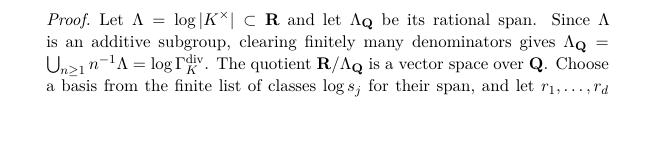
\bi{Let $\Lambda=\log|K^\times|\subset\mathbf R$ and let $\Lambda_{\mathbf Q}$ be its rational span. Since $\Lambda$ is an additive subgroup, clearing finitely many denominators gives $\Lambda_{\mathbf Q}=\bigcup_{n\geq1}n^{-1}\Lambda=\log\Gamma_K^{\mathrm{div}}$. The quotient $\mathbf R/\Lambda_{\mathbf Q}$ is a vector space over $\mathbf Q$. Choose a basis from the finite list of classes $\log s_j$ for their span, and let $r_1,\ldots,r_d$ be the corresponding radii. If $r^\nu\in|K^\times|$ for $\nu\in\mathbf Z^d$, the basis classes satisfy an integer relation, hence $\nu=0$. Thus $r$ is free over $K$.}
{令 $\Lambda=\log|K^\times|\subset\mathbf R$,并以 $\Lambda_{\mathbf Q}$ 表示其有理线性张成。由于 $\Lambda$ 为加法子群,通分有限多个分母便得 $\Lambda_{\mathbf Q}=\bigcup_{n\geq1}n^{-1}\Lambda=\log\Gamma_K^{\mathrm{div}}$。商 $\mathbf R/\Lambda_{\mathbf Q}$ 为 $\mathbf Q$-向量空间。从有限个 $\log s_j$ 的类中,选取其张成空间的一组基,并以 $r_1,\ldots,r_d$ 记对应半径。若对 $\nu\in\mathbf Z^d$ 有 $r^\nu\in|K^\times|$,则这些基的类满足一个整数关系,因此 $\nu=0$。所以 $r$ 在 $K$ 上自由。}

\bi{For each $j$ there are $q_{ji}\in\mathbf Q$ with $\log s_j-\sum_iq_{ji}\log r_i\in\Lambda_{\mathbf Q}$. Clear all these finitely many denominators, including those needed to put the remainders in $\Lambda$, by one integer $N$. Then $\mu_{ji}=Nq_{ji}$ is integral and $N\log s_j-\sum_i\mu_{ji}\log r_i\in\Lambda$. Choosing $c_j\in K^\times$ with this logarithmic absolute value proves the displayed identity.}
{对每个 $j$,存在 $q_{ji}\in\mathbf Q$,使 $\log s_j-\sum_iq_{ji}\log r_i\in\Lambda_{\mathbf Q}$。选取一个整数 $N$,通分所有这些有限多个分母,并使每个余项乘以 $N$ 后属于 $\Lambda$。于是 $\mu_{ji}=Nq_{ji}$ 为整数,且 $N\log s_j-\sum_i\mu_{ji}\log r_i\in\Lambda$。选取具有这一对数绝对值的 $c_j\in K^\times$,即得所列恒等式。}

\bi{By Lemma~\ref{fnd:freepolyradiusfield}, every nonzero element of $L$ has a unique dominant Laurent monomial $aT^\nu$, and its norm is $|a|r^\nu$. Conversely every such value occurs on that monomial. This proves the equality for $|L^\times|$. Taking divisible closures gives the second equality, or equivalently one can again clear the finitely many denominators in an expression $t r^q$. The scalar $c_jT^{\mu_j}\in L^\times$ has absolute value $s_j^N$, proving the last inclusion. The original field embeds isometrically by the same lemma.}
{由 Lemma~\ref{fnd:freepolyradiusfield},$L$ 的每个非零元素都有唯一的主导 Laurent 单项式 $aT^\nu$,其范数为 $|a|r^\nu$。反之,每个这样的值都在相应单项式上取到。这证明 $|L^\times|$ 的等式。取可除闭包即得第二个等式;等价地,也可对表达式 $t r^q$ 再次通分有限多个分母。标量 $c_jT^{\mu_j}\in L^\times$ 的绝对值为 $s_j^N$,由此得到最后的包含。同一引理保证原基域等距嵌入。}

\bi{If $K$ is trivially valued, then $\Gamma_K^{\mathrm{div}}=\{1\}$ and the same finite-dimensional linear-algebra argument applies in $\mathbf R$. If every prescribed radius is one, take the empty tuple; otherwise the chosen tuple contains a radius different from one and $L$ is nontrivially valued. The distinction between the value group and its divisible closure remains necessary: if $|K^\times|=q^{\mathbf Z}$ with $0<q<1$, the single radius $q^{1/2}$ already belongs to $\Gamma_K^{\mathrm{div}}$. The empty tuple then suffices, while $q^{1/2}\notin|K^\times|$.}
{若 $K$ 赋值平凡,则 $\Gamma_K^{\mathrm{div}}=\{1\}$,相同的有限维线性代数论证在 $\mathbf R$ 中适用。若所有给定半径均为一,则取空元组;否则所选元组含有不等于一的半径,$L$ 便非平凡赋值。仍须区别值群及其可除闭包:若 $|K^\times|=q^{\mathbf Z}$、$0<q<1$,则单个半径 $q^{1/2}$ 已属于 $\Gamma_K^{\mathrm{div}}$。此时空元组足够,但 $q^{1/2}\notin|K^\times|$。}
\end{proof}
Typeset reader excerpt
Typed proof inputs
- NAG-001548 · selected whole (direct operational uses)
- BASE-LINEAR · standing context or base
- BASE-LINEAR · standing context or base (requires)
- BASE-REAL · standing context or base
- BASE-REAL · standing context or base (requires)
- BASE-RINGS · standing context or base
- BASE-RINGS · standing context or base (requires)
- BASE-SETS · standing context or base
- BASE-SETS · standing context or base (requires)
- BASE-TOPOLOGY · standing context or base
- BASE-TOPOLOGY · standing context or base (requires)
- NAG-001548 · selected whole
- NAG-001548 · selected whole (requires)
Reader cross-references
Proof map
Verified map inputs · NAG-001556
Registered proof input
- NAG-001548 · The free-polyradius field · accepted whole
NAG-001556 · A free extension for finitely many radii · Chapter argument