NAG-001596 · Accepted whole
Value groups and residues of a finite extension
3 Reduction, formal models and residual geometry
Open in the English reader · PDF page 611
Statement · exact TeX
\begin{lemma}[\bi{Value groups and residues of a finite extension}
{有限扩张的值群与剩余域}]
\label{fnd:finitevaluedindexbound}
\bi{For a finite valued extension $E/F$, both
$e=[|E^\times|:|F^\times|]$ and
$f=[\widetilde E:\widetilde F]$ are finite, and
$ef\le[E:F]$. If $|F^\times|$ is nontrivial cyclic,
then $|E^\times|$ is nontrivial cyclic as well.}
{对有限赋值扩张 $E/F$,数
$e=[|E^\times|:|F^\times|]$ 及
$f=[\widetilde E:\widetilde F]$ 均有限,且
$ef\le[E:F]$。若 $|F^\times|$ 为非平凡循环群,
则 $|E^\times|$ 亦为非平凡循环群。}
\end{lemma}
Full selected proof · exact TeX
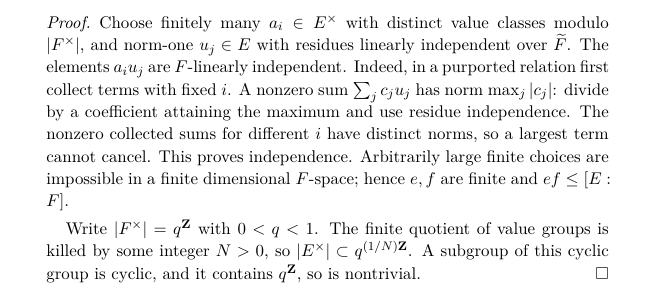
\begin{proof}
\bi{Choose finitely many $a_i\in E^\times$ with distinct
value classes modulo $|F^\times|$, and norm-one
$u_j\in E$ with residues linearly independent over
$\widetilde F$. The elements $a_i u_j$ are $F$-linearly
independent. Indeed, in a purported relation first collect
terms with fixed $i$. A nonzero sum $\sum_j c_j u_j$ has
norm $\max_j|c_j|$: divide by a coefficient attaining
the maximum and use residue independence. The nonzero
collected sums for different $i$ have distinct norms,
so a largest term cannot cancel. This proves independence.
Arbitrarily large finite choices are impossible in a finite
dimensional $F$-space; hence $e,f$ are finite and $ef\le[E:F]$.}
{选择有限个 $a_i\in E^\times$,使其模 $|F^\times|$ 的
值类互异;再选择范数一的 $u_j\in E$,使其剩余类在
$\widetilde F$ 上线性无关。则 $a_i u_j$ 在 $F$ 上线性无关。
事实上,将假设的线性关系先按 $i$ 收集。非零和
$\sum_j c_j u_j$ 的范数等于 $\max_j|c_j|$:除以一个取得
最大值的系数,再用剩余类线性无关性即可。对不同 $i$,
各非零收集项的范数不同,故最大项不能抵消。这证明线性无关。
有限维 $F$-空间不容许任意大的有限无关组,因此 $e,f$ 有限,
并满足 $ef\le[E:F]$。}

\bi{Write $|F^\times|=q^{\mathbf Z}$ with $0<q<1$.
The finite quotient of value groups is killed by some
integer $N>0$, so $|E^\times|\subset q^{(1/N)\mathbf Z}$.
A subgroup of this cyclic group is cyclic, and it contains
$q^{\mathbf Z}$, so is nontrivial.}
{写 $|F^\times|=q^{\mathbf Z}$,其中 $0<q<1$。
值群的有限商被某个整数 $N>0$ 消去,因此
$|E^\times|\subset q^{(1/N)\mathbf Z}$。此循环群的子群
仍循环,且它包含 $q^{\mathbf Z}$,所以非平凡。}
\end{proof}
Typeset reader excerpt
Typed proof inputs
- BASE-LINEAR · standing context or base
- BASE-LINEAR · standing context or base (requires)
- BASE-REAL · standing context or base
- BASE-REAL · standing context or base (requires)
- BASE-RINGS · standing context or base
- BASE-RINGS · standing context or base (requires)
- BASE-TOPOLOGY · standing context or base
- BASE-TOPOLOGY · standing context or base (requires)
Proof map
Verified map inputs · NAG-001596
No addressable selected proof input is recorded in this projection.
Standing context and base inputs
BASE-LINEARBASE-REALBASE-RINGSBASE-TOPOLOGY
NAG-001596 · Value groups and residues of a finite extension · Chapter argument