NAG-001758 · Accepted whole
Henselian ordinary local rings
2 Analytic spaces, morphisms and fibres
Open in the English reader · PDF page 325
Statement · exact TeX
\begin{corollary}[\bi{Henselian ordinary local rings}{Hensel 通常局部环}]
\label{fnd:ordinaryanalyticstalkhenselian}
\bi{Every ordinary local ring $R$ of a good analytic space has the following properties: every finite $R$-algebra is a finite product of local rings, and every simple residue-field root of a monic polynomial over $R$ lifts uniquely to a root in $R$. In particular $R$ is henselian.}
{Good 解析空间的每个通常局部环 $R$ 均有以下性质:每个有限 $R$-代数是有限个局部环的乘积;$R$ 上首一多项式的每个单剩余域根都唯一提升为 $R$ 中的根。特别地,$R$ 是 Hensel 环。}
\end{corollary}
Full selected proof · exact TeX
\begin{proof}
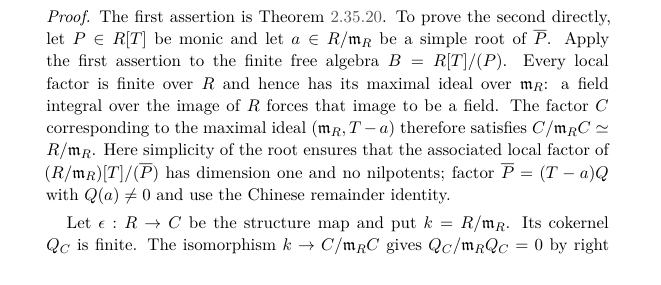
\bi{The first assertion is Theorem~\ref{fnd:finiteordinarygermrealization}. To prove the second directly, let $P\in R[T]$ be monic and let $a\in R/\mathfrak m_R$ be a simple root of $\overline P$. Apply the first assertion to the finite free algebra $B=R[T]/(P)$. Every local factor is finite over $R$ and hence has its maximal ideal over $\mathfrak m_R$: a field integral over the image of $R$ forces that image to be a field. The factor $C$ corresponding to the maximal ideal $(\mathfrak m_R,T-a)$ therefore satisfies $C/\mathfrak m_RC\simeq R/\mathfrak m_R$. Here simplicity of the root ensures that the associated local factor of $(R/\mathfrak m_R)[T]/(\overline P)$ has dimension one and no nilpotents; factor $\overline P=(T-a)Q$ with $Q(a)\ne0$ and use the Chinese remainder identity.}
{第一项即 Theorem~\ref{fnd:finiteordinarygermrealization}。为直接证明第二项,设 $P\in R[T]$ 首一,且 $a\in R/\mathfrak m_R$ 是 $\overline P$ 的单根。将第一项用于有限自由代数 $B=R[T]/(P)$。每个局部因子都在 $R$ 上有限,其极大理想必位于 $\mathfrak m_R$ 上方:若一个域在 $R$ 的像上整,则该像也是域。因此,对应于极大理想 $(\mathfrak m_R,T-a)$ 的因子 $C$ 满足 $C/\mathfrak m_RC\simeq R/\mathfrak m_R$。这里单根性使 $(R/\mathfrak m_R)[T]/(\overline P)$ 的相应局部因子为一维且无幂零元;将 $\overline P$ 分解为 $(T-a)Q$、其中 $Q(a)\ne0$,再用中国剩余恒等式即可。}

\bi{Let \(\epsilon:R\to C\) be the structure map and put \(k=R/\mathfrak m_R\).
Its cokernel \(Q_C\) is finite. The isomorphism \(k\to C/\mathfrak m_RC\)
gives \(Q_C/\mathfrak m_RQ_C=0\) by right exactness. Apply
\cite[Tag 00DV(2)]{StacksAlg} with \(M=Q_C\) and \(I=\mathfrak m_R\)
to see that \(\epsilon\) is surjective.

Let \(p_C:B\to C\) be the projection. Lift the images under \(p_C\)
of the standard free \(R\)-basis of \(B\) along \(\epsilon\).
These lifts define an \(R\)-linear map \(B\to R\). Its restriction to
the direct summand \(C\) splits \(\epsilon\) as a map of \(R\)-modules.
Thus \(N=\ker\epsilon\) is a direct summand of \(R\), hence finite,
and reduction of this split sequence identifies \(N/\mathfrak m_RN\)
with the kernel of \(k\to C/\mathfrak m_RC\). That kernel is zero.
Apply \cite[Tag 00DV(2)]{StacksAlg} with \(M=N\) and
\(I=\mathfrak m_R\) to get \(N=0\).
The image of $T$ in $C=R$ is the desired lifted root. If $b,c\in R$ were two lifts, then $P(b)-P(c)=(b-c)Q_1(b,c)$, where $Q_1(b,c)$ reduces to $\overline P'(a)\ne0$; hence $Q_1(b,c)$ is a unit and $b=c$.}
{因子 $C$ 是有限自由 $R$-模 $B$ 的直和因子,所以平坦。Nakayama 使 $R\to C$、$1\mapsto1$ 满射。其核 $N$ 有限;把 $0\to N\to R\to C\to0$ 与剩余域张量,由 $C$ 平坦且剩余映射为同构,得到 $N/\mathfrak m_RN=0$,再用 Nakayama 即得 $N=0$。$T$ 在 $C=R$ 中的像就是所求根。若 $b,c\in R$ 是两个提升,则 $P(b)-P(c)=(b-c)Q_1(b,c)$,其中 $Q_1(b,c)$ 模极大理想等于 $\overline P'(a)\ne0$;故 $Q_1(b,c)$ 为单位,$b=c$。}
\end{proof}
Typeset reader excerpt
Typed proof inputs
- NAG-001757 · selected whole
- NAG-001757 · selected whole (requires)
Reader cross-references
Proof map
Verified map inputs · NAG-001758
Registered proof input
- NAG-001757 · Realizing a finite ordinary-stalk algebra · accepted whole
NAG-001758 · Henselian ordinary local rings · Chapter argument