NAG-001802 · Accepted whole
Disc and projective-line reductions at the Gauss point
3 Reduction, formal models and residual geometry
Open in the English reader · PDF page 593
Statement · exact TeX
\begin{corollary}[\bi{Disc and projective-line reductions at the Gauss point}
{Gauss 点处圆盘与射影直线的约化}]
\label{fnd:standardgaussgermmodels}
\bi{At the unit Gauss point $x$, the ordinary germ reduction
of the closed unit disc is represented by
$\mathbb A^1_k$ pointed by $k(t)$; that of
$\mathbb P^{1,\mathrm{an}}$ is represented by
$\mathbb P^1_k$ pointed by the same field. The disc inclusion
induces the usual open immersion of these models, which is
not proper in the pointed birational category.}
{在单位 Gauss 点 $x$ 处,闭单位圆盘的通常芽约化由
$k(t)$ 指定带点结构的 $\mathbb A^1_k$ 表示;
$\mathbb P^{1,\mathrm{an}}$ 的通常芽约化则由同一域指定
带点结构的 $\mathbb P^1_k$ 表示。圆盘包含诱导这些模型
之间通常的开浸入,它在带点 birational 范畴中不适当。}
\end{corollary}
Full selected proof · exact TeX
\begin{proof}
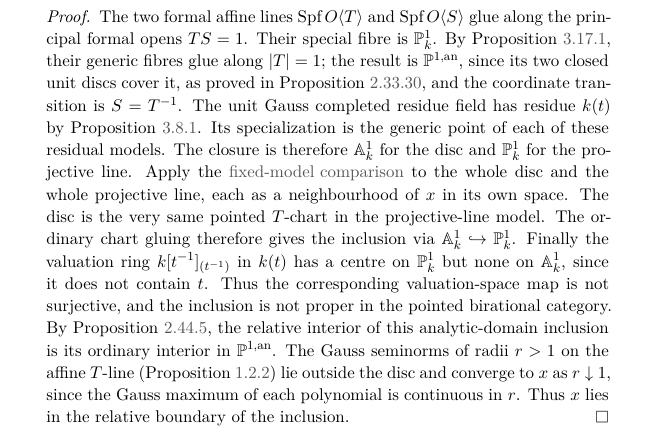
\bi{The two formal affine lines
$\operatorname{Spf}O\langle T\rangle$ and
$\operatorname{Spf}O\langle S\rangle$ glue along the
principal formal opens $TS=1$. Their special fibre is
$\mathbb P^1_k$. By
Proposition~\ref{fnd:formalprincipalopenflat}, their generic
fibres glue along $|T|=1$; the result is
$\mathbb P^{1,\mathrm{an}}$, since its two closed unit discs
cover it, as proved in
Proposition~\ref{fnd:analytificationprojectivecompact}, and
the coordinate transition is $S=T^{-1}$.
The unit Gauss completed residue field has residue $k(t)$
by Proposition~\ref{new:gauss_residue_formula}. Its
specialization is the generic point of each of these residual
models. The closure is therefore $\mathbb A^1_k$ for the
disc and $\mathbb P^1_k$ for the projective line.
Apply the
\mbox{\hyperref[prop:formal-supplied-model-pointed-descent]{fixed-model comparison}}
to the whole disc and the whole projective line, each as a
neighbourhood of \(x\) in its own space. The disc is the very same pointed
\(T\)-chart in the projective-line model. The ordinary chart
gluing therefore gives the inclusion via
\(\mathbb A^1_k\hookrightarrow\mathbb P^1_k\). Finally the valuation
ring $k[t^{-1}]_{(t^{-1})}$ in $k(t)$ has a centre on
$\mathbb P^1_k$ but none on $\mathbb A^1_k$, since it does
not contain $t$. Thus the corresponding valuation-space map
is not surjective, and the inclusion is not proper in the
pointed birational category. By Proposition~\ref{fnd:generaldomainordinaryinterior},
the relative interior of this analytic-domain inclusion is its
ordinary interior in \(\mathbb P^{1,\mathrm{an}}\).
The Gauss seminorms of radii \(r>1\) on the affine \(T\)-line
(Proposition~\ref{fnd:gaussnorm}) lie outside the disc and
converge to \(x\) as \(r\downarrow1\), since the Gauss
maximum of each polynomial is continuous in \(r\).
Thus \(x\) lies in the relative boundary of the inclusion.}
{两个形式仿射直线
$\operatorname{Spf}O\langle T\rangle$ 与
$\operatorname{Spf}O\langle S\rangle$ 沿 $TS=1$ 所给
主形式开集粘合,特殊纤维为 $\mathbb P^1_k$。由
Proposition~\ref{fnd:formalprincipalopenflat},泛纤维沿
$|T|=1$ 粘合;所得空间为 $\mathbb P^{1,\mathrm{an}}$,
因为 Proposition~\ref{fnd:analytificationprojectivecompact}
证明其两个闭单位圆盘覆盖整个空间,且坐标变换为
$S=T^{-1}$。由 Proposition~\ref{new:gauss_residue_formula},
单位 Gauss 完备剩余域的剩余域为 $k(t)$。其特化是上述
剩余模型的泛点,故在圆盘模型中的闭包为
$\mathbb A^1_k$,在射影直线模型中的闭包为
$\mathbb P^1_k$。将
\mbox{\hyperref[prop:formal-supplied-model-pointed-descent]{固定模型比较}}
分别应用于整个圆盘与整个射影直线,各自在其空间中作为 \(x\) 的邻域。
圆盘就是射影直线模型中同一个带点 \(T\) 图。通常图的粘合因此给出
由 \(\mathbb A^1_k\hookrightarrow\mathbb P^1_k\) 实现的包含。
最后,$k(t)$ 中的赋值环
$k[t^{-1}]_{(t^{-1})}$ 在 $\mathbb P^1_k$ 上有中心,
但因其不含 $t$,在 $\mathbb A^1_k$ 上没有中心。因此
对应的赋值空间映射不满射,该包含在带点 birational 范畴
中不适当。由 Proposition~\ref{fnd:generaldomainordinaryinterior},
这个解析域包含的相对内部就是它在 \(\mathbb P^{1,\mathrm{an}}\) 中的通常内部。
仿射 \(T\) 直线上半径 \(r>1\) 的 Gauss 半范数
(Proposition~\ref{fnd:gaussnorm})位于圆盘外,并在 \(r\downarrow1\)
时趋于 \(x\),因为每个多项式的 Gauss 最大值对 \(r\) 连续。
所以 \(x\) 位于该包含的相对边界。}
\end{proof}
Typeset reader excerpt
Typed proof inputs
No explicit typed target in the exported bindings.
Reader cross-references
Proof map
Verified map inputs · NAG-001802
No addressable selected proof input is recorded in this projection.
NAG-001802 · Disc and projective-line reductions at the Gauss point · Chapter argument