NAG-001892 · Accepted whole
Laurent coefficient normal form
2 Analytic spaces, morphisms and fibres
Open in the English reader · PDF page 401
Statement · exact TeX
\begin{lemma}[\bi{Laurent coefficient normal form}
{Laurent 系数正规形}]
\label{fnd:unitlaurentnormalform}
\bi{For \(0\leq \ell\leq s\), the quotient Banach algebra}
{对 \(0\leq\ell\leq s\),商 Banach 代数}
\[
 K\langle u_1,\ldots,u_s,v_1,\ldots,v_\ell\rangle/
       (u_1v_1-1,\ldots,u_\ell v_\ell-1)
\]
\bi{is isometrically the space of series
\(\sum_{\alpha\in\mathbf Z^\ell\times\mathbf N^{s-\ell}}
c_\alpha u^\alpha\) whose coefficients tend to zero, with the
maximum norm and Laurent-series multiplication.}
{等距等于级数
\(\sum_{\alpha\in\mathbf Z^\ell\times\mathbf N^{s-\ell}}
c_\alpha u^\alpha\) 的空间,其中系数趋于零,范数为最大值,
乘法为 Laurent 级数乘法。}
\end{lemma}
Full selected proof · exact TeX
\begin{proof}
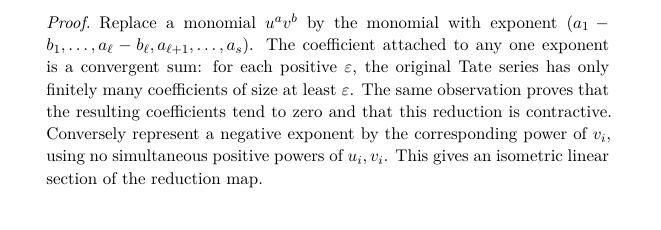
\bi{Replace a monomial \(u^av^b\) by the monomial with exponent
\((a_1-b_1,\ldots,a_\ell-b_\ell,a_{\ell+1},\ldots,a_s)\).
The coefficient attached to any one exponent is a convergent sum:
for each positive \(\varepsilon\), the original Tate series has
only finitely many coefficients of size at least \(\varepsilon\).
The same observation proves that the resulting coefficients tend
to zero and that this reduction is contractive. Conversely represent
a negative exponent by the corresponding power of \(v_i\), using
no simultaneous positive powers of \(u_i,v_i\). This gives an
isometric linear section of the reduction map.}
{将单项式 \(u^av^b\) 换成指数为
\((a_1-b_1,\ldots,a_\ell-b_\ell,a_{\ell+1},\ldots,a_s)\)
的单项式。每个固定指数的系数是收敛的和:对任意正数
\(\varepsilon\),原 Tate 级数中大小至少为 \(\varepsilon\)
的系数只有有限个。同一观察说明约化后的系数趋于零,并且此
约化为压缩映射。反之,用相应的 \(v_i\) 次幂表示负指数,
不同时使用 \(u_i,v_i\) 的正次幂,就得到约化映射的等距线性截面。}

\bi{For a monomial, its difference from its normal form is a sum
of multiples of \(u_iv_i-1\), by successively using
\((u_iv_i)^d-1=(u_iv_i-1)\sum_{a=0}^{d-1}(u_iv_i)^a\).
The multipliers have coefficient norms at most one. Apply this
identity to each term of a Tate series. For any
\(\varepsilon>0\), only finitely many original terms have
coefficients of size at least \(\varepsilon\), and each of them
produces finitely many terms in its multipliers. Consequently the
multiplier series converge in the Tate algebra. This proves that
the kernel is the actual ideal displayed above. The contractive
reduction and its isometric section identify its quotient norm with
the maximum coefficient norm. Laurent convolution is well-defined
by the same finite-large-coefficient argument and agrees with
polynomial multiplication on a dense subalgebra, which proves the
algebra assertion.}
{对单项式,逐次使用
\((u_iv_i)^d-1=(u_iv_i-1)\sum_{a=0}^{d-1}(u_iv_i)^a\),
可将它与正规形之差写成 \(u_iv_i-1\) 的倍数之和,且倍数的
系数范数至多为一。将此恒等式逐项用于 Tate 级数。对任意
\(\varepsilon>0\),只有有限个原始项的系数大小至少为
\(\varepsilon\),每个这样的项又只在各倍数中产生有限项。
因此各倍数级数在 Tate 代数中收敛,证明其核就是所列实际理想。
压缩的约化映射与等距截面将商范数识别为最大系数范数。
同一个有限大系数论证保证 Laurent 卷积良定义;它在稠密的
多项式子代数上与原乘法相同,从而得到代数断言。}
\end{proof}
Typeset reader excerpt
Typed proof inputs
- BASE-RINGS · standing context or base
- BASE-RINGS · standing context or base (requires)
- NAG-001414 · selected whole
- NAG-001414 · selected whole (requires)
- NAG-001421 · selected whole
- NAG-001421 · selected whole (requires)
Proof map
Verified map inputs · NAG-001892
AND · joint registered proof inputs
- NAG-001414 · Weighted coefficient completeness · accepted whole
- NAG-001421 · Convolution with two-sided exponents · accepted whole
Standing context and base inputs
BASE-RINGS
NAG-001892 · Laurent coefficient normal form · Chapter argument