NAG-001912 · Accepted whole
A coefficient ring with a uniform gap
3 Reduction, formal models and residual geometry
Open in the English reader · PDF page 516
Statement · exact TeX
\begin{lemma}[\bi{A coefficient ring with a uniform gap}
{具有一致间隙的系数环}]
\label{fnd:baldcoefficientring}
\bi{Let $K$ be a complete non-Archimedean field. For every sequence
$(a_i)$ in $K^\circ$ tending to zero, there is a closed subring
$S\subset K^\circ$ containing all $a_i$, such that every element of
$S$ of absolute value one is a unit in $S$ and there is a real
$\theta<1$ with $|s|\leq\theta$ for every $s\in S$ satisfying $|s|<1$.}
{设 $K$ 为完备非阿基米德域。对 $K^\circ$ 中每个趋于零的序列
$(a_i)$,存在包含全部 $a_i$ 的闭子环 $S\subset K^\circ$,使
$S$ 中绝对值为一的元素均可逆,且存在实数 $\theta<1$,满足
$s\in S$、$|s|<1$ 时总有 $|s|\leq\theta$。}
\end{lemma}
Full selected proof · exact TeX
\begin{proof}
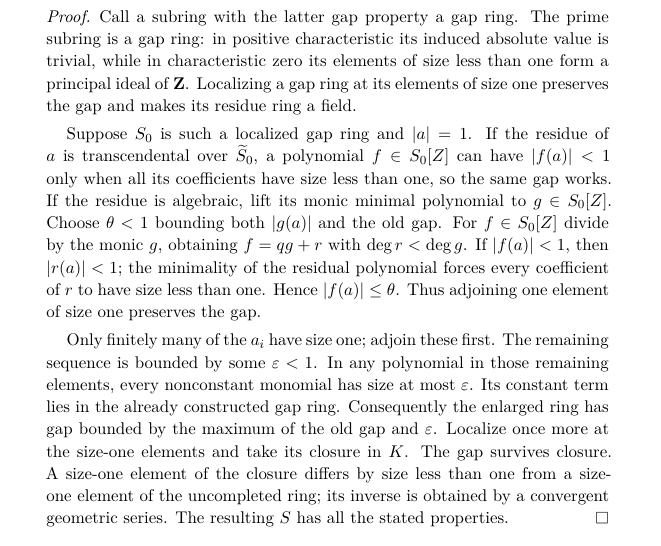
\bi{Call a subring with the latter gap property a gap ring. The prime
subring is a gap ring: in positive characteristic its induced absolute
value is trivial, while in characteristic zero its elements of size
less than one form a principal ideal of $\mathbf Z$. Localizing a gap
ring at its elements of size one preserves the gap and makes its
residue ring a field.}
{将具有后一间隙性质的子环称为间隙环。素子环具有此性质:正特征时
其诱导绝对值平凡;特征零时,$\mathbf Z$ 中绝对值小于一的元素构成
主理想。将间隙环的所有大小为一的元素局部化,不改变间隙,且其剩余环
成为域。}

\bi{Suppose $S_0$ is such a localized gap ring and $|a|=1$. If the
residue of $a$ is transcendental over $\widetilde S_0$, a polynomial
$f\in S_0[Z]$ can have $|f(a)|<1$ only when all its coefficients have
size less than one, so the same gap works. If the residue is algebraic,
lift its monic minimal polynomial to $g\in S_0[Z]$. Choose
$\theta<1$ bounding both $|g(a)|$ and the old gap. For $f\in S_0[Z]$
divide by the monic $g$, obtaining $f=qg+r$ with $\deg r<\deg g$.
If $|f(a)|<1$, then $|r(a)|<1$; the minimality of the residual
polynomial forces every coefficient of $r$ to have size less than one.
Hence $|f(a)|\leq\theta$. Thus adjoining one element of size one
preserves the gap.}
{设 $S_0$ 是这样局部化后的间隙环,且 $|a|=1$。若 $a$ 的剩余类在
$\widetilde S_0$ 上超越,则多项式 $f\in S_0[Z]$ 只有在全部系数大小
都小于一时才可能满足 $|f(a)|<1$,故原间隙仍适用。若该剩余类为代数
元素,将其首一最小多项式提升为 $g\in S_0[Z]$,并取 $\theta<1$
同时控制 $|g(a)|$ 与原间隙。对 $f\in S_0[Z]$ 作首一除法,写成
$f=qg+r$、$\deg r<\deg g$。若 $|f(a)|<1$,则 $|r(a)|<1$;
剩余最小多项式的最小性迫使 $r$ 的每个系数大小均小于一。因此
$|f(a)|\leq\theta$。所以添入一个大小为一的元素仍保留间隙。}

\bi{Only finitely many of the $a_i$ have size one; adjoin these first.
The remaining sequence is bounded by some $\varepsilon<1$. In any
polynomial in those remaining elements, every nonconstant monomial has
size at most $\varepsilon$. Its constant term lies in the already
constructed gap ring. Consequently the enlarged ring has gap bounded
by the maximum of the old gap and $\varepsilon$. Localize once more
at the size-one elements and take its closure in $K$. The gap survives
closure. A size-one element of the closure differs by size less than
one from a size-one element of the uncompleted ring; its inverse is
obtained by a convergent geometric series. The resulting $S$ has all
the stated properties.}
{序列中只有有限个 $a_i$ 大小为一,先添入这些元素。其余序列由某个
$\varepsilon<1$ 一致控制。在这些剩余元素的任意多项式中,每个非恒定
单项式的大小至多为 $\varepsilon$,而常数项属于已构造的间隙环。
因此新环的间隙由原间隙与 $\varepsilon$ 的最大值控制。再次局部化
所有大小为一的元素,再在 $K$ 中取闭包。间隙在闭包中保留;闭包中
任一大小为一的元素,与原环某个大小为一的元素之差小于一,其逆元
由收敛几何级数给出。所得 $S$ 满足全部要求。}
\end{proof}
Typeset reader excerpt
Typed proof inputs
- BASE-LINEAR · standing context or base (selected rule)
- BASE-REAL · standing context or base (selected rule)
- BASE-RINGS · standing context or base (selected rule)
- BASE-SETS · standing context or base (selected rule)
- BASE-TOPOLOGY · standing context or base (selected rule)
- BASE-LINEAR · standing context or base
- BASE-LINEAR · standing context or base (requires)
- BASE-REAL · standing context or base
- BASE-REAL · standing context or base (requires)
- BASE-RINGS · standing context or base
- BASE-RINGS · standing context or base (requires)
- BASE-SETS · standing context or base
- BASE-SETS · standing context or base (requires)
- BASE-TOPOLOGY · standing context or base
- BASE-TOPOLOGY · standing context or base (requires)
Proof map
Verified map inputs · NAG-001912
No addressable selected proof input is recorded in this projection.
NAG-001912 · A coefficient ring with a uniform gap · Chapter argument