NAG-001935 · Accepted whole
Integral finite normalization of a formal model
3 Reduction, formal models and residual geometry
Open in the English reader · PDF page 530
Statement · exact TeX
\begin{lemma}[\bi{Integral finite normalization of a formal model}
{形式模型的整有限正规化}]
\label{fnd:integralformalnormalization}
\bi{Let $A_0\ne0$ be an admissible $K^\circ$-algebra.
There is a finite injective continuous homomorphism
$R_0=K^\circ\langle Y_1,\ldots,Y_d\rangle\hookrightarrow A_0$.
The ring $R_0$ is an integrally closed domain.}
{设 $A_0\ne0$ 为 admissible $K^\circ$-代数。存在有限单射连续同态
$R_0=K^\circ\langle Y_1,\ldots,Y_d\rangle\hookrightarrow A_0$。
环 $R_0$ 为整闭整环。}
\end{lemma}
Full selected proof · exact TeX
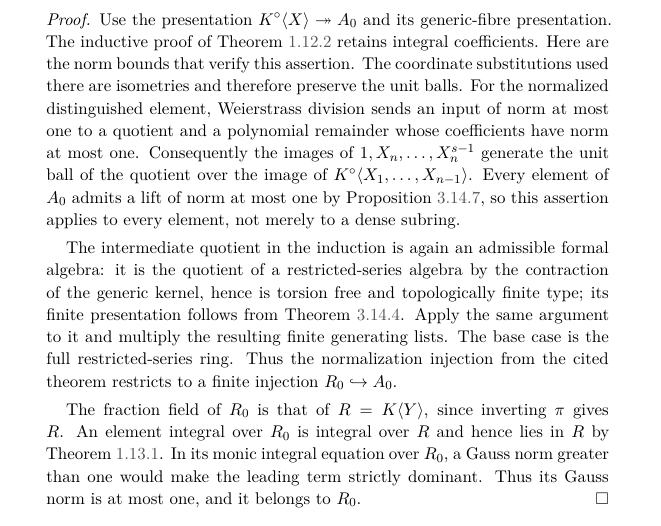
\begin{proof}
\bi{Use the presentation $K^\circ\langle X\rangle\twoheadrightarrow A_0$
and its generic-fibre presentation. The inductive proof of
Theorem~\ref{fnd:strictfinitenormalization} retains integral coefficients.
Here are the norm bounds that verify this assertion.
The coordinate substitutions used there are isometries and therefore
preserve the unit balls. For the normalized distinguished element,
Weierstrass division sends an input of norm at most one to a quotient
and a polynomial remainder whose coefficients have norm at most one.
Consequently the images of $1,X_n,\ldots,X_n^{s-1}$ generate the
unit ball of the quotient over the image of
$K^\circ\langle X_1,\ldots,X_{n-1}\rangle$.
Every element of $A_0$ admits a lift of norm at most one by
Proposition~\ref{fnd:affineformalpresentations}, so this assertion
applies to every element, not merely to a dense subring.}
{使用表示 $K^\circ\langle X\rangle\twoheadrightarrow A_0$
及其泛纤维表示。Theorem~\ref{fnd:strictfinitenormalization}
的归纳证明保留整系数,具体的范数控制如下。
其中使用的坐标代换均为等距映射,故保留单位球。
对正规化的 distinguished 元素作 Weierstrass 除法时,范数不超过一
的输入得到范数不超过一的商和余式;余式的各系数也不超过一。
因此 $1,X_n,\ldots,X_n^{s-1}$ 的像在
$K^\circ\langle X_1,\ldots,X_{n-1}\rangle$ 的像上生成商的单位球。
由 Proposition~\ref{fnd:affineformalpresentations},$A_0$ 的
每个元素都有范数不超过一的提升,故这里处理的是所有元素,而不只是
一个稠密子环。}

\bi{The intermediate quotient in the induction is again an admissible
formal algebra: it is the quotient of a restricted-series algebra by
the contraction of the generic kernel, hence is torsion free and
topologically finite type; its finite presentation follows from
Theorem~\ref{fnd:formaltorsionfreepresentation}.
Apply the same argument to it and multiply the resulting finite
generating lists. The base case is the full restricted-series ring.
Thus the normalization injection from the cited theorem restricts
to a finite injection $R_0\hookrightarrow A_0$.}
{归纳中的中间商仍为 admissible 形式代数:它是限制幂级数环
模去泛纤维核的收缩,因而无挠且拓扑有限型;其有限表示性由
Theorem~\ref{fnd:formaltorsionfreepresentation} 给出。
对它重复同一论证,并将有限生成列表相乘。归纳的起点为整个
限制幂级数环。于是所引定理中的正规化单射限制为有限单射
$R_0\hookrightarrow A_0$。}

\bi{The fraction field of $R_0$ is that of
$R=K\langle Y\rangle$, since inverting $\pi$ gives $R$.
An element integral over $R_0$ is integral over $R$ and hence lies
in $R$ by Theorem~\ref{fnd:stricttatefactorial}.
In its monic integral equation over $R_0$, a Gauss norm greater
than one would make the leading term strictly dominant.
Thus its Gauss norm is at most one, and it belongs to $R_0$.}
{$R_0$ 与 $R=K\langle Y\rangle$ 有相同的分式域,因为逆转
$\pi$ 得到 $R$。在 $R_0$ 上整的元素也在 $R$ 上整,故由
Theorem~\ref{fnd:stricttatefactorial} 属于 $R$。
在其系数属于 $R_0$ 的首一整方程中,若该元素的 Gauss 范数大于一,
首项将严格占优。因此其 Gauss 范数不超过一,即它属于 $R_0$。}
\end{proof}
Typeset reader excerpt
Typed proof inputs
- BASE-RINGS · standing context or base
- BASE-RINGS · standing context or base (requires)
- CLAUSE:NAG-001918:attained_quotient_norm_and_unit_ball_forward · selected scope, text unavailable
- CLAUSE:NAG-001918:attained_quotient_norm_and_unit_ball_forward · selected scope, text unavailable (requires)
- NAG-000182 · selected whole
- NAG-000182 · selected whole (requires)
- NAG-001378 · selected whole
- NAG-001378 · selected whole (requires)
- NAG-001382 · selected whole
- NAG-001382 · selected whole (requires)
- NAG-001403 · selected whole
- NAG-001403 · selected whole (requires)
- NAG-001451 · selected whole
- NAG-001451 · selected whole (requires)
- NAG-001454 · selected whole
- NAG-001454 · selected whole (requires)
- NAG-001915 · selected whole
- NAG-001915 · selected whole (requires)
- NAG-001916 · selected whole
- NAG-001916 · selected whole (requires)
Reader cross-references
Proof map
Verified map inputs · NAG-001935
AND · joint registered proof inputs
- NAG-000182 · Multiplicativity of the weighted Gauss norm · accepted whole
- NAG-001378 · Division and strictness over Banach coefficients · accepted whole
- NAG-001382 · Distinguished coordinates · accepted whole
- NAG-001403 · Finite modules over strict affinoids · accepted whole
- NAG-001451 · Finite normalization for strict affinoid algebras · accepted whole
- NAG-001454 · Factorization and normality of Tate algebras · accepted whole
- NAG-001915 · Torsion-free finite modules are finitely presented · accepted whole
- NAG-001916 · Adic topology on finite formal modules · accepted whole
Standing context and base inputs
BASE-RINGS
Unlinked source pointers
These pointers have no operative linked edge in this map.
CLAUSE:NAG-001918:attained_quotient_norm_and_unit_ball_forward
NAG-001935 · Integral finite normalization of a formal model · Chapter argument