NAG-001938 · Accepted whole
Prescribing the center in an integral extension
3 Reduction, formal models and residual geometry
Open in the English reader · PDF page 531
Statement · exact TeX
\begin{lemma}[\bi{Prescribing the center in an integral extension}
{在整扩张中指定中心}]
\label{fnd:normalbaseprescribedcenter}
\bi{Let $R$ be an integrally closed domain with fraction field $F$,
and let $B$ be an integral domain finite over $R$.
Suppose a real-valued non-Archimedean absolute value on $F$
is at most one on $R$, with center
$\mathfrak p=\{r\in R:|r|<1\}$.
For every prime $\mathfrak q\subset B$ above $\mathfrak p$,
the absolute value extends to $\operatorname{Frac}(B)$ with
center exactly $\mathfrak q$.}
{设 $R$ 为整闭整环,分式域为 $F$,而 $B$ 为 $R$ 上有限的整环。
设 $F$ 上的实值非阿基米德绝对值在 $R$ 上不超过一,中心为
$\mathfrak p=\{r\in R:|r|<1\}$。
对 $\mathfrak p$ 上方的每个素理想 $\mathfrak q\subset B$,
该绝对值都延拓到 $\operatorname{Frac}(B)$,使其中心恰为
$\mathfrak q$。}
\end{lemma}
Full selected proof · exact TeX
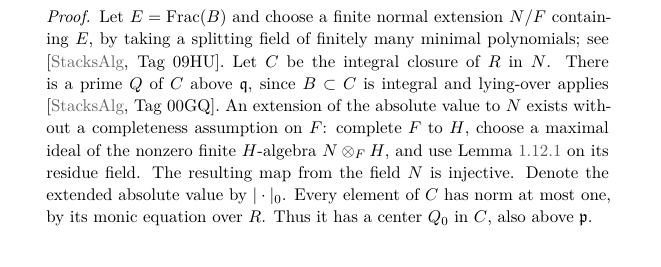
\begin{proof}
\bi{Let $E=\operatorname{Frac}(B)$ and choose a finite normal
extension $N/F$ containing $E$, by taking a splitting field
of finitely many minimal polynomials; see \cite[Tag 09HU]{StacksAlg}.
Let $C$ be the integral closure of $R$ in $N$.
There is a prime $Q$ of $C$ above $\mathfrak q$, since
$B\subset C$ is integral and lying-over applies
\cite[Tag 00GQ]{StacksAlg}.
An extension of the absolute value to $N$ exists without a
completeness assumption on $F$: complete $F$ to $H$, choose
a maximal ideal of the nonzero finite $H$-algebra
$N\otimes_F H$, and use Lemma~\ref{fnd:finiteextensionnorms}
on its residue field. The resulting map from the field $N$
is injective. Denote the extended absolute value by $|\cdot|_0$.
Every element of $C$ has norm at most one, by its monic equation
over $R$. Thus it has a center $Q_0$ in $C$, also above
$\mathfrak p$.}
{令 $E=\operatorname{Frac}(B)$,取有限个最小多项式的分裂域,
便得到包含 $E$ 的有限正规扩张 $N/F$;参见
\cite[Tag 09HU]{StacksAlg}。令 $C$ 为 $R$ 在 $N$ 中的整闭包。
由于 $B\subset C$ 是整扩张,由 lying-over
\cite[Tag 00GQ]{StacksAlg},存在位于 $\mathfrak q$ 上方的
$C$ 的素理想 $Q$。
绝对值到 $N$ 的延拓不要求 $F$ 完备:将 $F$ 完备化为 $H$,
取非零有限 $H$-代数 $N\otimes_F H$ 的一个极大理想,
再对其剩余域应用 Lemma~\ref{fnd:finiteextensionnorms}。
从域 $N$ 出发的所得映射为单射,故定义一个延拓绝对值
$|\cdot|_0$。由 $C$ 中元素在 $R$ 上的首一方程可知,它们的
绝对值均不超过一。因此该绝对值在 $C$ 中有中心 $Q_0$,
同样位于 $\mathfrak p$ 上方。}

\bi{Put $G=\operatorname{Aut}_F(N)$. The fixed field $N^G/F$
is purely inseparable by \cite[Tag 030M]{StacksAlg}.
Every element $z\in C^G$ consequently has a power
$z^{p^e}\in R$ in positive characteristic, and already lies
in $R$ in characteristic zero: the power lies in $F$ and
is integral over the normal ring $R$.
It follows that $Q$ and $Q_0$ have the same contraction to $C^G$,
because membership of $z$ is determined by membership of that power.
By \cite[Tag 0BRI]{StacksAlg}, some $\sigma\in G$ satisfies
$\sigma(Q)=Q_0$. The absolute value $|z|=|\sigma(z)|_0$
then has center $Q$ on $C$. Its restriction to $E$ has center
$\mathfrak q$ on $B$, as required.}
{令 $G=\operatorname{Aut}_F(N)$。由 \cite[Tag 030M]{StacksAlg},
不动域 $N^G/F$ 为纯不可分扩张。因此在正特征情形,每个
$z\in C^G$ 的某个幂 $z^{p^e}$ 属于 $R$;在特征零情形
它本身就属于 $R$。确实,这个幂属于 $F$ 且在正规环 $R$ 上整。
所以 $Q$ 和 $Q_0$ 到 $C^G$ 的收缩相同:$z$ 的归属由该幂的
归属决定。由 \cite[Tag 0BRI]{StacksAlg},存在
$\sigma\in G$ 使 $\sigma(Q)=Q_0$。
于是 $|z|=|\sigma(z)|_0$ 在 $C$ 中的中心为 $Q$,
其在 $E$ 上的限制在 $B$ 中的中心就是 $\mathfrak q$。}
\end{proof}
Typeset reader excerpt
Typed proof inputs
- APP-STACKS-00GQ@NAG-001938:2 · named external application
- APP-STACKS-00GQ@NAG-001938:2 · named external application (requires)
- APP-STACKS-030M@NAG-001938:3 · named external application
- APP-STACKS-030M@NAG-001938:3 · named external application (requires)
- APP-STACKS-09HU@NAG-001938:1 · named external application
- APP-STACKS-09HU@NAG-001938:1 · named external application (requires)
- APP-STACKS-0BRI@NAG-001938:4 · named external application
- APP-STACKS-0BRI@NAG-001938:4 · named external application (requires)
- BASE-RINGS · standing context or base
- BASE-RINGS · standing context or base (requires)
- NAG-001450 · selected whole
- NAG-001450 · selected whole (requires)
Reader cross-references
Proof map
Verified map inputs · NAG-001938
Registered proof input
- NAG-001450 · Finite-dimensional norms and finite field extensions · accepted whole
Standing context and base inputs
BASE-RINGS
Unlinked source pointers
These pointers have no operative linked edge in this map.
APP-STACKS-00GQ@NAG-001938:2APP-STACKS-030M@NAG-001938:3APP-STACKS-09HU@NAG-001938:1APP-STACKS-0BRI@NAG-001938:4
NAG-001938 · Prescribing the center in an integral extension · Chapter argument