NAG-001955 · Accepted whole
Graded extension by arbitrary Gauss fields
3 Reduction, formal models and residual geometry
Open in the English reader · PDF page 550
Statement · exact TeX
\begin{theorem}[\bi{Graded extension by arbitrary Gauss fields}
{任意 Gauss 域扩张的分次相容性}]
\label{fnd:generalgaussgradedbasechange}
\bi{Let $A$ be affinoid and let $L$ be an iterated Gauss-field
extension of $K$, with finitely many arbitrary positive radii.
There are canonical isomorphisms}
{设 $A$ 为 affinoid,$L$ 为使用有限个任意正半径从 $K$ 得到的
迭代 Gauss 域扩张。存在典范同构}
\[
 \widetilde A^{\rm gr}\otimes_{\widetilde K^{\rm gr}}
      \widetilde L^{\rm gr}
       \simeq\widetilde{A\widehat\otimes_KL}^{\rm gr}.
\]
\bi{If $(e_i)$ is the resulting orthogonal basis of $L/K$,
then for every coefficient expansion,}
{若 $(e_i)$ 为所得的 $L/K$ 正交基,则对每个系数展开有}
\[
 \rho_{A_L}\left(\sum_i a_i e_i\right)
           =\max_i\rho_A(a_i)|e_i|.
\]
\end{theorem}
Full selected proof · exact TeX
\begin{proof}
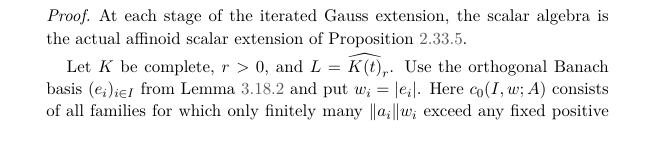
At each stage of the iterated Gauss extension, the scalar algebra
is the actual affinoid scalar extension of
Proposition~\ref{fnd:generalscalarpresentation}.

Let \(K\) be complete, \(r>0\), and
\(L=\widehat{K(t)}_r\). Use the orthogonal Banach basis
\((e_i)_{i\in I}\) from Lemma~\ref{fnd:generalgaussfieldbasis} and put \(w_i=|e_i|\).
Here \(c_0(I,w;A)\) consists of all families for which only
finitely many \(\|a_i\|w_i\) exceed any fixed positive threshold.
Let \(A\) carry its given admissible Banach algebra norm. At this
step the scalar algebra is the actual separated completed
projective product \(A_L=A\widehat\otimes_K L\).

The coefficient functionals of the basis are bounded maps
\(\ell_i:L\to K\) of norm at most \(w_i^{-1}\). On \(A\otimes_K L\)
they give
\[
 w_i\|(1\otimes\ell_i)(z)\|\leq \|z\|_\pi .
\]
Indeed for every finite representation
\(z=\sum_j a_j\otimes\lambda_j\) the ultrametric inequality bounds
the left side by \(\max_j\|a_j\||\lambda_j|\). Take the infimum
over all such representations. For a finite coefficient family,
the representation \(\sum_i a_i\otimes e_i\) gives the reverse
bound for \(\|z\|_\pi\), hence equality with the weighted maximum.
Finite basis expansions approximate all scalar factors of every
finite tensor in the projective seminorm. Thus finite coefficient
families are dense in the separated completion. They are also
dense in the complete weighted \(c_0\)-space, so that
\[
 A_L \simeq c_0(I,w;A)
\]
isometrically as Banach spaces, via the actual coefficient maps.
This argument uses finite truncations for each family and places
no countability condition on \(I\).

For \(x\in\mathcal M_K(A)\) set \(F=\mathcal H(x)\) and
\(L_x=\widehat{F(t)}_r\). The Gauss absolute value is
multiplicative on polynomials by Proposition~\ref{fnd:gaussnorm}, hence extends by
ratios to the rational function field. The inclusion
\(K(t)\hookrightarrow F(t)\) is isometric for these Gauss norms
and extends to \(L\hookrightarrow L_x\). The map
\(a\otimes l\mapsto a(x)l\) is contractive for each finite tensor
representation, by Lemma~\ref{new:seminormcontractive} and the isometric scalar
inclusion. It therefore extends to a bounded \(L\)-algebra map
\(A_L\to L_x\) and gives a bounded point \(x_r\) of \(A_L\).
By the extension-stability in Lemma~\ref{fnd:generalgaussfieldbasis}, the value of a finite
coefficient family at this point is
\(\max_i|a_i(x)|w_i\). The same equality holds for every weighted
\(c_0\)-family by truncation and contractivity.

Every bounded point of \(A_L\) restricts along the constant
inclusion to a bounded point of \(A\) and has scalar values
\(|e_i|=w_i\). The ultrametric inequality and truncation bound
its evaluation above by \(\max_i \rho_A(a_i)w_i\).
Conversely, for each \(i\) use the points \(x_r\) as \(x\)
ranges through \(\mathcal M_K(A)\) to bound the upper spectral
seminorm from below by \(\rho_A(a_i)w_i\). Consequently
\[
 \rho_{A_L}\Bigl(\sum_i a_i e_i\Bigr)=
       \max_i \rho_A(a_i)w_i .
\]
Here \(\rho_A(a_i)\leq\|a_i\|\), so a positive supremum is a
maximum. If all weights of the evaluated coefficients vanish
the same inequalities give zero. The zero algebra gives both
sides zero with the usual zero convention.

Assume the one-step coefficient and spectral formulas for the chosen
positive Gauss radius, including the actual coefficient expansion
on \(A_L=A\widehat\otimes_K L\). Write \(L\) in the orthogonal Banach
basis \((e_i)\) of Lemma~\ref{fnd:generalgaussfieldbasis} and put \(w_i=|e_i|\). For a
submultiplicative spectral seminorm \(\rho\), use the positive
degree \(q\) quotient \(\{\rho\leq q\}/\{\rho<q\}\).

The bounded structural maps from \(A\) and \(L\) into \(A_L\) are
filtered for these seminorms. For \(A\) this follows by restricting
points and for \(L\) by their scalar absolute values. The same
inequalities apply to the zero algebra. Hence multiplication
of homogeneous representatives induces the canonical graded
algebra homomorphism
\[
 \widetilde A^{\rm gr}\otimes_{\widetilde K^{\rm gr}}
     \widetilde L^{\rm gr}\longrightarrow\widetilde{A_L}^{\rm gr}.
\]
For \(z=\sum_i a_i e_i\) with \(\rho_{A_L}(z)\leq q\), only
finitely many indices satisfy \(\rho_A(a_i)w_i=q>0\).
Indeed \(\rho_A(a_i)\leq\|a_i\|\), and the coefficient weights
tend to zero in the weighted \(c_0\) sense. Among the remaining
indices the supremum of the spectral weights is strictly
below \(q\): all but finitely many are smaller than \(q/2\), and
every retained nonleading weight is strictly below \(q\). The
spectral formula therefore identifies the degree \(q\) class of
\(z\) with the finite sum of the classes
\(\operatorname{in}_{q/w_i}(a_i)\operatorname{in}_{w_i}(e_i)\)
at equality indices. For a finite sum of homogeneous coefficients
in degree \(q\), choose representatives of size at most \(q/w_i\).
If some coefficient class is nonzero, the formula gives spectral
size exactly \(q\), so its image class is nonzero.

Applying the same argument to \(L\) with its orthogonal coefficient
norm shows that the \(\operatorname{in}_{w_i}(e_i)\) freely generate
\(\widetilde L^{\rm gr}\) over \(\widetilde K^{\rm gr}\) as a
graded module. The preceding surjectivity and injectivity in each
degree prove that the displayed map is an isomorphism. Its
multiplication is the one induced by multiplying actual lifts.

For iteration, let \(K\subset L\subset L'\) be successive stages,
and let \((f_j)\) be the next orthogonal basis, of weights
\(v_j=|f_j|\). In the actual scalar algebra write
\(z=\sum_j b_j f_j\), \(b_j=\sum_i a_{ij}e_i\). Each column is a
weighted \(c_0\)-family and the numbers
\((\sup_i\|a_{ij}\|w_i)v_j\) tend to zero. This is equivalent to
the single weighted \(c_0\) condition on
\((\|a_{ij}\|w_iv_j)_{i,j}\): above any positive threshold only
finitely many columns can occur and each contributes finitely
many entries. Conversely the single condition implies both
column conditions by testing at half the given threshold.
The same norm calculation with \(A=K\) gives the product
orthogonal basis \((e_i f_j)\) of \(L'/K\).

The scalar-tower comparison of Corollary~\ref{fnd:iteratedaffinoidbasechange} identifies
\((A_L)_{L'}\) with \(A_{L'}\), compatibly with structural maps.
On finite coefficient sums it sends the two-stage expressions
to \(\sum_{i,j}a_{ij}(e_i f_j)\). The weighted \(c_0\) description
and continuity give the same equality for limits. The two
spectral formulas give
\[
 \rho_{A_{L'}}(z)
 =\max_j v_j\rho_{A_L}(b_j)
 =\max_{i,j}v_jw_i\,\rho_A(a_{ij}).
\]
The graded maps compose by the usual algebraic tensor associator,
since each is induced by multiplication of representatives.
Iteration proves the claim for any finite tower, including the
empty tower, whose comparison is the identity.
\end{proof}
Typeset reader excerpt
Typed proof inputs
- NAG-000182 · selected whole
- NAG-000182 · selected whole (requires)
- NAG-000655 · selected whole
- NAG-000655 · selected whole (requires)
- NAG-001685 · selected whole
- NAG-001685 · selected whole (requires)
- NAG-001689 · selected whole
- NAG-001689 · selected whole (requires)
- NAG-001954 · selected whole
- NAG-001954 · selected whole (requires)
Reader cross-references
Proof map
Verified map inputs · NAG-001955
AND · joint registered proof inputs
- NAG-000182 · Multiplicativity of the weighted Gauss norm · accepted whole
- NAG-000655 · Result 1.6.1 · accepted whole
- NAG-001685 · Scalar extension and actual relation ideals · accepted whole
- NAG-001689 · Iterated base change · accepted whole
- NAG-001954 · Orthogonal coordinates on one Gauss field · accepted whole
NAG-001955 · Graded extension by arbitrary Gauss fields · Chapter argument