NAG-001956 · Accepted whole
Graded scalar descent and degree-one reduction
3 Reduction, formal models and residual geometry
Open in the English reader · PDF page 553
Statement · exact TeX
\begin{lemma}[\bi{Graded scalar descent and degree-one reduction}
{分次标量下降与一次约化}]
\label{fnd:gradedscalardescent}
\bi{Every graded module over a graded field has a homogeneous
basis. Scalar extension by a nonzero graded algebra over that
field is faithful and exact. Finite generation of an algebra
or a module descends under this scalar extension.
If a graded $k$-algebra $C$ is supported in the degree group
of $k$, multiplication induces}
{分次域上的每个分次模都具有齐次基。由该分次域上的非零分次
代数作标量扩张是忠实正合的;代数或模的有限生成性沿此扩张
下降。若分次 $k$-代数 $C$ 的支撑包含于 $k$ 的次数群,
则乘法诱导同构}
\[
 C_1\otimes_{k_1}k\simeq C.
\]
\bi{For algebras with this support condition, a graded map
is finite precisely when its degree-one map is finite.}
{对满足上述支撑条件的代数,分次映射有限当且仅当其一次部分
的映射有限。}
\end{lemma}
Full selected proof · exact TeX
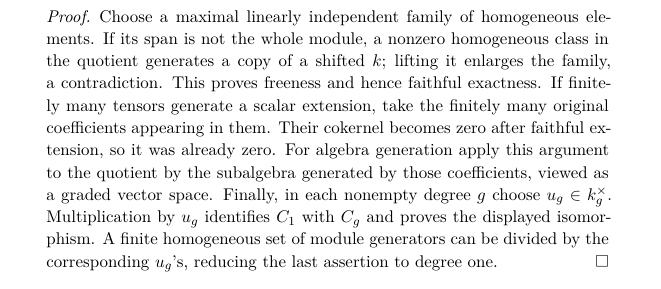
\begin{proof}
\bi{Choose a maximal linearly independent family of homogeneous
elements. If its span is not the whole module, a nonzero homogeneous
class in the quotient generates a copy of a shifted $k$;
lifting it enlarges the family, a contradiction. This proves
freeness and hence faithful exactness. If finitely many tensors
generate a scalar extension, take the finitely many original
coefficients appearing in them. Their cokernel becomes zero
after faithful extension, so it was already zero. For algebra
generation apply this argument to the quotient by the subalgebra
generated by those coefficients, viewed as a graded vector space.
Finally, in each nonempty degree $g$ choose $u_g\in k_g^\times$.
Multiplication by $u_g$ identifies $C_1$ with $C_g$ and proves
the displayed isomorphism. A finite homogeneous set of module
generators can be divided by the corresponding $u_g$'s, reducing
the last assertion to degree one.}
{选取极大的齐次线性无关族。如果它的线性包不是全模,商模中
一个非零齐次类就生成一个移位的 $k$;提升该类即可扩大原族,
矛盾。这证明自由性,进而证明忠实正合性。
若标量扩张后有有限个生成张量,取其中出现的有限个原系数。
这些系数生成映射的余核在忠实扩张后为零,故本来就为零。
对代数生成性,把由这些系数生成的子代数之商视为分次向量
空间,应用相同论证。最后,对每个非空次数 $g$ 取
$u_g\in k_g^\times$。乘以 $u_g$ 将 $C_1$ 识别为 $C_g$,
证明所列同构。将有限个齐次模生成元除以相应的 $u_g$,
便将最后一个断言化到一次部分。}
\end{proof}
Typeset reader excerpt
Typed proof inputs
- BASE-LINEAR · standing context or base
- BASE-LINEAR · standing context or base (requires)
- BASE-RINGS · standing context or base
- BASE-RINGS · standing context or base (requires)
- BASE-SETS · standing context or base
- BASE-SETS · standing context or base (requires)
Proof map
Verified map inputs · NAG-001956
No addressable selected proof input is recorded in this projection.
Standing context and base inputs
BASE-LINEARBASE-RINGSBASE-SETS
NAG-001956 · Graded scalar descent and degree-one reduction · Chapter argument