NAG-002020 · Accepted whole
Product flatness on ordinary stalks
3 Reduction, formal models and residual geometry
Open in the English reader · PDF page 624
Statement · exact TeX
\begin{proposition}[\bi{Product flatness on ordinary stalks}{通常茎上的乘积平坦性}]
\label{cand:groundfieldproductstalkflat}
\bi{Let $Y,X$ be good $K$-analytic spaces, let $\mathcal F$ be coherent on $Y_G$, and put $P=Y\times_KX$. For $w\in P$ with image $x\in X$, the module $(p_Y^*\mathcal F)_w$ is flat over $\mathcal O_{X,x}$.}
{设 $Y,X$ 为 good $K$-解析空间,$\mathcal F$ 是 $Y_G$ 上的凝聚层,并令 $P=Y\times_KX$。对 $w\in P$,记其在 $X$ 中的像为 $x$,则模 $(p_Y^*\mathcal F)_w$ 在 $\mathcal O_{X,x}$ 上平坦。}
\end{proposition}
Full selected proof · exact TeX
\begin{proof}
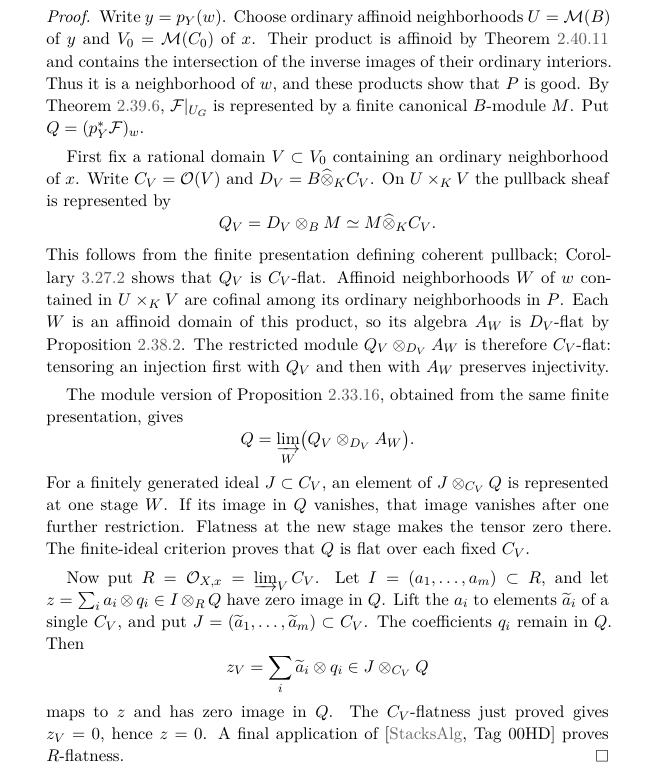
\bi{Write $y=p_Y(w)$. Choose ordinary affinoid neighborhoods $U=\mathcal M(B)$ of $y$ and $V_0=\mathcal M(C_0)$ of $x$. Their product is affinoid by Theorem~\ref{fnd:generalanalyticproducts} and contains the intersection of the inverse images of their ordinary interiors. Thus it is a neighborhood of $w$, and these products show that $P$ is good. By Theorem~\ref{fnd:fullgkiehltheoremb}, $\mathcal F|_{U_G}$ is represented by a finite canonical $B$-module $M$. Put $Q=(p_Y^*\mathcal F)_w$.}
{记 $y=p_Y(w)$。选择 $y$ 的普通 affinoid 邻域 $U=\mathcal M(B)$ 及 $x$ 的普通 affinoid 邻域 $V_0=\mathcal M(C_0)$。由 Theorem~\ref{fnd:generalanalyticproducts},它们的乘积为 affinoid,且包含两者普通内部的逆像之交。因此该乘积是 $w$ 的邻域,这些乘积也说明 $P$ 为 good。由 Theorem~\ref{fnd:fullgkiehltheoremb},$\mathcal F|_{U_G}$ 由有限典范 $B$-模 $M$ 表示。令 $Q=(p_Y^*\mathcal F)_w$。}

\bi{First fix a rational domain $V\subset V_0$ containing an ordinary neighborhood of $x$. Write $C_V=\mathcal O(V)$ and $D_V=B\widehat\otimes_K C_V$. On $U\times_KV$ the pullback sheaf is represented by}
{先固定 $V_0$ 中包含 $x$ 的普通邻域的 rational 域 $V$。记 $C_V=\mathcal O(V)$、$D_V=B\widehat\otimes_K C_V$。在 $U\times_KV$ 上,拉回层由下列模表示:}
\[
 Q_V=D_V\otimes_B M\simeq M\widehat\otimes_K C_V.
\]
\bi{This follows from the finite presentation defining coherent pullback; Corollary~\ref{cand:groundfieldcoherenttensor} shows that $Q_V$ is $C_V$-flat. Affinoid neighborhoods $W$ of $w$ contained in $U\times_KV$ are cofinal among its ordinary neighborhoods in $P$. Each $W$ is an affinoid domain of this product, so its algebra $A_W$ is $D_V$-flat by Proposition~\ref{fnd:generalizeddomainflatness}. The restricted module $Q_V\otimes_{D_V}A_W$ is therefore $C_V$-flat: tensoring an injection first with $Q_V$ and then with $A_W$ preserves injectivity.}
{这来自定义凝聚拉回的有限表示;Corollary~\ref{cand:groundfieldcoherenttensor} 说明 $Q_V$ 在 $C_V$ 上平坦。包含于 $U\times_KV$ 的 $w$ 的 affinoid 邻域 $W$,在 $w$ 于 $P$ 中的普通邻域中余终。每个 $W$ 均为该乘积的 affinoid 域,所以由 Proposition~\ref{fnd:generalizeddomainflatness},其代数 $A_W$ 在 $D_V$ 上平坦。因此限制模 $Q_V\otimes_{D_V}A_W$ 在 $C_V$ 上平坦:任一单射依次与 $Q_V$、$A_W$ 张量,仍保持单射。}

\bi{The module version of Proposition~\ref{fnd:ordinaryaffinoidstalks}, obtained from the same finite presentation, gives}
{由同一有限表示得到的 Proposition~\ref{fnd:ordinaryaffinoidstalks} 的模版本给出}
\[
 Q=\varinjlim_W\bigl(Q_V\otimes_{D_V}A_W\bigr).
\]
\bi{For a finitely generated ideal $J\subset C_V$, an element of $J\otimes_{C_V}Q$ is represented at one stage $W$. If its image in $Q$ vanishes, that image vanishes after one further restriction. Flatness at the new stage makes the tensor zero there. The finite-ideal criterion proves that $Q$ is flat over each fixed $C_V$.}
{对有限生成理想 $J\subset C_V$,$J\otimes_{C_V}Q$ 中的元素可在某一阶段 $W$ 表示。若其在 $Q$ 中的像消失,则再限制一次后其像已经消失。新阶段的平坦性使该张量在该阶段为零。有限理想判别准则因而说明 $Q$ 在每个固定的 $C_V$ 上平坦。}

\bi{Now put $R=\mathcal O_{X,x}=\varinjlim_V C_V$. Let $I=(a_1,\ldots,a_m)\subset R$, and let $z=\sum_i a_i\otimes q_i\in I\otimes_RQ$ have zero image in $Q$. Lift the $a_i$ to elements $\widetilde a_i$ of a single $C_V$, and put $J=(\widetilde a_1,\ldots,\widetilde a_m)\subset C_V$. The coefficients $q_i$ remain in $Q$. Then}
{现在令 $R=\mathcal O_{X,x}=\varinjlim_V C_V$。设 $I=(a_1,\ldots,a_m)\subset R$,且 $z=\sum_i a_i\otimes q_i\in I\otimes_RQ$ 在 $Q$ 中的像为零。将全部 $a_i$ 提升为同一个 $C_V$ 中的元素 $\widetilde a_i$,并令 $J=(\widetilde a_1,\ldots,\widetilde a_m)\subset C_V$;系数 $q_i$ 仍留在 $Q$ 中。于是}
\[
 z_V=\sum_i\widetilde a_i\otimes q_i\in J\otimes_{C_V}Q
\]
\bi{maps to $z$ and has zero image in $Q$. The $C_V$-flatness just proved gives $z_V=0$, hence $z=0$. A final application of \cite[Tag 00HD]{StacksAlg} proves $R$-flatness.}
{映到 $z$,且在 $Q$ 中的像为零。刚证明的 $C_V$-平坦性给出 $z_V=0$,故 $z=0$。最后应用 \cite[Tag 00HD]{StacksAlg},得到 $R$-平坦性。}
\end{proof}
Typeset reader excerpt
Typed proof inputs
- APP-STACKS-00HD@NAG-002020:existing-6-1 · named external application (existing exact named Stacks authority)
- APP-STACKS-00HD@NAG-002020:existing-6-2 · named external application (existing exact named Stacks authority)
- NAG-001615 · selected whole (accepted native whole)
- NAG-001624 · selected whole (accepted native whole)
- NAG-001698 · selected whole (accepted native whole)
- NAG-001832 · selected whole, export unavailable (accepted native whole)
- NAG-002019 · selected whole (accepted native whole)
Named external registrations
Reader cross-references
Proof map
Verified map inputs · NAG-002020
AND · joint registered proof inputs
- NAG-001615 · Fibre products of analytic spaces · accepted whole Exact source window 55–64
- NAG-001624 · Kiehl and Theorem B on the analytic G-site · accepted whole Exact source window 55–64
- NAG-001698 · Ordinary affinoid stalks · accepted whole Exact source window 65–80
- NAG-001832 · Result 2.38.2 · accepted whole; PDF destination Exact source window 55–64
- NAG-002019 · Finite modules on an affinoid product · accepted whole Exact source window 55–64
Unlinked source pointers
These pointers have no operative linked edge in this map.
APP-STACKS-00HD@NAG-002020:existing-6-1APP-STACKS-00HD@NAG-002020:existing-6-2
NAG-002020 · Product flatness on ordinary stalks · Chapter argument