NAG-002056 · Accepted whole
Attaching the two ends of a nodal tube
Open in the English reader · PDF page 672
Statement · exact TeX
\begin{proposition}[\bi{Attaching the two ends of a nodal tube}
{结点管域两个端点的附着}]
\label{cand:nodaltubeendpoints}
\bi{Let $\mathcal X$ be a curve model and suppose given a pointed
\textup{\'etale} diagram}
{设 $\mathcal X$ 为曲线模型,并给定带点 \textup{\'etale} 图}
\[
 (\mathcal X,q)\longleftarrow(U,u)\longrightarrow
 (W_a,\bar0),\qquad
 W_a=\operatorname{Spec}O[s,t]/(st-a),\quad 0<|a|<1,
\]
\bi{where $U$ is affine and the three selected special-fibre points
are $k$-rational. In $Y=\widehat U_\eta$, put
$D=]u[$ and $C=\overline D$. Let $v_t,v_s$ be the component points
of the branches $t=0,s=0$, respectively. Then}
{其中 $U$ 仿射,且三个所选特殊纤维点均为 $k$-有理点。在
$Y=\widehat U_\eta$ 中令 $D=]u[$、$C=\overline D$。以
$v_t,v_s$ 分别表示分支 $t=0,s=0$ 的分量点。则}
\[
 D\simeq A_K(|a|,1),\qquad
 C=D\cup\{v_t,v_s\},\qquad
 |s(v_t)|=1,\quad |s(v_s)|=|a|.
\]
\bi{Every net in $D$ whose $|s|$ tends to $1$ converges to $v_t$;
every net whose $|s|$ tends to $|a|$ converges to $v_s$.
For each neighborhood of either endpoint in $C$, a full radial
tail of $D$ is contained in that neighborhood. The image of $C$ in
$X$ is $C_q=\overline{]q[}$; the only possible identification is that
of $v_t$ with $v_s$. The two endpoints map to the component points
of the corresponding branches of $q$.}
{在 $D$ 中,凡 $|s|$ 趋于 $1$ 的点网均趋于 $v_t$;凡 $|s|$
趋于 $|a|$ 的点网均趋于 $v_s$。$C$ 中任一端点的每个邻域都
包含 $D$ 的一个完整径向尾部。$C$ 在 $X$ 中的像为
$C_q=\overline{]q[}$;唯一可能发生的识别是将 $v_t$ 与 $v_s$
识别。两个端点分别映到 $q$ 的对应分支的分量点。}
\end{proposition}
Full selected proof · exact TeX
\begin{proof}
\bi{The entire-tube isomorphisms of
Corollary~\ref{cand:pointednodalannulustube} identify $s$ with the
annular coordinate.
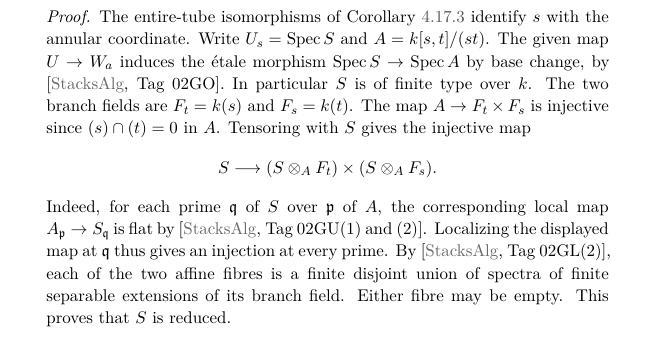
Write \(U_s=\operatorname{Spec}S\) and \(A=k[s,t]/(st)\). The given
map \(U\to W_a\) induces the \textup{\'etale} morphism
\(\operatorname{Spec}S\to\operatorname{Spec}A\) by base change,
by \cite[Tag 02GO]{StacksAlg}. In particular \(S\) is of finite type
over \(k\). The two branch fields are \(F_t=k(s)\) and \(F_s=k(t)\).
The map \(A\to F_t\times F_s\) is injective since \((s)\cap(t)=0\)
in \(A\). Tensoring with \(S\) gives the injective map
\[
 S\longrightarrow (S\otimes_A F_t)\times (S\otimes_A F_s).
\]
Indeed, for each prime \(\mathfrak q\) of \(S\) over
\(\mathfrak p\) of \(A\), the corresponding local map
\(A_{\mathfrak p}\to S_{\mathfrak q}\) is flat by
\cite[Tag 02GU(1) and (2)]{StacksAlg}. Localizing the displayed
map at \(\mathfrak q\) thus gives an injection at every prime.
By \cite[Tag 02GL(2)]{StacksAlg}, each of the two affine fibres
is a finite disjoint union of spectra of finite separable
extensions of its branch field. Either fibre may be empty.
This proves that \(S\) is reduced.

If \(\mathfrak q\) is minimal in \(S\), its contraction is minimal
in \(A\). Otherwise the contraction contains an element outside
both minimal primes of \(A\), by avoidance of these two primes.
Such an element is a nonzerodivisor on \(S\) by the displayed
injection. But its image in the nonzero field \(S_{\mathfrak q}\)
would be zero, a contradiction. For a minimal \(\mathfrak q\)
over the branch prime \(\mathfrak p\), localize \(S/\mathfrak q\)
at the nonzero elements of \(A/\mathfrak p\). The result is a
nonzero domain quotient of the corresponding affine fibre algebra,
hence a finite extension of that branch field. It is the fraction
field of \(S/\mathfrak q\). Its transcendence degree over \(k\)
is one, so \cite[Tag 00P0]{StacksAlg} gives
\(\dim(S/\mathfrak q)=1\). Thus the special fibre of \(U\) is a
reduced pure one-dimensional curve.
Lemma~\ref{cand:pointednodalbranches} gives exactly the two
components through $u$. Lemma~\ref{cand:closedtubeboundary} gives
$C\setminus D\subseteq\{v_t,v_s\}$. At $v_t$, the reduction of $s$
is nonzero, so $|s(v_t)|=1$; at $v_s$, the reduction of $t$ is
nonzero, so $|t(v_s)|=1$ and $st=a$ gives $|s(v_s)|=|a|$.}
{Corollary~\ref{cand:pointednodalannulustube} 的整管域同构将 $s$
识别为圆环坐标。$U$ 的特殊纤维是约化曲线:它 \textup{\'etale}
于结点曲线 $st=0$,而此类态射保持结点性,见
\cite[Tag 0C57]{StacksAlg}。
Lemma~\ref{cand:pointednodalbranches} 给出通过 $u$ 的恰好两个
分量。由 Lemma~\ref{cand:closedtubeboundary},有
$C\setminus D\subseteq\{v_t,v_s\}$。在 $v_t$ 处,$s$ 的约化
非零,故 $|s(v_t)|=1$;在 $v_s$ 处,$t$ 的约化非零,故
$|t(v_s)|=1$,再由 $st=a$ 得到 $|s(v_s)|=|a|$。}

\bi{The affinoid $Y$ is compact Hausdorff. A net in $D$ whose
$|s|$ tends to $1$ has cluster points in $C$, and continuity of
$|s|$ forces every cluster point to be $v_t$. Compactness then
implies convergence to $v_t$: otherwise a subnet outside a fixed
neighborhood would have a cluster point there. The inner end is
identical. Applying this to the Gauss points with radii tending to
the two endpoints proves that both $v_t$ and $v_s$ belong to $C$.
If $N$ is a neighborhood of $v_t$ in $C$, the compact set
$C\setminus N$ has $\max|s|<1$ after replacing $N$ by an open
subneighborhood. Thus a full outer tail lies in $N$. The minimum
of $|s|$ on a compact complement similarly proves the inner-tail
assertion.}
{Affinoid 空间 $Y$ 紧且 Hausdorff。$D$ 中满足 $|s|\to1$ 的点网
在 $C$ 中具有聚点,且 $|s|$ 的连续性迫使每个聚点都等于
$v_t$。紧性于是给出整个点网趋于 $v_t$:否则可在某个固定
邻域外取子网,并在该邻域外取得聚点。内端同理。对半径分别
趋于两个端值的 Gauss 点应用此结论,便知 $v_t,v_s$ 都属于
$C$。若 $N$ 是 $C$ 中 $v_t$ 的邻域,先取其中一个开子邻域,
则紧集 $C\setminus N$ 上有 $\max|s|<1$,所以某个完整外尾部
包含于 $N$。在紧补集上取 $|s|$ 的最小值,同样得到内尾部
的断言。}

\bi{By Lemma~\ref{cand:pointednodalbranches}, the two residual
generic points map to component generic points of $\mathcal X_s$.
Functoriality of specialization and uniqueness of component points
identify the images of $v_t,v_s$. The image of compact $C$ is
closed in Hausdorff $X$ and contains $]q[$. Conversely, continuity
and density of $D$ in $C$ put that image inside $\overline{]q[}$.
The restriction $D\to]q[$ is an isomorphism, and an endpoint cannot
map into $]q[$ because its specialization is generic. Consequently
only the two endpoints can be identified.}
{由 Lemma~\ref{cand:pointednodalbranches},两个剩余泛点映到
$\mathcal X_s$ 的分量泛点。特化的函子性与分量点唯一性识别
$v_t,v_s$ 的像。紧集 $C$ 的像在 Hausdorff 空间 $X$ 中闭,且
包含 $]q[$。反过来,由连续性及 $D$ 在 $C$ 中稠密,此像
包含于 $\overline{]q[}$。限制 $D\to]q[$ 是同构,而端点的
特化为泛点,所以端点不能映入 $]q[$。因此只可能识别两个端点。}
\end{proof}
Typeset reader excerpt
Typed proof inputs
- NAG-002041 · selected whole
- NAG-002054 · selected whole
- NAG-002055 · selected whole
- NAG-002041 · selected whole (requires)
- NAG-002054 · selected whole (requires)
- NAG-002055 · selected whole (requires)
Reader cross-references
Proof map
Verified map inputs · NAG-002056
AND · joint registered proof inputs
- NAG-002041 · Transport of a split nodal chart · accepted whole
- NAG-002054 · Boundary points of a closed-point tube · accepted whole
- NAG-002055 · Two components in a pointed nodal chart · accepted whole
NAG-002056 · Attaching the two ends of a nodal tube · Chapter argument