NAG-002069 · Accepted whole
Normalization points and model branches
Open in the English reader · PDF page 683
Statement · exact TeX
\begin{lemma}[\bi{Normalization points and model branches}
{正规化点与模型分支}]
\label{cand:normalizedmodelbranches}
\bi{Let $D$ be a reduced finite-type curve over a field $k$,
with at-worst-nodal singularities. Its normalization is the
disjoint union of the normalizations $C^\nu$ of its irreducible
components $C$. A smooth closed point $q$ of $D$ has one
preimage on the normalization, on the unique component through
$q$, with the same residue field. A split node $q$ has precisely
two preimages $p_+,p_-$, both with residue field $k$. The two
points lie on the normalized components selected by the two
local branches; they remain distinct if both branches belong
to the same global component.}
{设 $D$ 为域 $k$ 上约化有限型曲线,且其奇点至多为节点。
其正规化是各不可约分量 $C$ 的正规化 $C^\nu$ 的不交并。
$D$ 的光滑闭点 $q$ 在正规化上只有一个逆像,它位于经过
$q$ 的唯一分量上,且剩余域不变。分裂节点 $q$ 恰有两个
逆像 $p_+,p_-$,二者的剩余域均为 $k$。这两个点分别位于
两条局部分支所选出的正规化分量上;即使两分支属于同一个
整体分量,它们仍是不同的点。}

\bi{For a pointed \'etale diagram with $E$ affine}
{对于 $E$ 为仿射概形的带点 \'etale 图}
\[
 (D,q)\ \longleftarrow\ (E,u)\
       \longrightarrow\
       \bigl(\operatorname{Spec}k[s,t]/(st),o\bigr),
 \qquad \kappa(q)=\kappa(u)=k,
\]
\bi{the normalization points over $u$ identify with those over
$q$ and with the two origins of the normalized coordinate axes.
Thus the branches $t=0$ and $s=0$ select unambiguously the two
points of the normalization of $D$ above $q$.}
{位于 $u$ 上方的正规化点,分别与 $q$ 上方的正规化点和
两条正规化坐标轴的原点对应。因此,分支 $t=0$ 与 $s=0$
无歧义地选出 $D$ 的正规化中位于 $q$ 上方的两个点。}
\end{lemma}
Full selected proof · exact TeX
\begin{proof}
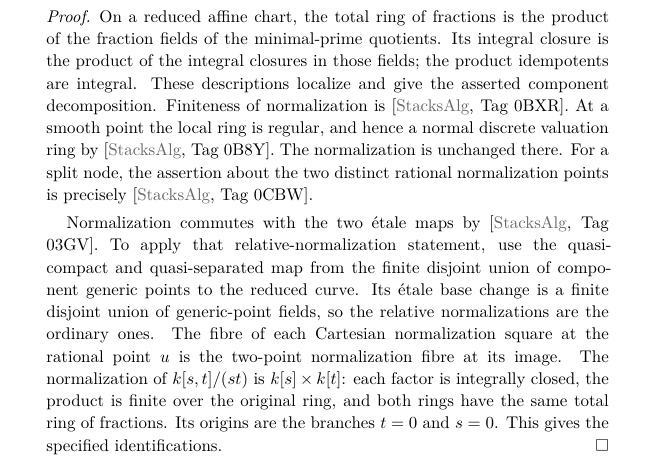
\bi{On a reduced affine chart, the total ring of fractions is
the product of the fraction fields of the minimal-prime quotients.
Its integral closure is the product of the integral closures in
those fields; the product idempotents are integral. These
descriptions localize and give the asserted component
decomposition. Finiteness of normalization is
\cite[Tag 0BXR]{StacksAlg}. At a smooth point the local ring
is regular, and hence a normal discrete valuation ring by
\cite[Tag 0B8Y]{StacksAlg}. The normalization is unchanged
there. For a split node, the assertion about the two distinct
rational normalization points is precisely
\cite[Tag 0CBW]{StacksAlg}.}
{在约化仿射坐标片上,总分式环是各极小素商分式域之积。
其整闭包是这些域中整闭包之积,因为乘积中的幂等元都是
整元素。此描述与局部化相容,给出所述分量分解。正规化
有限性见 \cite[Tag 0BXR]{StacksAlg}。光滑点的局部环
正则,故由 \cite[Tag 0B8Y]{StacksAlg} 为正规的离散赋值环,
在那里正规化不改变概形。对于分裂节点,两个互异有理
正规化点的断言正是 \cite[Tag 0CBW]{StacksAlg}。}

\bi{Normalization commutes with the two \'etale maps by
\cite[Tag 03GV]{StacksAlg}. To apply that relative-normalization
statement, use the quasi-compact and quasi-separated map from
the finite disjoint union of component generic points to the
reduced curve. Its \'etale base change is a finite disjoint union
of generic-point fields, so the relative normalizations are the
ordinary ones. The fibre of each Cartesian normalization square
at the rational point $u$ is the two-point normalization fibre
at its image. The normalization of $k[s,t]/(st)$ is
$k[s]\times k[t]$: each factor is integrally closed, the product
is finite over the original ring, and both rings have the same
total ring of fractions. Its origins are the branches $t=0$ and
$s=0$. This gives the specified identifications.}
{由 \cite[Tag 03GV]{StacksAlg},正规化与这两个 \'etale
映射相容。应用该相对正规化定理时,取从有限个分量泛点
的不交并到约化曲线的准紧且准分离映射;其 \'etale 基变换
是有限个泛点域的不交并,故相对正规化就是通常正规化。
每个 Cartesian 正规化方块在有理点 $u$ 处的纤维,都是
其像的两点正规化纤维。$k[s,t]/(st)$ 的正规化为
$k[s]\times k[t]$:两因子整闭,其乘积在原环上有限,
且二者具有同一总分式环。其中两个原点就是分支 $t=0$
与 $s=0$。由此得到指定的识别。}
\end{proof}
Typeset reader excerpt
Typed proof inputs
- APP-STACKS-00HS@NAG-002069:D-minimal-contraction · named external application
- APP-STACKS-00HS@NAG-002069:D-minimal-contraction · named external application (requires)
- APP-STACKS-00HS@NAG-002069:axes-minimal-contraction · named external application
- APP-STACKS-00HS@NAG-002069:axes-minimal-contraction · named external application (requires)
- APP-STACKS-02GL@NAG-002069:D-generic-fibres · named external application
- APP-STACKS-02GL@NAG-002069:D-generic-fibres · named external application (requires)
- APP-STACKS-02GL@NAG-002069:axes-generic-fibres · named external application
- APP-STACKS-02GL@NAG-002069:axes-generic-fibres · named external application (requires)
- APP-STACKS-03GV@NAG-002069:D-square · named external application
- APP-STACKS-03GV@NAG-002069:D-square · named external application (requires)
- APP-STACKS-03GV@NAG-002069:axes-square · named external application
- APP-STACKS-03GV@NAG-002069:axes-square · named external application (requires)
- APP-STACKS-056T@NAG-002069:smooth-open · named external application
- APP-STACKS-056T@NAG-002069:smooth-open · named external application (requires)
- APP-STACKS-0B8Y@NAG-002069:integral-local · named external application
- APP-STACKS-0B8Y@NAG-002069:integral-local · named external application (requires)
- APP-STACKS-0BXR@NAG-002069:componentwise · named external application
- APP-STACKS-0BXR@NAG-002069:componentwise · named external application (requires)
- APP-STACKS-0CBW@NAG-002069:split-rational-node · named external application
- APP-STACKS-0CBW@NAG-002069:split-rational-node · named external application (requires)
- BASE-RINGS · standing context or base
- BASE-RINGS · standing context or base (requires)
Proof map
Verified map inputs · NAG-002069
No addressable selected proof input is recorded in this projection.
Standing context and base inputs
BASE-RINGS
Unlinked source pointers
These pointers have no operative linked edge in this map.
APP-STACKS-00HS@NAG-002069:D-minimal-contractionAPP-STACKS-00HS@NAG-002069:axes-minimal-contractionAPP-STACKS-02GL@NAG-002069:D-generic-fibresAPP-STACKS-02GL@NAG-002069:axes-generic-fibresAPP-STACKS-03GV@NAG-002069:D-squareAPP-STACKS-03GV@NAG-002069:axes-squareAPP-STACKS-056T@NAG-002069:smooth-openAPP-STACKS-0B8Y@NAG-002069:integral-localAPP-STACKS-0BXR@NAG-002069:componentwiseAPP-STACKS-0CBW@NAG-002069:split-rational-node
NAG-002069 · Normalization points and model branches · Chapter argument