NAG-002114 · Accepted whole
Lengths on a curve and on its normalization
5 Tropicalization, multiplicities and balancing
Open in the English reader · PDF page 893
Statement · exact TeX
\begin{lemma}[\bi{Lengths on a curve and on its normalization}{曲线及其正规化上的长度}]
\label{cand:curvenormalizationlength}
\bi{Let $B$ be a pure one-dimensional finite-type algebra over a field $k$. Let $s\in B$ be a nonzerodivisor such that $B/sB$ is finite-dimensional over $k$. For each minimal prime $P_i$, put}
{设 $B$ 为域 $k$ 上纯一维有限型代数,$s\in B$ 为非零因子,且 $B/sB$ 在 $k$ 上有限维。对每个极小素理想 $P_i$,置}
\[
 \nu_i=\operatorname{length}_{B_{P_i}}(B_{P_i}),\qquad
 B_i=B/P_i,
\]
\bi{and let $\overline B_i$ be the normalization of $B_i$ in its fraction field. Then}
{并以 $\overline B_i$ 记 $B_i$ 在其分式域中的正规化,则}
\[
 \dim_k(B/sB)
 =\sum_i\nu_i
   \sum_{\substack{q\in\operatorname{Spec}\overline B_i\ \mathrm{closed}\\s(q)=0}}
       [\kappa(q):k]\operatorname{ord}_q(s).
 \tag{L}\label{eq:candcurvenormlength}
\]
\end{lemma}
Full selected proof · exact TeX
\begin{proof}
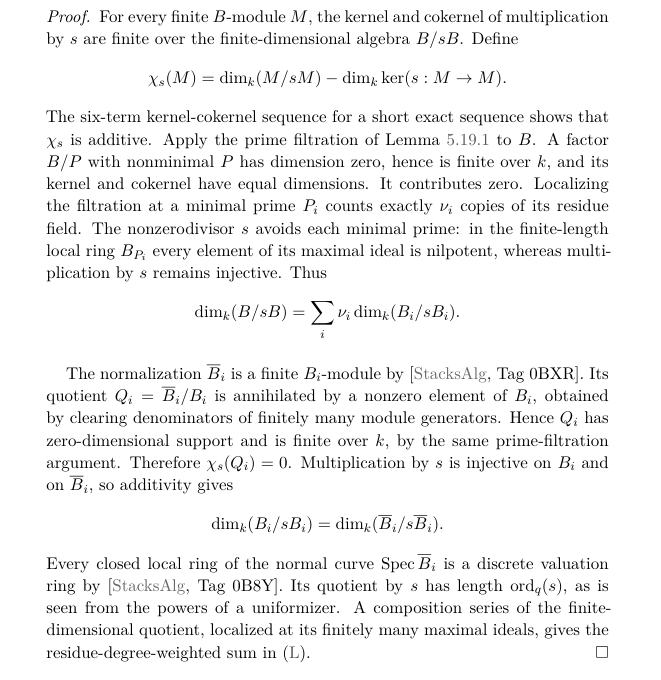
\bi{For every finite $B$-module $M$, the kernel and cokernel of multiplication by $s$ are finite over the finite-dimensional algebra $B/sB$. Define}
{对每个有限 $B$-模 $M$,乘以 $s$ 的核与余核均在有限维代数 $B/sB$ 上有限。定义}
\[
 \chi_s(M)=\dim_k(M/sM)-\dim_k\ker(s:M\to M).
\]
\bi{The six-term kernel-cokernel sequence for a short exact sequence shows that $\chi_s$ is additive. Apply the prime filtration of Lemma~\ref{cand:finiteprimefiltration} to $B$. A factor $B/P$ with nonminimal $P$ has dimension zero, hence is finite over $k$, and its kernel and cokernel have equal dimensions. It contributes zero. Localizing the filtration at a minimal prime $P_i$ counts exactly $\nu_i$ copies of its residue field. The nonzerodivisor $s$ avoids each minimal prime: in the finite-length local ring $B_{P_i}$ every element of its maximal ideal is nilpotent, whereas multiplication by $s$ remains injective. Thus}
{短正合列的六项核—余核正合列说明 $\chi_s$ 可加。将 Lemma~\ref{cand:finiteprimefiltration} 的素滤过用于 $B$。若因子 $B/P$ 中的 $P$ 非极小,则该因子零维,故在 $k$ 上有限;其乘法核与余核维数相等,贡献为零。在极小素理想 $P_i$ 处局部化此滤过,恰好计算其剩余域的 $\nu_i$ 个副本。非零因子 $s$ 避开每个极小素理想:有限长度局部环 $B_{P_i}$ 的极大理想中的每个元素均幂零,而乘以 $s$ 仍单射。因此}
\[
 \dim_k(B/sB)=\sum_i\nu_i\dim_k(B_i/sB_i).
\]

\bi{The normalization $\overline B_i$ is a finite $B_i$-module by \cite[Tag 0BXR]{StacksAlg}. Its quotient $Q_i=\overline B_i/B_i$ is annihilated by a nonzero element of $B_i$, obtained by clearing denominators of finitely many module generators. Hence $Q_i$ has zero-dimensional support and is finite over $k$, by the same prime-filtration argument. Therefore $\chi_s(Q_i)=0$. Multiplication by $s$ is injective on $B_i$ and on $\overline B_i$, so additivity gives}
{由 \cite[Tag 0BXR]{StacksAlg},正规化 $\overline B_i$ 在 $B_i$ 上有限。将有限个模生成元的分母清除,得到消去商 $Q_i=\overline B_i/B_i$ 的非零 $B_i$ 元素。因此 $Q_i$ 的支集零维,再用同一素滤过论证,得其在 $k$ 上有限。于是 $\chi_s(Q_i)=0$。乘以 $s$ 在 $B_i$ 及 $\overline B_i$ 上均单射,故由可加性,}
\[
 \dim_k(B_i/sB_i)=\dim_k(\overline B_i/s\overline B_i).
\]
\bi{Every closed local ring of the normal curve $\operatorname{Spec}\overline B_i$ is a discrete valuation ring by \cite[Tag 0B8Y]{StacksAlg}. Its quotient by $s$ has length $\operatorname{ord}_q(s)$, as is seen from the powers of a uniformizer. A composition series of the finite-dimensional quotient, localized at its finitely many maximal ideals, gives the residue-degree-weighted sum in~\eqref{eq:candcurvenormlength}.}
{由 \cite[Tag 0B8Y]{StacksAlg},正规曲线 $\operatorname{Spec}\overline B_i$ 的每个闭点局部环均为离散赋值环。用一致化元的幂滤过,可见其模 $s$ 的商长度为 $\operatorname{ord}_q(s)$。将有限维商的组成列在有限个极大理想处局部化,即得~\eqref{eq:candcurvenormlength} 中带剩余次数的总和。}
\end{proof}
Typeset reader excerpt
Typed proof inputs
- APP-STACKS-00FN@NAG-002114:actual-finite-type-base · named external application (verified Stacks application)
- APP-STACKS-0B8Y@NAG-002114:actual-normal-local-dvr · named external application (verified Stacks application)
- APP-STACKS-0BXR@NAG-002114:actual-integral-normalization · named external application (verified Stacks application)
- BASE-RINGS · standing context or base (declared elementary base)
- NAG-002105 · selected whole (whole proof)
- APP-STACKS-00FN@NAG-002114:actual-finite-type-base · named external application
- APP-STACKS-00FN@NAG-002114:actual-finite-type-base · named external application (requires)
- APP-STACKS-0B8Y@NAG-002114:actual-normal-local-dvr · named external application
- APP-STACKS-0B8Y@NAG-002114:actual-normal-local-dvr · named external application (requires)
- APP-STACKS-0BXR@NAG-002114:actual-integral-normalization · named external application
- APP-STACKS-0BXR@NAG-002114:actual-integral-normalization · named external application (requires)
- BASE-RINGS · standing context or base
- BASE-RINGS · standing context or base (requires)
- NAG-002105 · selected whole
- NAG-002105 · selected whole (requires)
Reader cross-references
Proof map
Verified map inputs · NAG-002114
Registered proof input
- NAG-002105 · Finite filtrations and zero-dimensional algebras · accepted whole
Standing context and base inputs
BASE-RINGS
Unlinked source pointers
These pointers have no operative linked edge in this map.
APP-STACKS-00FN@NAG-002114:actual-finite-type-baseAPP-STACKS-0B8Y@NAG-002114:actual-normal-local-dvrAPP-STACKS-0BXR@NAG-002114:actual-integral-normalization
NAG-002114 · Lengths on a curve and on its normalization · Chapter argument