NAG-002135 · Accepted whole
An affine neighborhood of finitely many projective points
5 Tropicalization, multiplicities and balancing
Open in the English reader · PDF page 917
Statement · exact TeX
\begin{lemma}[\bi{An affine neighborhood of finitely many projective points}
{有限个射影点的仿射邻域}]
\label{cand:finiteprojectiveaffineneighborhood}
\bi{Let $Z$ be a projective scheme over any field $k$ and let
$q_1,\ldots,q_m$ be distinct closed points. They lie in a common
affine open of $Z$. If $C$ is a projective integral curve and
$p_1,\ldots,p_m$ are distinct closed points of its normalization,
there are functions $u_i\in k(C)^\times$ satisfying}
{设 $Z$ 为任意域 $k$ 上的射影概形,$q_1,\ldots,q_m$
为互异闭点。它们包含于 $Z$ 的同一个仿射开集中。若 $C$
为射影整曲线,$p_1,\ldots,p_m$ 为其正规化上的互异闭点,
则存在函数 $u_i\in k(C)^\times$ 满足}
\[
 \operatorname{ord}_{p_j}(u_i)=\delta_{ij}.
\]
\end{lemma}
Full selected proof · exact TeX
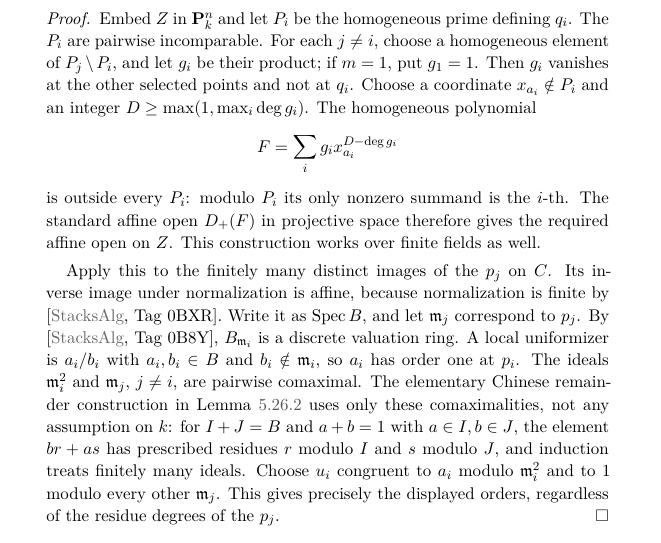
\begin{proof}
\bi{Embed $Z$ in $\mathbf P^n_k$ and let $P_i$ be the homogeneous
prime defining $q_i$. The $P_i$ are pairwise incomparable. For
each $j\ne i$, choose a homogeneous element of $P_j\setminus P_i$,
and let $g_i$ be their product; if $m=1$, put $g_1=1$. Then
$g_i$ vanishes at the other selected points and not at $q_i$.
Choose a coordinate $x_{a_i}\notin P_i$ and an integer
$D\geq\max(1,\max_i\deg g_i)$. The homogeneous polynomial}
{将 $Z$ 嵌入 $\mathbf P^n_k$,以 $P_i$ 记定义 $q_i$ 的
齐次素理想。这些理想两两不可比较。对每个 $j\ne i$,
选择 $P_j\setminus P_i$ 中的齐次元素,并以其乘积为
$g_i$;若 $m=1$,令 $g_1=1$。于是 $g_i$ 在其余所选
点上消失,而在 $q_i$ 不消失。选择坐标
$x_{a_i}\notin P_i$ 及整数
$D\geq\max(1,\max_i\deg g_i)$。齐次多项式}
\[
 F=\sum_i g_i x_{a_i}^{D-\deg g_i}
\]
\bi{is outside every $P_i$: modulo $P_i$ its only nonzero
summand is the $i$-th. The standard affine open $D_+(F)$ in
projective space therefore gives the required affine open on $Z$.
This construction works over finite fields as well.}
{不属于任何 $P_i$:模 $P_i$ 后,唯一非零的加项就是第
$i$ 项。因此射影空间的标准仿射开集 $D_+(F)$ 在 $Z$ 上
给出所需仿射邻域。此构造也适用于有限域。}

\bi{Apply this to the finitely many distinct images of the $p_j$
on $C$. Its inverse image under normalization is affine, because
normalization is finite by \cite[Tag 0BXR]{StacksAlg}. Write
it as $\operatorname{Spec}B$, and let $\mathfrak m_j$ correspond
to $p_j$. By \cite[Tag 0B8Y]{StacksAlg}, $B_{\mathfrak m_i}$
is a discrete valuation ring. A local uniformizer is $a_i/b_i$
with $a_i,b_i\in B$ and $b_i\notin\mathfrak m_i$, so $a_i$
has order one at $p_i$. The ideals $\mathfrak m_i^2$ and
$\mathfrak m_j$, $j\ne i$, are pairwise comaximal. The elementary
Chinese remainder construction in Lemma~\ref{cand:residualfiniteorders}
uses only these comaximalities, not any assumption on $k$:
for $I+J=B$ and $a+b=1$ with $a\in I,b\in J$, the element
$br+as$ has prescribed residues $r$ modulo $I$ and $s$ modulo
$J$, and induction treats finitely many ideals. Choose $u_i$
congruent to $a_i$ modulo $\mathfrak m_i^2$ and to $1$ modulo
every other $\mathfrak m_j$. This gives precisely the displayed
orders, regardless of the residue degrees of the $p_j$.}
{将上述构造用于 $p_j$ 在 $C$ 上的有限个互异像。
由 \cite[Tag 0BXR]{StacksAlg},正规化有限,所以此仿射
邻域的逆像仍仿射。写作 $\operatorname{Spec}B$,并以
$\mathfrak m_j$ 对应 $p_j$。由 \cite[Tag 0B8Y]{StacksAlg},
$B_{\mathfrak m_i}$ 为离散赋值环。其局部一致化参数可写为
$a_i/b_i$,其中 $a_i,b_i\in B$ 且
$b_i\notin\mathfrak m_i$,故 $a_i$ 在 $p_i$ 的阶数为一。
理想 $\mathfrak m_i^2$ 及 $j\ne i$ 的 $\mathfrak m_j$
两两互素。Lemma~\ref{cand:residualfiniteorders} 中的初等
中国剩余构造仅使用这些互素关系,不需要关于 $k$ 的假设:
若 $I+J=B$,写 $a+b=1$、$a\in I,b\in J$,则 $br+as$
模 $I$、模 $J$ 分别给出指定剩余类 $r,s$,归纳即可处理
有限个理想。选择 $u_i$,使它模 $\mathfrak m_i^2$ 同余于
$a_i$,且模其余每个 $\mathfrak m_j$ 同余于 $1$。
所得阶数恰如所列,与各 $p_j$ 的剩余次数无关。}
\end{proof}
Typeset reader excerpt
Typed proof inputs
- APP-STACKS-01MB@NAG-002135:single-standard-affine-open · named external application (verified Stacks application)
- APP-STACKS-0B8Y@NAG-002135:actual-normal-local-dvr · named external application (verified Stacks application)
- APP-STACKS-0BXR@NAG-002135:actual-integral-normalization · named external application (verified Stacks application)
- BASE-RINGS · standing context or base (declared elementary base)
- CONTEXT:002200-crt · standing context or base (literal context)
- APP-STACKS-01MB@NAG-002135:single-standard-affine-open · named external application
- APP-STACKS-01MB@NAG-002135:single-standard-affine-open · named external application (requires)
- APP-STACKS-0B8Y@NAG-002135:actual-normal-local-dvr · named external application
- APP-STACKS-0B8Y@NAG-002135:actual-normal-local-dvr · named external application (requires)
- APP-STACKS-0BXR@NAG-002135:actual-integral-normalization · named external application
- APP-STACKS-0BXR@NAG-002135:actual-integral-normalization · named external application (requires)
- BASE-RINGS · standing context or base
- BASE-RINGS · standing context or base (requires)
- CONTEXT:002200-crt · standing context or base
- CONTEXT:002200-crt · standing context or base (requires)
Reader cross-references
Proof map
Verified map inputs · NAG-002135
No addressable selected proof input is recorded in this projection.
Standing context and base inputs
BASE-RINGSCONTEXT:002200-crt
Unlinked source pointers
These pointers have no operative linked edge in this map.
APP-STACKS-01MB@NAG-002135:single-standard-affine-openAPP-STACKS-0B8Y@NAG-002135:actual-normal-local-dvrAPP-STACKS-0BXR@NAG-002135:actual-integral-normalization
NAG-002135 · An affine neighborhood of finitely many projective points · Chapter argument