NAG-002147 · Accepted whole
Marked curves of genus at least two
Open in the English reader · PDF page 726
Statement · exact TeX
\begin{corollary}[\bi{Marked curves of genus at least two}
{亏格至少二的标记曲线}]
\label{cand:markedstablevaluationretraction}
\bi{Let $K$ be complete of characteristic zero with its
given nontrivial non-Archimedean absolute value, let $C/K$
be a smooth projective geometrically connected curve of
genus at least two, and let $D$ be a finite reduced closed
subscheme of $C$. There is a finite Galois extension $L/K$
and a projective split nodal model of $C_L$ whose
$L$-rational marked sections $D_L$ have distinct smooth
specializations, with the canonical Galois action extending
to the model. Consequently $(C\setminus D)^{\an}$ admits
a jointly continuous strong deformation retraction onto
a finite metric graph with one infinite ray for every
closed point of $D$, using the original absolute value.}
{设 $K$ 为特征零的完备域,配备给定非平凡
非阿基米德绝对值;$C/K$ 为亏格至少二的光滑
射影几何连通曲线,$D$ 为 $C$ 的有限约化闭子概形。
存在有限 Galois 扩张 $L/K$ 及 $C_L$ 的射影分裂
结点模型,使 $D_L$ 的 $L$-有理标记截面具有互异
光滑专化,且典范 Galois 作用延拓到模型。
因此 $(C\setminus D)^{\an}$ 关于原绝对值具有
到有限度量图的联合连续强形变收缩,
对 $D$ 的每个闭点恰有一条无限射线。}
\end{corollary}
Full selected proof · exact TeX
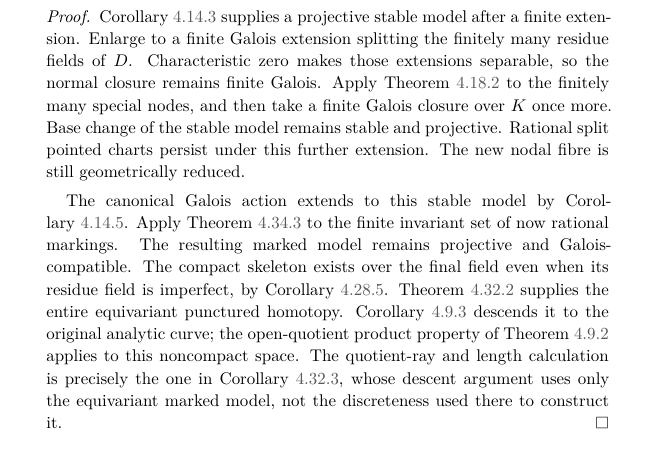
\begin{proof}
\bi{Corollary~\ref{cand:stablecompletevaluation} supplies
a projective stable model after a finite extension.
Enlarge to a finite Galois extension splitting the finitely
many residue fields of $D$. Characteristic zero makes those
extensions separable, so the normal closure remains finite
Galois. Apply Theorem~\ref{cand:simultaneousnodalsplitting}
to the finitely many special nodes, and then take a finite
Galois closure over $K$ once more.
Base change of the stable model remains stable and
projective. Rational split pointed charts persist under
this further extension. The new nodal fibre is still
geometrically reduced.}
{由 Corollary~\ref{cand:stablecompletevaluation},
有限扩域后存在射影稳定模型。
将扩域扩大为分裂 $D$ 的有限多个剩余域的有限
Galois 扩张。特征零保证这些扩张可分,
所以正规包仍为有限 Galois 扩张。
对有限个特殊结点应用
Theorem~\ref{cand:simultaneousnodalsplitting},
然后再次取在 $K$ 上的有限 Galois 正规包。
稳定模型基变换后仍稳定且射影,
有理分裂带点坐标片在进一步扩域后仍成立,
新的结点纤维仍几何约化。}

\bi{The canonical Galois action extends to this stable
model by Corollary~\ref{cand:stablegaloisaction}.
Apply Theorem~\ref{cand:equivariantmarkedrefinement} to
the finite invariant set of now rational markings.
The resulting marked model remains projective and
Galois-compatible. The compact skeleton exists over the
final field even when its residue field is imperfect,
by Corollary~\ref{cand:charzerosplitmodelskeleton}.
Theorem~\ref{cand:generalmarkedmodelskeleton} supplies
the entire equivariant punctured homotopy.
Corollary~\ref{cand:galoisretractiondescent} descends it
to the original analytic curve; the open-quotient product
property of Theorem~\ref{cand:galoisanalyticquotient}
applies to this noncompact space.
The quotient-ray and length calculation is precisely the
one in Corollary~\ref{cand:puncturedcurvedvrretraction},
whose descent argument uses only the equivariant marked
model, not the discreteness used there to construct it.}
{由 Corollary~\ref{cand:stablegaloisaction},
典范 Galois 作用延拓到此稳定模型。
对现已成为有理点的有限不变标记组应用
Theorem~\ref{cand:equivariantmarkedrefinement}。
所得标记模型仍射影且与 Galois 作用相容。
即使最终剩余域不完美,也可由
Corollary~\ref{cand:charzerosplitmodelskeleton}
构造紧骨架。
Theorem~\ref{cand:generalmarkedmodelskeleton}
给出整个等变穿孔同伦。
Corollary~\ref{cand:galoisretractiondescent}
将其下降到原解析曲线;
Theorem~\ref{cand:galoisanalyticquotient}
的开商映射乘积性质适用于此非紧空间。
商射线与长度的计算正是
Corollary~\ref{cand:puncturedcurvedvrretraction}
中的计算;其中下降论证仅使用等变标记模型,
并不使用该处构造模型所需的离散性。}
\end{proof}
Standing context 1 · exact TeX
\bi{Throughout this section $K$ is a complete nontrivially
valued field, $O=K^\circ$, and $k=\widetilde K$.
A split nodal model is a separated flat finitely presented $O$-scheme
with smooth generic fibre and reduced nodal special fibre,
whose nodes are $k$-rational and admit the actual rational
pointed charts of Theorem~\ref{cand:simultaneousnodalsplitting}.
Its formal generic fibre is assumed Hausdorff.
A marking is a finite set of distinct $K$-rational generic
points. In the proper case each extends uniquely to an
$O$-section by \cite[Tag 0BX5]{StacksAlg}.}
{本节中 $K$ 为完备非平凡赋值域,$O=K^\circ$、
$k=\widetilde K$。分裂结点模型指分离、平坦、有限表示
$O$-概形,其泛纤维光滑、特殊纤维约化且仅有结点,
并且结点均为 $k$-有理点,具有
Theorem~\ref{cand:simultaneousnodalsplitting}
中的实际有理带点坐标片。假设其形式泛纤维为 Hausdorff。
标记指有限个互异的 $K$-有理泛纤维点。在 proper 情形,
由 \cite[Tag 0BX5]{StacksAlg},每个标记唯一延拓为
$O$-截面。}
Typeset reader excerpt
Typed proof inputs
- NAG-002024 · selected whole (selected native whole)
- NAG-002025 · selected whole (selected native whole)
- NAG-002045 · selected whole (selected native whole)
- NAG-002047 · selected whole (selected native whole)
- NAG-002053 · selected whole (selected native whole)
- NAG-002098 · selected whole (selected native whole)
- NAG-002126 · selected whole (selected native whole)
- NAG-002146 · selected whole (earlier same-batch whole candidate)
- SUPPORT:NAG-002127:fixed_equivariant_model_metric_ray_quotient · typed target unresolved in this export (exact approved scoped replay)
Reader cross-references
Proof map
Verified map inputs · NAG-002147
AND · joint registered proof inputs
- NAG-002024 · The scalar-extension quotient · accepted whole Exact source window 419–437
- NAG-002025 · Descent of equivariant retractions · accepted whole Exact source window 419–437
- NAG-002045 · Stable models for the fixed absolute value · accepted whole Exact source window 395–417
- NAG-002047 · The semilinear action on a stable model · accepted whole Exact source window 419–437
- NAG-002053 · All lifts of a finite set of nodes · accepted whole Exact source window 395–417
- NAG-002098 · Global skeletons in characteristic zero · accepted whole Exact source window 419–437
- NAG-002126 · A split marked model gives a punctured skeleton · accepted whole Exact source window 419–437
- NAG-002146 · Equivariant finite marked refinement · accepted whole Exact source window 419–437
Unlinked source pointers
These pointers have no operative linked edge in this map.
SUPPORT:NAG-002127:fixed_equivariant_model_metric_ray_quotient
NAG-002147 · Marked curves of genus at least two · Chapter argument