NAG-002148 · Accepted whole
Gauss discs and fractional linear maps
Open in the English reader · PDF page 727
Statement · exact TeX
\begin{lemma}[\bi{Gauss discs and fractional linear maps}
{Gauss 圆盘与分式线性变换}]
\label{cand:gaussdiscmetriccalculus}
\bi{Let $F$ be a complete nontrivially valued field.
For $a\in F$ and $r>0$, let $\zeta_{a,r}$ be the Gauss
seminorm with centre $a$ and radius $r$. The set}
{设 $F$ 为完备非平凡赋值域。
对 $a\in F$、$r>0$,记 $\zeta_{a,r}$ 为中心为 $a$、
半径为 $r$ 的 Gauss 半范数。集合}
\[
             \mathcal B_F=\{\zeta_{a,r}:a\in F,\ r>0\}
\]
\bi{has the following tree metric: if $x=\zeta_{a,r}$,
$y=\zeta_{b,s}$, and $R=\max(r,s,|a-b|)$, then}
{具有以下树度量:若 $x=\zeta_{a,r}$、
$y=\zeta_{b,s}$,且 $R=\max(r,s,|a-b|)$,则}
\[
 d(x,y)=2\log R-\log r-\log s.
\]
\bi{Their interval is obtained by increasing the first
radius from $r$ to $R$ and the second from $s$ to $R$,
with the common endpoint
$\zeta_{a,R}=\zeta_{b,R}$ identified.
Every finite hull is a finite compact metric tree,
embedded with its metric topology in
$(\mathbf P^1_F)^{\an}$.
Fractional linear maps and semilinear maps induced by
isometric field automorphisms preserve $\mathcal B_F$,
its metric, and its intervals.
They carry points with radius in $|F^\times|$ to points
of that same kind.}
{其区间通过将第一半径从 $r$ 增到 $R$、
第二半径从 $s$ 增到 $R$ 得到,并将公共端点
$\zeta_{a,R}=\zeta_{b,R}$ 识别。
每个有限凸包都是有限紧度量树,
其度量拓扑与在 $(\mathbf P^1_F)^{\an}$ 中的子空间拓扑
相同。分式线性变换以及由等距域自同构诱导的半线性
变换,保持 $\mathcal B_F$、其度量和区间,
并将半径属于 $|F^\times|$ 的点映到同类点。}
\end{lemma}
Full selected proof · exact TeX
\begin{proof}
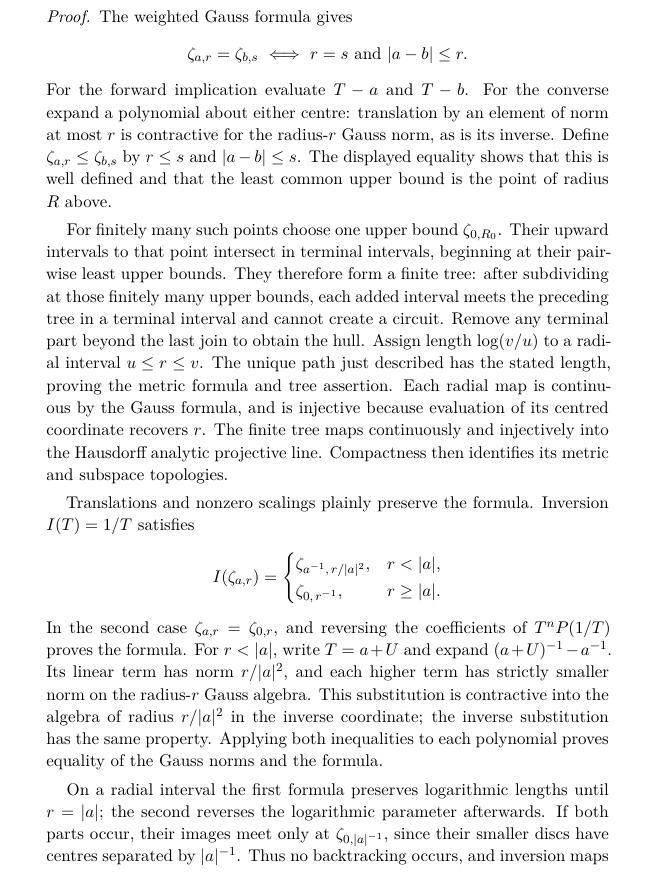
\bi{The weighted Gauss formula gives}
{加权 Gauss 公式给出}
\[
 \zeta_{a,r}=\zeta_{b,s}
       \ \Longleftrightarrow\
       r=s\ \hbox{and}\ |a-b|\leq r.
\]
\bi{For the forward implication evaluate $T-a$ and $T-b$.
For the converse expand a polynomial about either centre:
translation by an element of norm at most $r$ is
contractive for the radius-$r$ Gauss norm, as is its inverse.
Define $\zeta_{a,r}\leq\zeta_{b,s}$ by
$r\leq s$ and $|a-b|\leq s$. The displayed equality shows
that this is well defined and that the least common upper
bound is the point of radius $R$ above.}
{正向只需计算 $T-a$ 和 $T-b$。
反向则将多项式分别在两个中心展开:
按范数不超过 $r$ 的元素平移,对半径 $r$ 的
Gauss 范数是压缩映射,其逆也如此。
以 $r\leq s$ 且 $|a-b|\leq s$ 定义
$\zeta_{a,r}\leq\zeta_{b,s}$。
上述等式说明其定义良好,
而最小公共上界恰为半径 $R$ 的上述点。}

\bi{For finitely many such points choose one upper bound
$\zeta_{0,R_0}$. Their upward intervals to that point
intersect in terminal intervals, beginning at their pairwise
least upper bounds. They therefore form a finite tree:
after subdividing at those finitely many upper bounds,
each added interval meets the preceding tree in a terminal
interval and cannot create a circuit.
Remove any terminal part beyond the last join to obtain
the hull. Assign length $\log(v/u)$ to a radial interval
$u\leq r\leq v$. The unique path just described has the
stated length, proving the metric formula and tree assertion.
Each radial map is continuous by the Gauss formula, and
is injective because evaluation of its centred coordinate
recovers $r$. The finite tree maps continuously and
injectively into the Hausdorff analytic projective line.
Compactness then identifies its metric and subspace topologies.}
{对有限个这样的点,选择一个公共上界
$\zeta_{0,R_0}$。它们到该点的向上区间相交于末端区间,
交集从两两最小公共上界开始。因此它们构成有限树:
在有限个公共上界处细分后,
每添入一个区间,它与此前的树相交于一个末端区间,
不可能产生回路。删去最后一个连接点以上多余的末端
部分,即得到凸包。赋予径向区间 $u\leq r\leq v$
长度 $\log(v/u)$,上述唯一路径就具有所列长度,
证明度量公式和树性质。
由 Gauss 公式,每条径向映射连续;
对其中心坐标求值可恢复 $r$,故其单射。
所得有限树连续单射地映入 Hausdorff 解析射影直线,
由紧性知度量拓扑与子空间拓扑相同。}

\bi{Translations and nonzero scalings plainly preserve the
formula. Inversion $I(T)=1/T$ satisfies}
{平移与非零数乘显然保持该公式。
反演 $I(T)=1/T$ 满足}
\[
 I(\zeta_{a,r})=
 \begin{cases}
   \zeta_{a^{-1},\,r/|a|^2},&r<|a|,\\
   \zeta_{0,\,r^{-1}},&r\geq|a|.
 \end{cases}
\]
\bi{In the second case $\zeta_{a,r}=\zeta_{0,r}$, and
reversing the coefficients of $T^nP(1/T)$ proves the formula.
For $r<|a|$, write $T=a+U$ and expand
$(a+U)^{-1}-a^{-1}$.
Its linear term has norm $r/|a|^2$, and each higher term
has strictly smaller norm on the radius-$r$ Gauss algebra.
This substitution is contractive into the algebra of radius
$r/|a|^2$ in the inverse coordinate; the inverse substitution
has the same property. Applying both inequalities to each
polynomial proves equality of the Gauss norms and the formula.}
{在第二种情形,$\zeta_{a,r}=\zeta_{0,r}$,
将 $T^nP(1/T)$ 的系数倒序即可证明公式。
当 $r<|a|$ 时,写 $T=a+U$ 并展开
$(a+U)^{-1}-a^{-1}$。
其一次项在半径 $r$ 的 Gauss 代数上的范数为
$r/|a|^2$,每个高次项均严格更小。
此代换在逆坐标中半径为 $r/|a|^2$ 的代数与原代数之间
给出压缩映射,逆代换亦如此。
将两个不等式依次作用于每个多项式,
即得 Gauss 范数的相等及上述公式。}

\bi{On a radial interval the first formula preserves
logarithmic lengths until $r=|a|$; the second reverses the
logarithmic parameter afterwards.
If both parts occur, their images meet only at
$\zeta_{0,|a|^{-1}}$, since their smaller discs have centres
separated by $|a|^{-1}$. Thus no backtracking occurs, and
inversion maps every interval isometrically to the interval
between its endpoints. Every fractional linear map is a
composition of affine maps and inversion, so it preserves
the metric and the intervals. An isometric field
automorphism sends $\zeta_{a,r}$ to $\zeta_{\sigma(a),r}$,
which has the same properties.
The displayed formulas also preserve radii in the value group.}
{在径向区间上,第一个公式在 $r=|a|$ 之前保持对数
长度,第二个公式在其后反转对数参数。
若两部分同时出现,其像只在
$\zeta_{0,|a|^{-1}}$ 相交,
因为较小圆盘的两个中心间距为 $|a|^{-1}$。
故路径不会折返,反演将每个区间等距地映到
其端点之间的区间。每个分式线性变换均为仿射变换
与反演的复合,故保持度量和区间。
等距域自同构将 $\zeta_{a,r}$ 映到
$\zeta_{\sigma(a),r}$,也具有相同性质。
所列公式还保持半径属于值群这一条件。}
\end{proof}
Typeset reader excerpt
Typed proof inputs
- BASE-RINGS · standing context or base
- BASE-RINGS · standing context or base (requires)
- BASE-TOPOLOGY · standing context or base
- BASE-TOPOLOGY · standing context or base (requires)
- NAG-000182 · selected whole
- NAG-000182 · selected whole (requires)
- NAG-000232 · selected whole
- NAG-000232 · selected whole (requires)
Proof map
Verified map inputs · NAG-002148
AND · joint registered proof inputs
- NAG-000182 · Multiplicativity of the weighted Gauss norm · accepted whole
- NAG-000232 · Substitution · accepted whole
Standing context and base inputs
BASE-RINGSBASE-TOPOLOGY
NAG-002148 · Gauss discs and fractional linear maps · Chapter argument