NAG-002162 · Accepted whole
Finite control of bounded coefficients
5 Tropicalization, multiplicities and balancing
Open in the English reader · PDF page 890
Statement · exact TeX
\begin{lemma}[\bi{Finite control of bounded coefficients}
{有界系数的有限控制}]
\label{cand:noetherianboundedcoefficients}
\bi{Let $C$ be a nonzero affinoid algebra, and let
$R\subseteq C$ be a Noetherian subring all of whose elements
have norm at most one. For a family $c_\nu\in R$ indexed by
$\mathbb N^d$, put}
{设 $C$ 为非零 affinoid 代数,$R\subseteq C$ 为
Noetherian 子环,且其全部元素的范数至多为一。
对由 $\mathbb N^d$ 指标的族 $c_\nu\in R$,置}
\[
 q(x,t)=\max_\nu|c_\nu(x)|t^{|\nu|}\quad(0\leq t<1),
 \qquad q(x,1)=\sup_\nu|c_\nu(x)|.
\]
\bi{There is a finite set of indices $E$ for which}
{存在有限指标集 $E$,使}
\[
 q(x,1)=\max_{\nu\in E}|c_\nu(x)|
                      \qquad(x\in\mathcal M(C)).
\]
\bi{If the family is nonzero and $N=\max_{\nu\in E}|\nu|$,
then $t^Nq(x,1)\leq q(x,t)\leq q(x,1)$ for $0<t\leq1$.
Consequently $q$ is jointly continuous on
$\mathcal M(C)\times[0,1]$.}
{若该族非零,且 $N=\max_{\nu\in E}|\nu|$,则对
$0<t\leq1$ 有 $t^Nq(x,1)\leq q(x,t)\leq q(x,1)$。
因此 $q$ 在 $\mathcal M(C)\times[0,1]$ 上联合连续。}
\end{lemma}
Full selected proof · exact TeX
\begin{proof}
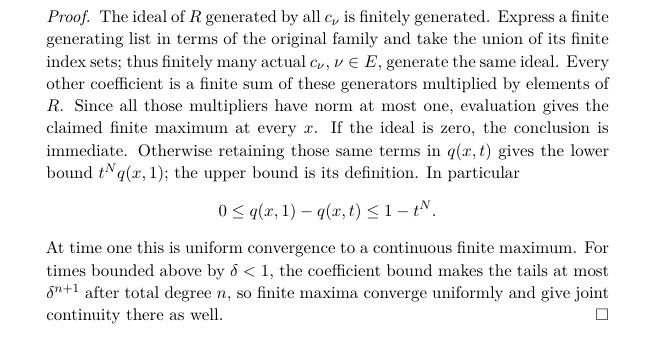
\bi{The ideal of $R$ generated by all $c_\nu$ is finitely
generated. Express a finite generating list in terms of the
original family and take the union of its finite index sets;
thus finitely many actual $c_\nu$, $\nu\in E$, generate
the same ideal. Every other coefficient is a finite sum of
these generators multiplied by elements of $R$. Since all
those multipliers have norm at most one, evaluation gives
the claimed finite maximum at every $x$. If the ideal is
zero, the conclusion is immediate. Otherwise retaining those
same terms in $q(x,t)$ gives the lower bound $t^Nq(x,1)$;
the upper bound is its definition. In particular}
{由全部 $c_\nu$ 生成的 $R$ 的理想有限生成。把一组
有限生成元用原族表示,并取出现的有限指标集之并,
可知有限个实际系数 $c_\nu$、$\nu\in E$ 即生成同一
理想。其他每个系数都是这些生成元乘以 $R$ 中元素
后的有限和。由于这些乘子的范数至多为一,在每个
$x$ 处取值即得所称有限最大值。若该理想为零,结论
立即成立。否则,在 $q(x,t)$ 中保留同样的项,便得
下界 $t^Nq(x,1)$,上界则来自定义。特别地,}
\[
 0\leq q(x,1)-q(x,t)\leq1-t^N.
\]
\bi{At time one this is uniform convergence to a continuous
finite maximum. For times bounded above by $\delta<1$,
the coefficient bound makes the tails at most
$\delta^{n+1}$ after total degree $n$, so finite maxima
converge uniformly and give joint continuity there as well.}
{在时刻一,这给出向连续有限最大值的一致收敛。
对于上界为 $\delta<1$ 的时刻,系数界使总次数 $n$
之后的尾项至多为 $\delta^{n+1}$,所以有限最大值
一致收敛,也给出这些时刻的联合连续性。}
\end{proof}
Typeset reader excerpt
Typed proof inputs
- BASE-RINGS · standing context or base
- BASE-RINGS · standing context or base (requires)
- BASE-TOPOLOGY · standing context or base
- BASE-TOPOLOGY · standing context or base (requires)
- NAG-000655 · selected whole
- NAG-000655 · selected whole (requires)
Proof map
Verified map inputs · NAG-002162
Registered proof input
- NAG-000655 · Result 1.6.1 · accepted whole
Standing context and base inputs
BASE-RINGSBASE-TOPOLOGY
NAG-002162 · Finite control of bounded coefficients · Chapter argument