NAG-002170 · Accepted whole
The Deuring model in residue characteristic two
Open in the English reader · PDF page 735
Statement · exact TeX
\begin{proposition}[\bi{The Deuring model in residue characteristic two}
{剩余特征二时的 Deuring 模型}]
\label{cand:deuringsemistablevaluation}
\bi{Let $F$ be complete of characteristic zero with
nontrivial absolute value and residue characteristic two.
Every pointed smooth projective genus-one curve over $F$
has, after a finite extension, a projective model of the form}
{设 $F$ 完备、特征零、绝对值非平凡,
且剩余特征为二。
每条带点光滑射影亏格一曲线在有限扩域后,
都具有以下形式的射影模型:}
\[
                 y^2+a xy+y=x^3,\qquad a\in O.
\]
\bi{Its special fibre is smooth if $|j|\leq1$ and has
exactly one ordinary double point if $|j|>1$.
Here $j$ is the parameter of
Lemma~\ref{cand:shortweierstrassreconstruction},
and $O$ is the valuation ring after extension.}
{若 $|j|\leq1$,其特殊纤维光滑;
若 $|j|>1$,则特殊纤维恰有一个普通二重点。
这里 $j$ 为
Lemma~\ref{cand:shortweierstrassreconstruction}
的参数,而 $O$ 为扩域后的赋值环。}
\end{proposition}
Full selected proof · exact TeX
\begin{proof}
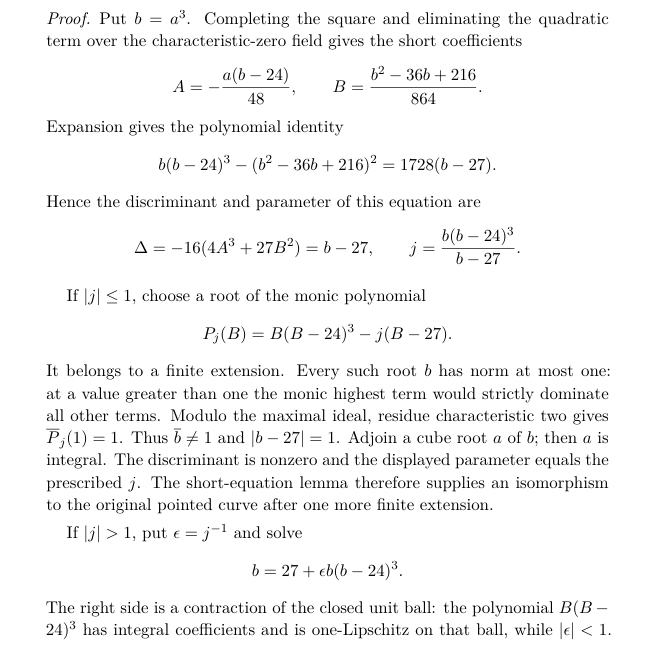
\bi{Put $b=a^3$.
Completing the square and eliminating the quadratic term
over the characteristic-zero field gives the short coefficients}
{令 $b=a^3$。在特征零域上配方并消去二次项,
得到短方程系数}
\[
 A=-\frac{a(b-24)}{48},\qquad
 B=\frac{b^2-36b+216}{864}.
\]
\bi{Expansion gives the polynomial identity}
{展开可得多项式恒等式}
\[
 b(b-24)^3-(b^2-36b+216)^2=1728(b-27).
\]
\bi{Hence the discriminant and parameter of this equation are}
{所以此方程的判别式和参数为}
\[
 \Delta=-16(4A^3+27B^2)=b-27,\qquad
 j=\frac{b(b-24)^3}{b-27}.
\]

\bi{If $|j|\leq1$, choose a root of the monic polynomial}
{若 $|j|\leq1$,选取以下首一多项式的一个根:}
\[
                   P_j(B)=B(B-24)^3-j(B-27).
\]
\bi{It belongs to a finite extension.
Every such root $b$ has norm at most one: at a value
greater than one the monic highest term would strictly
dominate all other terms.
Modulo the maximal ideal, residue characteristic two gives
$\overline P_j(1)=1$.
Thus $\overline b\ne1$ and $|b-27|=1$.
Adjoin a cube root $a$ of $b$; then $a$ is integral.
The discriminant is nonzero and the displayed parameter
equals the prescribed $j$. The short-equation lemma
therefore supplies an isomorphism to the original pointed
curve after one more finite extension.}
{该根属于某个有限扩域。
每个这样的根 $b$ 的范数至多一:
若其范数大于一,首一最高项将严格支配全部其他项。
模极大理想后,由剩余特征二得
$\overline P_j(1)=1$。
故 $\overline b\ne1$、$|b-27|=1$。
添入 $b$ 的立方根 $a$,则 $a$ 整。
判别式非零,所列参数等于给定的 $j$。
因此短方程引理在进一步有限扩域后,
给出它与原带点曲线的同构。}

\bi{If $|j|>1$, put $\epsilon=j^{-1}$ and solve}
{若 $|j|>1$,令 $\epsilon=j^{-1}$,求解}
\[
                 b=27+\epsilon b(b-24)^3.
\]
\bi{The right side is a contraction of the closed unit
ball: the polynomial $B(B-24)^3$ has integral
coefficients and is one-Lipschitz on that ball, while
$|\epsilon|<1$.
Iteration starting at $27$ converges in $F$ to a solution.
It has $\overline b=1$, so both $b$ and $b-24$ are units.
The equation then gives}
{右侧是闭单位球上的压缩映射:
多项式 $B(B-24)^3$ 系数整,
在该球上为一-Lipschitz,
而 $|\epsilon|<1$。
从 $27$ 出发迭代,便在 $F$ 中收敛到一个解。
它满足 $\overline b=1$,
故 $b$ 与 $b-24$ 都为单位元。
方程从而给出}
\[
              0<|b-27|=|\epsilon|<1 .
\]
\bi{Adjoin a cube root $a$ and then the finite
short-equation isomorphism as above.
In either case further extension preserves all the
strict and unit norm conditions.}
{如上添入立方根 $a$,
再作短方程同构所需的有限扩域。
两种情形中的严格范数条件和单位范数条件
都在进一步扩域后保持。}

\bi{We verify the special fibre directly.
At infinity it is smooth by
Lemma~\ref{cand:integralplanecubicfamily}.
On the affine chart in characteristic two, let
$\alpha=\overline a$. The partial derivatives are}
{直接验证特殊纤维。
由 Lemma~\ref{cand:integralplanecubicfamily},
它在无穷远点光滑。
在特征二的仿射片中,令 $\alpha=\overline a$,
偏导数为}
\[
       F_x=\alpha y+x^2,\qquad F_y=\alpha x+1.
\]
\bi{If $\alpha=0$, there is no singular point.
If $\alpha\ne0$, the only candidate is
$x_0=\alpha^{-1}$, $y_0=\alpha^{-3}$.
Substitution into the equation shows that it is singular
exactly when $\alpha^3=1$.
Thus the integral-$j$ case is geometrically smooth.
In the other case use $u=x-x_0$, $v=y-y_0$.
The derivative ideal is}
{若 $\alpha=0$,不存在奇点。
若 $\alpha\ne0$,
唯一可能的奇点为
$x_0=\alpha^{-1}$、$y_0=\alpha^{-3}$。
代入方程表明,
它恰在 $\alpha^3=1$ 时为奇点。
因此整 $j$ 情形几何光滑。
在另一情形中令 $u=x-x_0$、$v=y-y_0$,
导数理想为}
\[
          (\alpha v+u^2,\alpha u)=(u,v).
\]
\bi{The local hypersurface has depth one since $u$ is a
nonzerodivisor: its equation modulo $u$ is $v^2$,
so the equation is not divisible by $u$.
Its residue point is rational and its first differential
Fitting ideal is the displayed maximal ideal.
By \cite[Tag 0C4D(5)]{StacksAlg} it is a node.
Equivalently, its quadratic part}
{局部超曲面的深度为一,因为 $u$ 是非零因子:
方程模 $u$ 后为 $v^2$,所以方程不被 $u$ 整除。
其剩余点有理,
微分模的第一个 Fitting 理想为上述极大理想。
由 \cite[Tag 0C4D(5)]{StacksAlg},它为结点。
等价地,其二次部分为}
\[
                 v^2+\alpha uv+\alpha^{-1}u^2,
\]
\bi{which has two distinct factors after a finite separable
residue extension because $\alpha\ne0$.
These calculations exhaust all geometric singular points.
Thus the special fibre is geometrically reduced and
at worst nodal.
The integral-family lemma finishes the model construction.}
{因为 $\alpha\ne0$,它在某个有限可分剩余域扩张后
具有两个不同因子。
上述计算穷尽全部几何奇点,
所以特殊纤维几何约化且至多具有结点。
由整三次曲线族引理完成模型构造。}
\end{proof}
Typeset reader excerpt
Typed proof inputs
- APP-STACKS-00T7@NAG-002170:residual-smooth-opens · named external application
- APP-STACKS-00T7@NAG-002170:residual-smooth-opens · named external application (requires)
- APP-STACKS-0C4D@NAG-002170:deuring-node · named external application
- APP-STACKS-0C4D@NAG-002170:deuring-node · named external application (requires)
- BASE-RINGS · standing context or base
- BASE-RINGS · standing context or base (requires)
- BASE-TOPOLOGY · standing context or base
- BASE-TOPOLOGY · standing context or base (requires)
- NAG-001450 · selected whole
- NAG-001450 · selected whole (requires)
- NAG-002167 · selected whole
- NAG-002167 · selected whole (requires)
- NAG-002168 · selected whole
- NAG-002168 · selected whole (requires)
Reader cross-references
Proof map
Verified map inputs · NAG-002170
AND · joint registered proof inputs
- NAG-001450 · Finite-dimensional norms and finite field extensions · accepted whole
- NAG-002167 · Short Weierstrass equations and their parameter · accepted whole
- NAG-002168 · The integral plane-cubic family · accepted whole
Standing context and base inputs
BASE-RINGSBASE-TOPOLOGY
Unlinked source pointers
These pointers have no operative linked edge in this map.
APP-STACKS-00T7@NAG-002170:residual-smooth-opensAPP-STACKS-0C4D@NAG-002170:deuring-node
NAG-002170 · The Deuring model in residue characteristic two · Chapter argument