NAG-002203 · Accepted whole
Faithful tropicalization of a compact model skeleton
5 Tropicalization, multiplicities and balancing
Open in the English reader · PDF page 916
Statement · exact TeX
\begin{theorem}[\bi{Faithful tropicalization of a compact model skeleton}
{紧模型骨架的忠实热带化}]
\label{cand:faithfulcompactmodelskeleton}
\bi{There is a nonempty Zariski open $U\subset X$ containing
$\Sigma$ in $U^{\mathrm{an}}$ and a closed immersion
$\varphi:U\hookrightarrow\mathbf G_m^n$ such that
$\varphi_{\mathrm{trop}}|_\Sigma$ is a homeomorphism onto its
image. After a finite subdivision of $\Sigma$, its restriction
to each edge is integral affine with primitive derivative vector.
Thus each edge has its original logarithmic length measured in
the primitive lattice length of its tropical image.}
{存在非空 Zariski 开集 $U\subset X$,使
$\Sigma\subset U^{\mathrm{an}}$,以及闭浸入
$\varphi:U\hookrightarrow\mathbf G_m^n$,使
$\varphi_{\mathrm{trop}}|_\Sigma$ 是到其像的同胚。将
$\Sigma$ 作有限细分后,它在每条边上的限制整仿射,且导数
向量本原。因此,当以热带像的本原格长度计量时,每条边
保持原来的对数长度。}
\end{theorem}
Full selected proof · exact TeX
\begin{proof}
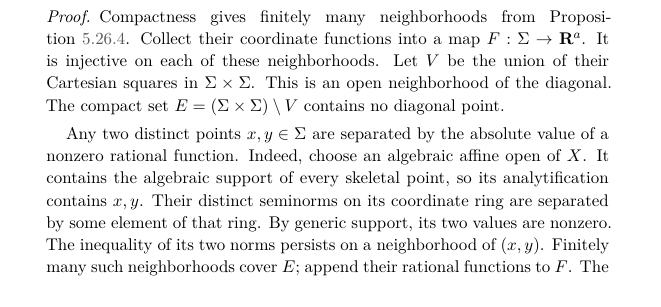
\bi{Compactness gives finitely many neighborhoods from
Proposition~\ref{cand:rationalstarcoordinates}. Collect their
coordinate functions into a map $F:\Sigma\to\mathbf R^a$.
It is injective on each of these neighborhoods. Let $V$ be the
union of their Cartesian squares in $\Sigma\times\Sigma$.
This is an open neighborhood of the diagonal. The compact set
$E=(\Sigma\times\Sigma)\setminus V$ contains no diagonal
point.}
{由紧性,从 Proposition~\ref{cand:rationalstarcoordinates}
选取有限个邻域。将其坐标函数汇集成映射
$F:\Sigma\to\mathbf R^a$;它在每个所选邻域上单射。
以 $V$ 表示这些邻域在 $\Sigma\times\Sigma$ 中的
Cartesian 平方之并,则 $V$ 是对角线的开邻域。紧集
$E=(\Sigma\times\Sigma)\setminus V$ 不含对角线上的点。}

\bi{Any two distinct points $x,y\in\Sigma$ are separated by
the absolute value of a nonzero rational function. Indeed,
choose an algebraic affine open of $X$. It contains the algebraic
support of every skeletal point, so its analytification contains
$x,y$. Their distinct seminorms on its coordinate ring are
separated by some element of that ring. By generic support,
its two values are nonzero. The inequality of its two norms
persists on a neighborhood of $(x,y)$. Finitely many such
neighborhoods cover $E$; append their rational functions to
$F$. The resulting map $G$ is injective on all of $\Sigma$.
It is a homeomorphism onto its image because its source is
compact and its target is Hausdorff.}
{任意两个不同的 $x,y\in\Sigma$ 都可由某个非零有理函数
的绝对值区分。事实上,选择 $X$ 的一个代数仿射开集;它
包含每个骨架点的代数支撑,所以其解析化包含 $x,y$。
坐标环上的两个不同半范数由该环中的某个元素区分;由于
支撑为泛点,该元素的两个取值均非零。两范数不等的条件
在 $(x,y)$ 的某个邻域上仍成立。有限个这样的邻域覆盖
$E$;将相应有理函数添入 $F$。所得 $G$ 在整个 $\Sigma$
上单射。源紧且靶 Hausdorff,故它是到其像的同胚。}

\bi{Proposition~\ref{cand:rationalskeletalpiecewise} gives a
finite common subdivision on which all coordinates of $G$
are integral affine. On the interior of each resulting edge,
one of the original local coordinates has slope $1$ or $-1$.
Its derivative vector is therefore primitive. Refining further
retains this property.}
{由 Proposition~\ref{cand:rationalskeletalpiecewise},存在
有限共同细分,使 $G$ 的全部坐标在各边上整仿射。在每条
所得边的内部,某个原局部坐标的斜率为 $1$ 或 $-1$,故
其导数向量本原。进一步细分仍保持该性质。}

\bi{It remains to realize these coordinates in a closed torus
immersion. Choose a nonempty affine open $U_0=\operatorname{Spec}A$
of $X$. Write the finitely many rational functions of $G$ as
fractions of nonzero elements of $A$, and invert all their
numerators and denominators. This gives a finite-type algebra
$B$ and an affine open on which these functions are units.
Choose finitely many nonzero algebra generators of $B$, and
invert them as well, obtaining $B'$. The chosen generators
and their inverses generate $B'$, so they give a surjection
from a Laurent polynomial algebra onto $B'$. Append the
functions defining $G$ to this generating list. The resulting
map $U=\operatorname{Spec}B'\to\mathbf G_m^n$ is a closed
immersion. Every inverted element is nonzero in $K(X)$,
so its zero locus contains no skeletal point; hence
$\Sigma\subset U^{\mathrm{an}}$. Adding coordinates retains
injectivity and a derivative coordinate equal to $1$ or $-1$.
Apply Proposition~\ref{cand:rationalskeletalpiecewise} once more
to the appended functions and take a finite common refinement.
All coordinates of the closed immersion are then affine on every
subdivided edge, while the primitive derivative coordinate is retained.
The primitive derivative formula identifies the two edge
lengths, as asserted.}
{最后将这些坐标纳入环面闭浸入。选择非空仿射开集
$U_0=\operatorname{Spec}A\subset X$。将 $G$ 的有限个有理
函数写为 $A$ 中非零元素的分式,并将其全部分子、分母
取逆。所得有限型代数 $B$ 对应一个仿射开集,在其上这些
函数均为单位。选择 $B$ 的有限个非零代数生成元,并将
它们也取逆,得 $B'$。所选生成元及其逆生成 $B'$,故给出
从一个 Laurent 多项式代数到 $B'$ 的满射。再把定义 $G$
的函数加入生成元列表,所得
$U=\operatorname{Spec}B'\to\mathbf G_m^n$ 为闭浸入。
每个被取逆的元素在 $K(X)$ 中非零,其零集不含骨架点,
故 $\Sigma\subset U^{\mathrm{an}}$。添加坐标保持单射性,
并保留一个等于 $1$ 或 $-1$ 的导数坐标。
再对新增函数应用 Proposition~\ref{cand:rationalskeletalpiecewise},
并取有限共同细分。此时闭浸入的全部坐标在每条细分边上仿射,
且保留本原的导数坐标。本原导数公式便
识别了两种边长。}
\end{proof}
Typeset reader excerpt
Typed proof inputs
- NAG-000136 · selected whole (native proof input)
- NAG-001707 · selected whole (native proof input)
- NAG-002199 · selected whole (native proof input)
- NAG-002201 · selected whole (native proof input)
- NAG-002202 · selected whole (native proof input)
- NAG-000136 · selected whole
- NAG-000136 · selected whole (requires)
- NAG-001707 · selected whole
- NAG-001707 · selected whole (requires)
- NAG-002199 · selected whole
- NAG-002199 · selected whole (requires)
- NAG-002201 · selected whole
- NAG-002201 · selected whole (requires)
- NAG-002202 · selected whole
- NAG-002202 · selected whole (requires)
Reader cross-references
Proof map
Verified map inputs · NAG-002203
AND · joint registered proof inputs
- NAG-000136 · Result 2.10.1 · accepted whole
- NAG-001707 · Affine analytification and its mapping property · accepted whole
- NAG-002199 · Rational approximation of a nonzero germ · accepted whole
- NAG-002201 · Rational functions are piecewise integral affine · accepted whole
- NAG-002202 · Local rational coordinates of lattice slope one · accepted whole
NAG-002203 · Faithful tropicalization of a compact model skeleton · Chapter argument