NAG-002228 · Accepted whole
Uniqueness from vertices and actual tubes
Open in the English reader · PDF page 751
Statement · exact TeX
\begin{proposition}[Uniqueness from vertices and actual tubes]
\label{v035:f5:vertexuniqueness}
Let $X$ be Hausdorff, and let $\mathfrak X_1,\mathfrak X_2$ be
admissible formal models of $X$. Suppose their special fibres are
reduced pure curves of finite type over $k$. Suppose also that each
closed special point has a connected open tube, and that the boundary
of this tube consists exactly of the component vertices of the
components through that point. If the two models have the same set
$V\subset X$ of component vertices, there is a unique formal
isomorphism between them inducing the identity on $X$.
\end{proposition}
Full selected proof · exact TeX
\begin{proof}
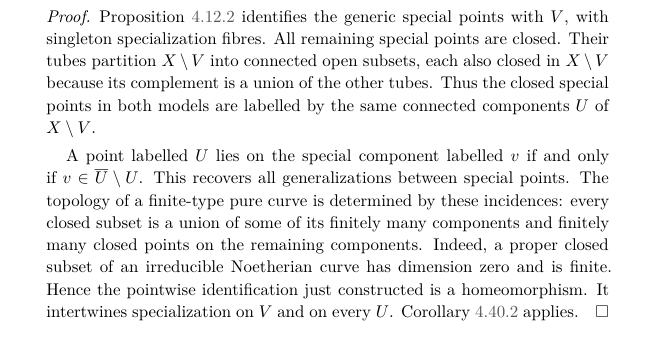
Proposition~\ref{cand:reducedmodelcomponentpoints} identifies the
generic special points with $V$, with singleton specialization fibres.
All remaining special points are closed. Their tubes partition
$X\setminus V$ into connected open subsets, each also closed in
$X\setminus V$ because its complement is a union of the other tubes.
Thus the closed special points in both models are labelled by the
same connected components $U$ of $X\setminus V$.

A point labelled $U$ lies on the special component labelled $v$ if
and only if $v\in\overline U\setminus U$. This recovers all
generalizations between special points. The topology of a finite-type
pure curve is determined by these incidences: every closed subset is
a union of some of its finitely many components and finitely many
closed points on the remaining components. Indeed, a proper closed
subset of an irreducible Noetherian curve has dimension zero and is
finite. Hence the pointwise identification just constructed is a
homeomorphism. It intertwines specialization on $V$ and on every $U$.
Corollary~\ref{v035:f5:specializationdeterminesmodel} applies.
\end{proof}
Standing context 1 · exact TeX
Let $K$ be a complete nontrivially real-valued non-Archimedean field,
with its specified absolute value. Write $O=K^\circ$,
$\mathfrak m=K^{\circ\circ}$, and $k=O/\mathfrak m$, and choose
$\pi\in O$ with $0<|\pi|<1$. All formal schemes below are
$\pi$-adic. An admissible formal algebra is understood to be
$\pi$-torsion-free and topologically finitely presented over $O$.
For a formal open $\mathfrak U\subset\mathfrak X$, put
$D_{\mathfrak U}=\operatorname{sp}^{-1}(\mathfrak U)$, with its
analytic $G$-domain structure.
Typeset reader excerpt
Typed proof inputs
- CLAUSE:NAG-001944:formal_topology · selected scope, text unavailable (sealed native clause under supplied hypotheses)
- NAG-001939 · selected whole (sealed native whole)
- NAG-002036 · selected whole (earlier unchanged original whole proposal)
- NAG-002227 · selected whole (earlier unchanged original whole proposal)
- CLAUSE:NAG-001944:formal_topology · selected scope, text unavailable
- CLAUSE:NAG-001944:formal_topology · selected scope, text unavailable (requires)
- NAG-001939 · selected whole
- NAG-001939 · selected whole (requires)
- NAG-002036 · selected whole
- NAG-002036 · selected whole (requires)
- NAG-002227 · selected whole
- NAG-002227 · selected whole (requires)
Reader cross-references
Proof map
Verified map inputs · NAG-002228
AND · joint registered proof inputs
- NAG-001939 · Surjectivity of formal specialization · accepted whole Exact source window 91–95
- NAG-002036 · The analytic point of a residual component · accepted whole Exact source window 89–93
- NAG-002227 · A model determined by its specialization map · accepted whole Exact source window 105–106
Unlinked source pointers
These pointers have no operative linked edge in this map.
CLAUSE:NAG-001944:formal_topology
NAG-002228 · Uniqueness from vertices and actual tubes · Chapter argument