NAG-002237 · Accepted whole
Exact realization by a split nodal model
Open in the English reader · PDF page 759
Statement · exact TeX
\begin{theorem}[Exact realization by a split nodal model]
\label{v035:f5:exactrealization}
Let $K$ be algebraically closed, complete and nontrivially valued,
with its original absolute value. Let $C/K$ be a smooth connected
projective curve and let $V$ be a semistable vertex set of $C^{\an}$.
There is a split nodal algebraic model $\mathcal C_V/O$ whose
component vertices are exactly the original points of $V$.
More precisely, from every split nodal algebraic model
$\mathcal C_0$ with vertex set containing $V$, there is a proper
morphism $\mathcal C_0\to\mathcal C_V$ inducing the identity on $C$.
\end{theorem}
Full selected proof · exact TeX
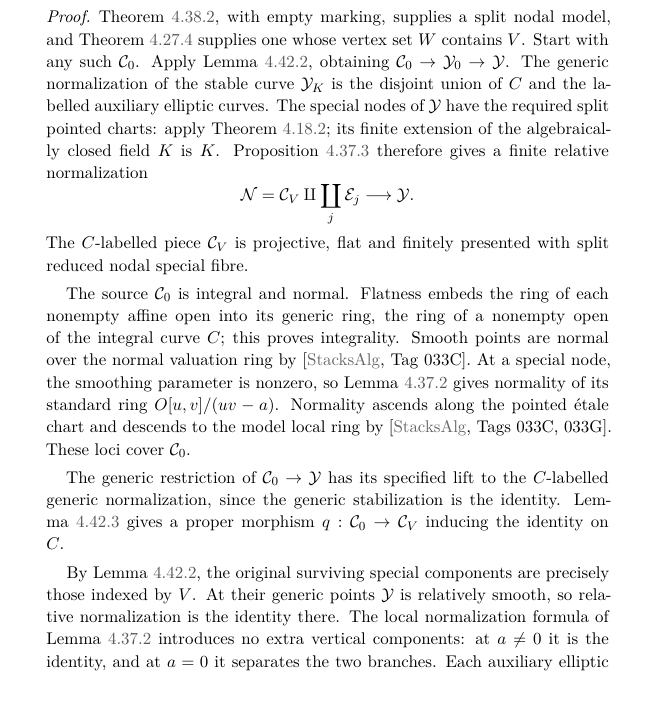
\begin{proof}
Theorem~\ref{cand:algebraicallyclosedmarkedmodels}, with empty
marking, supplies a split nodal model, and
Theorem~\ref{cand:finitetypeiirealization} supplies one whose
vertex set $W$ contains $V$. Start with any such $\mathcal C_0$.
Apply Lemma~\ref{v035:f5:elliptictails}, obtaining
$\mathcal C_0\to\mathcal Y_0\to\mathcal Y$.
The generic normalization of the stable curve $\mathcal Y_K$ is
the disjoint union of $C$ and the labelled auxiliary elliptic curves.
The special nodes of $\mathcal Y$ have the required split pointed
charts: apply Theorem~\ref{cand:simultaneousnodalsplitting}; its
finite extension of the algebraically closed field $K$ is $K$.
Proposition~\ref{cand:nodalmodelgenericnormalization} therefore
gives a finite relative normalization
\[
             \mathcal N=\mathcal C_V\amalg\coprod_j\mathcal E_j
                         \longrightarrow\mathcal Y.
\]
The $C$-labelled piece $\mathcal C_V$ is projective, flat and
finitely presented with split reduced nodal special fibre.

The source $\mathcal C_0$ is integral and normal. Flatness embeds
the ring of each nonempty affine open into its generic ring, the
ring of a nonempty open of the integral curve $C$; this proves
integrality. Smooth points are normal over the normal valuation
ring by \cite[Tag 033C]{StacksAlg}. At a special node, the smoothing
parameter is nonzero, so Lemma~\ref{cand:valuationnodenormalization}
gives normality of its standard ring $O[u,v]/(uv-a)$.
Normality ascends along the pointed \textup{\'etale} chart and
descends to the model local ring by
\cite[Tags 033C, 033G]{StacksAlg}. These loci cover $\mathcal C_0$.

The generic restriction of $\mathcal C_0\to\mathcal Y$ has its
specified lift to the $C$-labelled generic normalization, since the
generic stabilization is the identity. Lemma~\ref{v035:f5:normalizationlift}
gives a proper morphism $q:\mathcal C_0\to\mathcal C_V$ inducing
the identity on $C$.

By Lemma~\ref{v035:f5:elliptictails}, the original surviving special
components are precisely those indexed by $V$. At their generic
points $\mathcal Y$ is relatively smooth, so relative normalization
is the identity there. The local normalization formula of
Lemma~\ref{cand:valuationnodenormalization} introduces no extra
vertical components: at $a\ne0$ it is the identity, and at $a=0$
it separates the two branches. Each auxiliary elliptic model is
normal by smoothness over the normal base and is integral by flatness
and its integral generic fibre. The same normalization-lift lemma
puts its surviving special
component in its own generic-labelled piece $\mathcal E_j$.
Thus these auxiliary components belong to none of the other pieces,
and $\mathcal C_{V,s}$ has exactly the surviving original components.

For $v\in V$, let $\eta_v$ be its original component generic point.
The point $q_s(\eta_v)$ is the generic point of its surviving
component in $\mathcal C_{V,s}$. Functoriality of specialization
for the completed morphism gives
\[
       \operatorname{sp}_{\mathcal C_V}(v)=q_s(\eta_v).
\]
The singleton-fibre theorem
\ref{cand:reducedmodelcomponentpoints} identifies the new component
vertex with the original point $v$. Thus the vertex set is exactly
$V$ as a subset of $C^{\an}$.
\end{proof}
Standing context 1 · exact TeX
For the rest of this section and the next, assume that $K$ is
algebraically closed. Let $C/K$ be a smooth connected projective curve
and put $X=C^{\an}$. A split nodal algebraic model means a projective,
flat, finitely presented $O$-model of $C$ with reduced nodal special
fibre and the split pointed algebraic charts of
Theorem~\ref{cand:pointednodalvaluationchart}. The smoothing parameters
at its nodes are nonzero. Theorems~\ref{cand:projectiveformalcompletion}
and~\ref{cand:splitmodelskeleton} identify its completed generic fibre
with $X$ and supply its embedded finite graph and retraction.
The space $X$ is compact Hausdorff by
Proposition~\ref{fnd:analytificationprojectivecompact}.
Typeset reader excerpt
Typed proof inputs
- NAG-002036 · selected whole (exact native application)
- NAG-002037 · selected whole (exact native application)
- NAG-002038 · selected whole (exact native application)
- NAG-002053 · selected whole (exact native application)
- NAG-002102 · selected whole (exact native application)
- NAG-002205 · selected whole (exact native application)
- NAG-002206 · selected whole (exact native application)
- NAG-002210 · selected whole (exact native application)
- NAG-002235 · selected whole (exact native application)
- NAG-002236 · selected whole (exact native application)
- SUPPORT:NAG-001944:given_atlas_open_preimages_and_contraction · typed target unresolved in this export (exact native application)
Reader cross-references
- cand:algebraicallyclosedmarkedmodels
- cand:finitetypeiirealization
- cand:nodalmodelgenericnormalization
- cand:pointednodalvaluationchart
- cand:projectiveformalcompletion
- cand:reducedmodelcomponentpoints
- cand:simultaneousnodalsplitting
- cand:splitmodelskeleton
- cand:valuationnodenormalization
- fnd:analytificationprojectivecompact
- v035:f5:elliptictails
- v035:f5:normalizationlift
Proof map
Verified map inputs · NAG-002237
AND · joint registered proof inputs
- NAG-002036 · The analytic point of a residual component · accepted whole Exact source window 576–579
- Singleton fibre of the corresponding component's generic special point, keeping the original analytic point.
- NAG-002037 · Affine algebraic models · accepted whole Exact source window 555–579
- Complete the actual flat finitely presented affines of the contraction in the specialization comparison.
- NAG-002038 · Completion of a projective model · accepted whole Exact source window 569–575
- Actual projective completions and their fixed identifications over the same generic C.
- NAG-002053 · All lifts of a finite set of nodes · accepted whole Exact source window 526–528
- Actual split pointed node charts over algebraically closed K, for the stable family whose generic curve may be nodal.
- NAG-002102 · Realization of finitely many type II points · accepted whole Exact source window 520–521
- Insert every member of the prescribed nonempty semistable vertex set, staying over K.
- NAG-002205 · Normalizing a nodal chart over a valuation ring · accepted whole Exact source windows 538–547, 558–561
- Nonzero smoothing parameter on the actual strictly split source chart with smooth generic fibre; its standard algebra is normal.
- Two exact normalization cases a=0 and a≠0; no extra vertical component.
- NAG-002206 · Separating the generic components of a nodal model · accepted whole Exact source window 529–536
- Finite relative normalization in the prescribed generic normalization, including separate projective flat labelled pieces.
- NAG-002210 · Split marked models and skeleta in every genus · accepted whole Exact source window 518–519
- Empty-marking split projective model over the actual algebraically closed K.
- NAG-002235 · Protection by elliptic tails · accepted whole Exact source windows 522–525, 555–558
- Stabilize the actual split source with three elliptic tails per retained vertex; keep the original and auxiliary generic normalization labels.
- Exactly the original protected components survive at smooth generic points.
- NAG-002236 · Lifting to a generic normalization · accepted whole Exact source windows 549–553, 562–567
- Normal integral flat source with the fixed generic lift into the C-labelled piece, finite relative normalization and proper source.
- Normal smooth actual elliptic sources lift into their own generic-labelled pieces.
Unlinked source pointers
These pointers have no operative linked edge in this map.
SUPPORT:NAG-001944:given_atlas_open_preimages_and_contraction
NAG-002237 · Exact realization by a split nodal model · Chapter argument