NAG-002249 · Accepted whole
Finite piecewise-affine values
5 Tropicalization, multiplicities and balancing
Open in the English reader · PDF page 929
Statement · exact TeX
\begin{proposition}[Finite piecewise-affine values]
\label{v035:faithfulanalyticpl}
Let $g\in B$ be nonzero at every point of $\Sigma$.
Then $v(g)|_\Sigma$ is finite piecewise
$\Gamma$-integral-affine. One finite hyperplane subdivision of
the standard simplex induces a suitable subdivision on every
skeletal cell.
\end{proposition}
Full selected proof · exact TeX
\begin{proof}
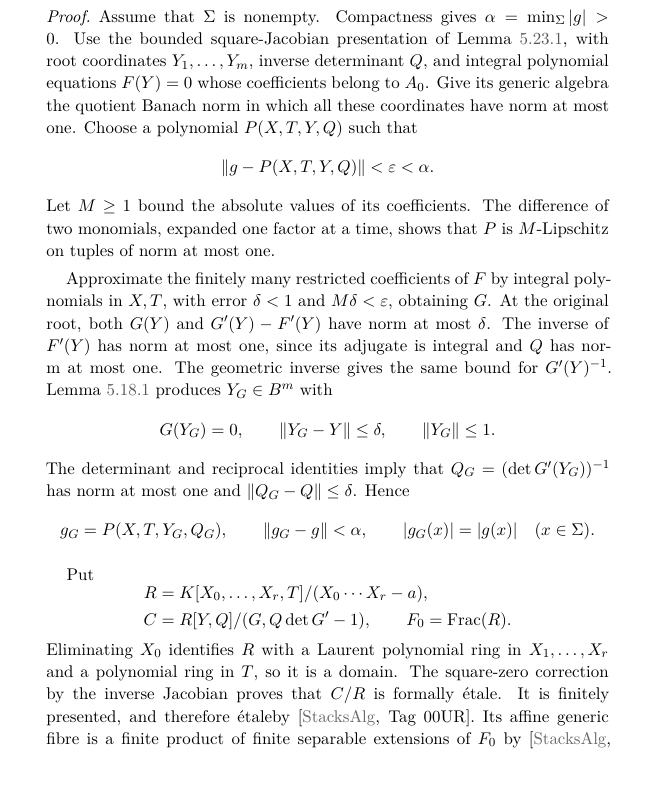
Assume that $\Sigma$ is nonempty. Compactness gives
$\alpha=\min_\Sigma|g|>0$. Use the bounded square-Jacobian
presentation of Lemma~\ref{cand:formaletaleboundedpresentation},
with root coordinates $Y_1,\ldots,Y_m$, inverse determinant $Q$,
and integral polynomial equations $F(Y)=0$ whose coefficients
belong to $A_0$. Give its generic algebra the quotient Banach
norm in which all these coordinates have norm at most one.
Choose a polynomial $P(X,T,Y,Q)$ such that
\[
 \|g-P(X,T,Y,Q)\|<\varepsilon<\alpha.
\]
Let $M\geq1$ bound the absolute values of its coefficients.
The difference of two monomials, expanded one factor at a time,
shows that $P$ is $M$-Lipschitz on tuples of norm at most one.

Approximate the finitely many restricted coefficients of $F$
by integral polynomials in $X,T$, with error
$\delta<1$ and $M\delta<\varepsilon$, obtaining $G$.
At the original root, both $G(Y)$ and $G'(Y)-F'(Y)$ have norm
at most $\delta$. The inverse of $F'(Y)$ has norm at most one,
since its adjugate is integral and $Q$ has norm at most one.
The geometric inverse gives the same bound for $G'(Y)^{-1}$.
Lemma~\ref{cand:banachcenterhensel} produces $Y_G\in B^m$ with
\[
 G(Y_G)=0,\qquad \|Y_G-Y\|\leq\delta,\qquad \|Y_G\|\leq1.
\]
The determinant and reciprocal identities imply that
$Q_G=(\det G'(Y_G))^{-1}$ has norm at most one and
$\|Q_G-Q\|\leq\delta$. Hence
\[
 g_G=P(X,T,Y_G,Q_G),\qquad \|g_G-g\|<\alpha,
 \qquad |g_G(x)|=|g(x)|\quad(x\in\Sigma).
\]

Put
\[
 \begin{aligned}
 R&=K[X_0,\ldots,X_r,T]/(X_0\cdots X_r-a),\\
 C&=R[Y,Q]/(G,Q\det G'-1),\qquad F_0=\operatorname{Frac}(R).
 \end{aligned}
\]
Eliminating $X_0$ identifies $R$ with a Laurent polynomial ring
in $X_1,\ldots,X_r$ and a polynomial ring in $T$, so it is a
domain. The square-zero correction by the inverse Jacobian
proves that $C/R$ is formally \etale. It is finitely presented,
and therefore \etale by \cite[Tag 00UR]{StacksAlg}. Its affine
generic fibre is a finite product of finite separable extensions
of $F_0$ by \cite[Tag 02GL]{StacksAlg}; finiteness here follows
from quasi-compactness of this discrete fibre. Thus the image
of $P$ satisfies a polynomial over $F_0$.

At a skeletal point, evaluation on $R$ is its standard Gauss
norm and has zero kernel. The evaluation $C\to\mathcal H(x)$
therefore extends to $C\otimes_R F_0$. In particular this generic
fibre is nonzero. Clear the denominators of an annihilating
polynomial and remove its largest common power of the variable.
Because $g_G(x)\ne0$, the resulting relation holds at every
skeletal point and has nonzero constant and leading coefficients:
\[
             \sum_{i=0}^{s}A_i g_G^i=0,\qquad A_i\in R.
\]
There are at least two nonzero terms. Write
$\lambda_i(w)=v(A_i(z_w))$ for each nonzero $A_i$. A Laurent
polynomial Gauss norm makes $\lambda_i$ the minimum of finitely
many $\Gamma$-integral-affine functions. At least two terms of
the displayed relation have the smallest valuation, whence
\[
 v(g(x_{\eta,w}))\in
 \left\{\frac{\lambda_i(w)-\lambda_j(w)}{j-i}:
                 i<j,\ A_iA_j\ne0\right\}.
\]
Subdivide the standard simplex by comparisons of coefficient
monomials and then by comparisons of the resulting affine
candidates. Multiplying the equations by positive integers
leaves integral hyperplanes with constants in $\Gamma$.
On a connected relative open piece the distinct candidates
have a fixed strict order. A continuous selection from them
must select one throughout that piece. This gives finitely
many rational-affine formulas, with a common subdivision on
all the skeletal cells.

To establish integrality, fix a relative open cell. The proof
of Theorem~\ref{cand:etalecellunitsaffine}, before its use of
the unit hypothesis, constructs a single coefficient field
$L_0$ with $v(L_0^\times)=\Gamma$ and an open polyannulus
parametrizing this cell's Gauss points. Pull back $g$ to that
polyannulus. The Laurent expansion constructed in
Lemma~\ref{cand:openpolyannulusunits} gives
\[
 \log|g(z_w)|=\max_m\{\log|c_m|-\langle m,w\rangle\}.
\]
On a full-dimensional open piece where the left side is
affine, choose a Laurent term attaining the maximum at an
interior point. The difference between the left side and this term is affine,
nonnegative, and zero at an interior point, so it is identically
zero there. That piece consequently has an integral slope
and a constant in $\Gamma$. Continuity gives the same assertion
on its faces. Each lower-dimensional piece is a face of a
full-dimensional piece in its original cell. An original
zero-dimensional cell is evaluated in $L_0$ itself. This proves
the assertion on every cell.
\end{proof}
Standing context 1 · exact TeX
Let $K$ be complete and nontrivially valued, with its specified
real-valued absolute value. Put $O=K^\circ$, $k=\widetilde K$,
$v=-\log|\cdot|$, and $\Gamma=v(K^\times)$.
Consider a topologically finitely presented formally \etale map
of admissible algebras
\[
 A_0=O\langle X_0,\ldots,X_r,T_1,\ldots,T_q\rangle/
              (X_0\cdots X_r-a)\longrightarrow B_0,
 \qquad 0<|a|<1.
\]
Write $B=B_0\otimes_O K$, $Y=\mathcal M(B)$, and
$\Sigma\subset Y$ for the inverse image of the standard skeleton.
The notation $\Delta_I$, $Q_I$, and $x_{\eta,w}$ is that of
Proposition~\ref{cand:actualskeletalfibrestrata} and
Theorem~\ref{cand:etaleskeletonfinitefaces}. In particular, $\Sigma$
is a compact finite complex, and a point over the relative interior
of $\Delta_I$ is specified by $w$ and $\eta\in Q_I$.
A finite piecewise $\Gamma$-integral-affine function has integral
linear parts and constants in $\Gamma$ on a finite subdivision
defined by integral linear inequalities with constants in $\Gamma$.
Typeset reader excerpt
Typed proof inputs
- NAG-000182 · selected whole (exact native application)
- NAG-002156 · selected whole (exact native application)
- NAG-002172 · selected whole (exact native application)
- NAG-002212 · selected whole (exact native application)
- NAG-002214 · selected whole (exact native application)
- NAG-002215 · selected whole (exact native application)
- NAG-002217 · selected whole (exact native application)
Reader cross-references
Proof map
Verified map inputs · NAG-002249
AND · joint registered proof inputs
- NAG-000182 · Multiplicativity of the weighted Gauss norm · accepted whole Exact source window 97–114
- Valuations of coefficient Laurent polynomials are minima of finitely many integral-affine functions. Compare the finitely many candidate root slopes on one common subdivision.
- NAG-002156 · Hensel lifting at a Banach-algebra center · accepted whole Exact source window 35–70
- Use compactness for the strictly positive norm floor, approximate by integral polynomial equations and apply the bounded inverse-Jacobian correction on the same Banach algebra.
- NAG-002172 · Result 5.23.1 · accepted whole Exact source window 35–70
- Use compactness for the strictly positive norm floor, approximate by integral polynomial equations and apply the bounded inverse-Jacobian correction on the same Banach algebra.
- NAG-002212 · Actual skeletal fibres and residual strata · accepted whole Exact source window 71–96
- The polynomial square-Jacobian algebra is finitely presented and formally étale. Its affine generic fibre is a finite product of finite separable fields; evaluation extends because the base Gauss point has zero kernel on the Laurent polynomial domain.
- NAG-002214 · A finite simplex realization of the chart skeleton · accepted whole Exact source window 35–70
- Use compactness for the strictly positive norm floor, approximate by integral polynomial equations and apply the bounded inverse-Jacobian correction on the same Banach algebra.
- NAG-002215 · Units on an open polyannulus · accepted whole Exact source window 115–135
- Use the fixed coefficient field and actual polyannulus constructed before the unit hypothesis in 002217. A Laurent term touching the affine maximum at an interior point makes the entire piece integral-affine.
- NAG-002217 · Result 5.25.3 · accepted whole Exact source window 115–135
- Use the fixed coefficient field and actual polyannulus constructed before the unit hypothesis in 002217. A Laurent term touching the affine maximum at an interior point makes the entire piece integral-affine.
NAG-002249 · Finite piecewise-affine values · Chapter argument