NAG-002252 · Accepted whole
Common affine neighbourhoods of residual points
5 Tropicalization, multiplicities and balancing
Open in the English reader · PDF page 932
Statement · exact TeX
\begin{lemma}[Common affine neighbourhoods of residual points]
\label{v035:faithfulaffinepairs}
Let $O$ be a local ring with residue field $k$, and let
$P\hookrightarrow\mathbf P^n_O$ be a closed immersion.
Every finite subset $Z\subset |P_k|$ is contained in an
affine open of $P$. If $P_k$ is of finite type over $k$,
there is a finite family of affine opens $U_j\subset P$
such that each $U_j$ contains $Z$ and every two points of
$P_k$ lie together in some $U_j$.
\end{lemma}
Full selected proof · exact TeX
\begin{proof}
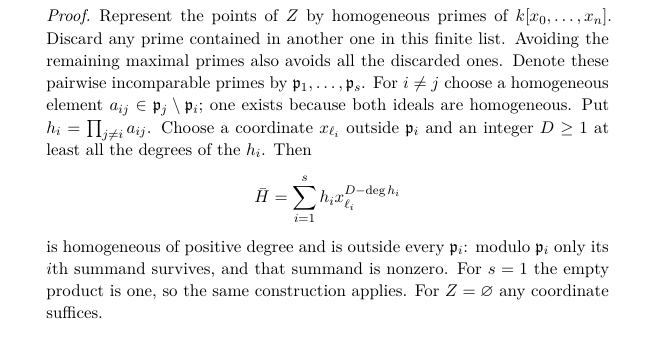
Represent the points of $Z$ by homogeneous primes of
$k[x_0,\ldots,x_n]$. Discard any prime contained in another
one in this finite list. Avoiding the remaining maximal
primes also avoids all the discarded ones. Denote these
pairwise incomparable primes by $\mathfrak p_1,\ldots,
\mathfrak p_s$.
For $i\ne j$ choose a homogeneous element
$a_{ij}\in\mathfrak p_j\setminus\mathfrak p_i$; one exists
because both ideals are homogeneous. Put
$h_i=\prod_{j\ne i}a_{ij}$. Choose a coordinate $x_{\ell_i}$
outside $\mathfrak p_i$ and an integer $D\geq1$ at least
all the degrees of the $h_i$. Then
\[
 \bar H=\sum_{i=1}^{s}h_i x_{\ell_i}^{D-\deg h_i}
\]
is homogeneous of positive degree and is outside every
$\mathfrak p_i$: modulo $\mathfrak p_i$ only its $i$th
summand survives, and that summand is nonzero. For $s=1$
the empty product is one, so the same construction applies.
For $Z=\varnothing$ any coordinate suffices.

Lift the coefficients to a homogeneous polynomial $H$ over
$O$. The standard open $D_+(H)$ in projective space is affine
by \cite[Tag 01MB]{StacksAlg}. Its intersection with $P$ is
therefore an affine open containing $Z$.

Apply the first assertion to $Z\cup\{p,q\}$ for every
$p,q\in P_k$. The open products $U_k\times_k U_k$ obtained
in this way cover $P_k\times_k P_k$: the two projections of
a point of the product form such a pair. This product has
a finite affine cover, obtained from the pairwise products
of a finite affine cover of $P_k$. Each affine scheme is
quasi-compact: refine an open cover by standard opens
$D(f_\alpha)$. Their elements generate the unit ideal,
since otherwise \cite[Tag 00E0(2)]{StacksAlg} would give
a maximal ideal outside the cover. An expression for $1$
uses finitely many $f_\alpha$ and gives a finite subcover.
Choose a finite subcover. Finally, every underlying pair
$(p,q)$ is the image of a point of the scheme product.
Indeed $\kappa(p)\otimes_k\kappa(q)$ is a nonzero ring:
if $1\otimes1=0$, this equality is witnessed by finitely
many defining bilinear relations. Let $E\subset\kappa(p)$
and $F\subset\kappa(q)$ be the finite-dimensional
$k$-subspaces spanned by $1$ and every entry in these
relations. Choose linear functionals on $E$ and $F$ that
take $1$ to $1$. Their product annihilates all the chosen
relations but takes $(1,1)$ to $1$, a contradiction.
By \cite[Tag 00E0(2)]{StacksAlg}, the nonzero tensor ring
has a maximal ideal, which is prime and provides the
desired point. Thus the finite subcover has the stated
pair property.
\end{proof}
Typeset reader excerpt
Typed proof inputs
- BASE-LINEAR · standing context or base
- BASE-LINEAR · standing context or base (requires)
- BASE-RINGS · standing context or base
- BASE-RINGS · standing context or base (requires)
- NAG-002252:STACKS-00E0:260-264 · named external application
- NAG-002252:STACKS-00E0:260-264 · named external application (requires)
- NAG-002252:STACKS-00E0:265-277 · named external application
- NAG-002252:STACKS-00E0:265-277 · named external application (requires)
- NAG-002252:STACKS-01MB:249-252 · named external application
- NAG-002252:STACKS-01MB:249-252 · named external application (requires)
Named external registrations
Proof map
Verified map inputs · NAG-002252
No addressable selected proof input is recorded in this projection.
Standing context and base inputs
BASE-LINEARBASE-RINGS
Exact named external applications
- NAG-002252:STACKS-00E0:260-264 Exact source window 260–264
- Part 2 of actual proper-ideal quotient in affine coordinate ring
- NAG-002252:STACKS-00E0:265-277 Exact source window 265–277
- Part 2 on actual nonzero residue-field tensor over k
- NAG-002252:STACKS-01MB:249-252 Exact source window 249–252
- Standard projective principal open of actual homogeneous H is affine
NAG-002252 · Common affine neighbourhoods of residual points · Chapter argument