NAG-002265 · Accepted whole
Result 4.44.1
Open in the English reader · PDF page 763
Statement · exact TeX
\begin{lemma}[Smooth finite \texorpdfstring{\'etale}{etale} multisections]
\label{v036:f5:multisections}
Let $\mathcal C/O$ be a proper flat finitely presented curve,
and let $q$ be a smooth closed point of $\mathcal C_s$ with
$l=\kappa(q)$ finite separable over $k$. There is a closed
immersion
\[
                        \operatorname{Spec}L^\circ\longrightarrow\mathcal C
\]
through $q$, for a finite unramified lift $L/K$ of $l/k$.
Its image is contained in the relative smooth locus.
Distinct choices of the special points give disjoint such
multisections.

If $\mathcal C_s$ is nodal, a finite union of its irreducible
components can be met by a finite disjoint union of these
multisections, avoiding any prescribed finite set of smooth
points and all nodes, with at least three geometric intersection
points on each geometric component in that union and none on
the other components.
\end{lemma}
Full selected proof · exact TeX
\begin{proof}
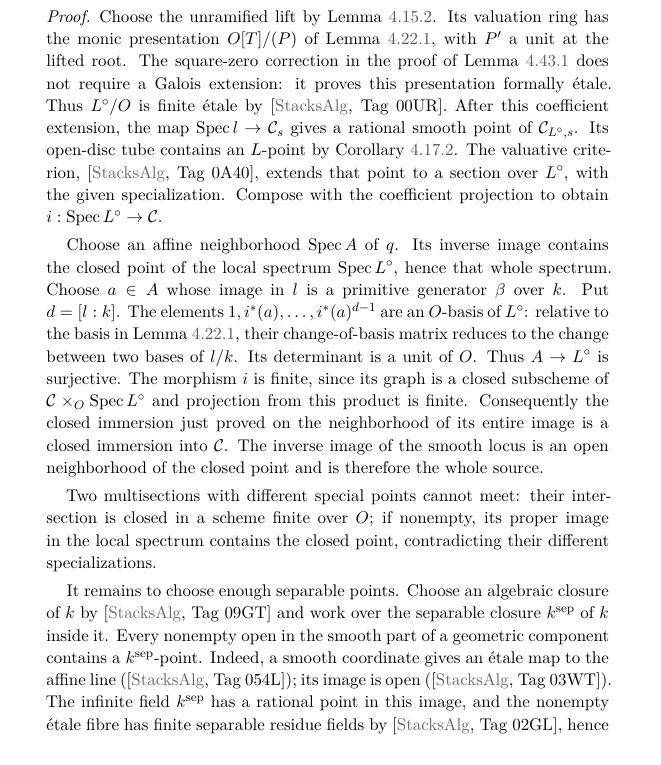
Choose the unramified lift by
Lemma~\ref{cand:residueextensionlift}. Its valuation ring
has the monic presentation $O[T]/(P)$ of
Lemma~\ref{cand:unramifiedmodelbasechange}, with $P'$ a unit
at the lifted root. The square-zero correction in the proof
of Lemma~\ref{v036:f5:unramifiedcoefficients} does not require
a Galois extension: it proves this presentation formally
\textup{\'etale}. Thus $L^\circ/O$ is finite \textup{\'etale}
by \cite[Tag 00UR]{StacksAlg}.
After this coefficient extension, the map
$\operatorname{Spec}l\to\mathcal C_s$ gives a rational smooth
point of $\mathcal C_{L^\circ,s}$. Its open-disc tube contains
an $L$-point by Corollary~\ref{cand:smoothpointpolydisctube}.
The valuative criterion, \cite[Tag 0A40]{StacksAlg}, extends
that point to a section over $L^\circ$, with the given
specialization. Compose with the coefficient projection to
obtain $i:\operatorname{Spec}L^\circ\to\mathcal C$.

Choose an affine neighborhood $\operatorname{Spec}A$ of $q$.
Its inverse image contains the closed point of the local
spectrum $\operatorname{Spec}L^\circ$, hence that whole
spectrum. Choose $a\in A$ whose image in $l$ is a primitive
generator $\beta$ over $k$. Put $d=[l:k]$. The elements
$1,i^*(a),\ldots,i^*(a)^{d-1}$ are an $O$-basis of $L^\circ$:
relative to the basis in
Lemma~\ref{cand:unramifiedmodelbasechange}, their change-of-basis
matrix reduces to the change between two bases of $l/k$.
Its determinant is a unit of $O$. Thus $A\to L^\circ$ is
surjective. The morphism $i$ is finite, since its graph is a
closed subscheme of $\mathcal C\times_O\operatorname{Spec}L^\circ$
and projection from this product is finite. Consequently the
closed immersion just proved on the neighborhood of its entire
image is a closed immersion into $\mathcal C$.
The inverse image of the smooth locus is an open neighborhood
of the closed point and is therefore the whole source.

Two multisections with different special points cannot meet:
their intersection is closed in a scheme finite over $O$;
if nonempty, its proper image in the local spectrum contains
the closed point, contradicting their different specializations.

It remains to choose enough separable points. Choose an
algebraic closure of $k$ by \cite[Tag 09GT]{StacksAlg} and
work over the separable closure $k^{\mathrm{sep}}$ of $k$
inside it.
Every nonempty open in
the smooth part of a geometric component contains a
$k^{\mathrm{sep}}$-point. Indeed, a smooth coordinate gives
an \textup{\'etale} map to the affine line
(\cite[Tag 054L]{StacksAlg}); its image is open
(\cite[Tag 03WT]{StacksAlg}). The infinite field
$k^{\mathrm{sep}}$ has a rational point in this image, and
the nonempty \textup{\'etale} fibre has finite separable
residue fields by \cite[Tag 02GL]{StacksAlg}, hence rational
points. A purely inseparable extension does not split the
underlying components: for such a field extension the prime
over a given prime is unique, because membership in it is
detected after taking sufficiently high $p$-powers. Thus this
argument applies to each geometric component.

Choose three points on each required component, successively
avoiding the finitely many previously chosen Galois orbits and
the prescribed exceptional points. Each chosen point is defined
over a finite separable extension of $k$, since the curve is of
finite type. Its image is a closed separable point of the original
curve. Take all the finitely many resulting closed points and
lift them by the first part. Their geometric specializations
have the required incidence and disjointness.
\end{proof}
Typeset reader excerpt
Typed proof inputs
- CLAUSE:NAG-002060:actual_monic_coefficients · selected scope, text unavailable (sealed exact native clause)
- CLAUSE:NAG-002060:actual_monic_coefficients · selected scope, text unavailable
- CLAUSE:NAG-002060:supplied_affine_coefficient_comparison · selected scope, text unavailable (sealed exact native clause)
- CLAUSE:NAG-002060:supplied_affine_coefficient_comparison · selected scope, text unavailable
- NAG-002040 · selected whole (sealed native whole)
- NAG-002040 · selected whole
- NAG-002050 · selected whole (sealed native whole)
- NAG-002050 · selected whole
- NAG-002262 · selected whole (sealed native whole)
- NAG-002262 · selected whole
- STACKS-00UR · named external application (existing frozen Stacks authority and named consumer)
- STACKS-00UR · named external application
- STACKS-02GL · named external application (existing frozen Stacks authority and named consumer)
- STACKS-02GL · named external application
- STACKS-03WT · named external application (existing frozen Stacks authority and named consumer)
- STACKS-03WT · named external application
- STACKS-054L · named external application (existing frozen Stacks authority and named consumer)
- STACKS-054L · named external application
- STACKS-09GT · named external application (existing frozen Stacks authority and named consumer)
- STACKS-09GT · named external application
- STACKS-0A40 · named external application (existing frozen Stacks authority and named consumer)
- STACKS-0A40 · named external application
- CLAUSE:NAG-002060:actual_monic_coefficients · selected scope, text unavailable (requires)
- CLAUSE:NAG-002060:supplied_affine_coefficient_comparison · selected scope, text unavailable (requires)
- NAG-002040 · selected whole (requires)
- NAG-002050 · selected whole (requires)
- NAG-002262 · selected whole (requires)
- STACKS-00UR · named external application (requires)
- STACKS-02GL · named external application (requires)
- STACKS-03WT · named external application (requires)
- STACKS-054L · named external application (requires)
- STACKS-09GT · named external application (requires)
- STACKS-0A40 · named external application (requires)
Reader cross-references
Proof map
Verified map inputs · NAG-002265
AND · joint registered proof inputs
- NAG-002040 · The tube of a rational smooth point · accepted whole
- NAG-002050 · Lifting a finite separable residue extension · accepted whole
- NAG-002262 · Integral Galois descent for unramified coefficients · accepted whole
Unlinked source pointers
These pointers have no operative linked edge in this map.
CLAUSE:NAG-002060:actual_monic_coefficientsCLAUSE:NAG-002060:supplied_affine_coefficient_comparisonSTACKS-00URSTACKS-02GLSTACKS-03WTSTACKS-054LSTACKS-09GTSTACKS-0A40