NAG-002270 · Accepted whole
An algebraically closed comparison field
Open in the English reader · PDF page 768
Statement · exact TeX
\begin{lemma}[An algebraically closed comparison field]
\label{v036:f5:comparisonfield}
There is an isometric extension $K\subset\Omega$ with
$\Omega$ complete and algebraically closed and with
$\widetilde\Omega$ an algebraic closure of $k$.
\end{lemma}
Full selected proof · exact TeX
\begin{proof}
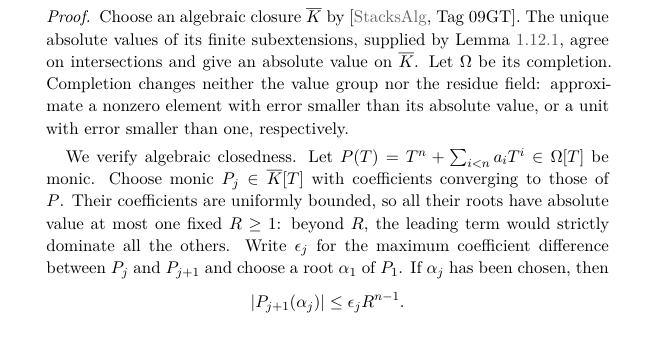
Choose an algebraic closure $\overline K$ by
\cite[Tag 09GT]{StacksAlg}. The unique
absolute values of its finite subextensions, supplied by
Lemma~\ref{fnd:finiteextensionnorms}, agree on intersections
and give an absolute value on $\overline K$. Let $\Omega$
be its completion. Completion changes neither the value
group nor the residue field: approximate a nonzero element
with error smaller than its absolute value, or a unit with
error smaller than one, respectively.

We verify algebraic closedness. Let
$P(T)=T^n+\sum_{i<n}a_iT^i\in\Omega[T]$ be monic.
Choose monic $P_j\in\overline K[T]$ with coefficients
converging to those of $P$. Their coefficients are uniformly
bounded, so all their roots have absolute value at most one
fixed $R\geq1$: beyond $R$, the leading term would strictly
dominate all the others. Write $\epsilon_j$ for the maximum
coefficient difference between $P_j$ and $P_{j+1}$ and
choose a root $\alpha_1$ of $P_1$. If $\alpha_j$ has been
chosen, then
\[
 |P_{j+1}(\alpha_j)|\leq\epsilon_j R^{n-1}.
\]
Factor $P_{j+1}$ over $\overline K$. At least one of its
roots $\alpha_{j+1}$ satisfies
$|\alpha_j-\alpha_{j+1}|\leq
(\epsilon_jR^{n-1})^{1/n}$. These bounds tend to zero,
so the ultrametric inequality makes $(\alpha_j)$ Cauchy.
Its limit is a root of $P$. Induction on the degree now
shows that $\Omega$ is algebraically closed.

The residue field of $\overline K$ is algebraic over $k$:
each of its elements comes from a finite extension, whose
residue degree is finite by \cite[Tag 0ASH]{StacksAlg}.
It is algebraically closed, since lifting a monic residual
polynomial and taking a root in $\overline K$ produces an
integral root and hence a residual root. Completion retains
that residue field, proving the assertion.
\end{proof}
Typeset reader excerpt
Typed proof inputs
- NAG-001450 · selected whole (actual native theorem application)
- BASE-REAL · standing context or base
- BASE-REAL · standing context or base (requires)
- BASE-RINGS · standing context or base
- BASE-RINGS · standing context or base (requires)
- BASE-TOPOLOGY · standing context or base
- BASE-TOPOLOGY · standing context or base (requires)
- NAG-001450 · selected whole
- NAG-001450 · selected whole (requires)
- NAG-002270:STACKS-09GT:396-397 · named external application
- NAG-002270:STACKS-09GT:396-397 · named external application (requires)
- NAG-002270:STACKS-0ASH:427-433 · named external application
- NAG-002270:STACKS-0ASH:427-433 · named external application (requires)
Named external registrations
Reader cross-references
Proof map
Verified map inputs · NAG-002270
Registered proof input
- NAG-001450 · Finite-dimensional norms and finite field extensions · accepted whole
- Compatible unique extending absolute values at each finite subextension including inseparable cases
Standing context and base inputs
BASE-REALBASE-RINGSBASE-TOPOLOGY
Unlinked source pointers
These pointers have no operative linked edge in this map.
NAG-002270:STACKS-09GT:396-397NAG-002270:STACKS-0ASH:427-433
NAG-002270 · An algebraically closed comparison field · Chapter argument