algebraic graph closure
The ledger retains this scope. Its exact text or reader anchor is unavailable in this edition.
NAG-002310 · Accepted whole
Open in the English reader · PDF page 777
\begin{lemma}[The actual closure of the generic graph]
\label{v037:f5:graphmodel}
Let $\mathcal X_1,\mathcal X_2$ be projective flat finitely
presented $O$-models of $C$. The schematic closure $\mathcal G$
of the generic diagonal in $\mathcal X_1\times_O\mathcal X_2$
is integral, projective, flat and finitely presented over $O$.
Its two projections
\[
                 p_i:\mathcal G\longrightarrow\mathcal X_i
\]
are proper and induce the identity on $C$. If $\mathcal X_i$
is integral, $p_i$ is birational and surjective.

For every complete isometric extension $L/K$, the completion
of $\mathcal G_{L^\circ}$ is an admissible formal model of
$C_L^{\an}$. Its specialization is surjective onto every
point of its special fibre and satisfies
\[
 \operatorname{sp}_{\mathcal X_{i,L^\circ}}
       =(p_i)_{\widetilde L}\circ
                    \operatorname{sp}_{\mathcal G_{L^\circ}}.
\]
\end{lemma}
\begin{proof}
On an affine open $\operatorname{Spec}B$ of the product, let
$I\subset B[1/\pi]$ be the ideal of the generic diagonal.
Its closure has ring
\[
                         B/(I\cap B).
\]
These ideals commute with localization and hence define a
closed subscheme of the product. A nonempty such affine
closure has coordinate ring contained in the coordinate
ring of a nonempty open of the integral curve $C$. It is
therefore a domain and has no $O$-torsion. The generic
diagonal is dense, so these affines give an integral
scheme. Torsion-freeness over a valuation ring gives
flatness by \cite[Tag 0539]{StacksAlg}. Each affine ring is
of finite type over $O$, as a quotient of the coordinate
ring of the product. It is consequently finitely presented
by \cite[Tag 053E(1)]{StacksAlg}. The closure is projective
as a closed subscheme of the projective product; in particular
it is quasi-compact and separated. The local finite
presentation just proved is therefore a finite presentation.

The projections are proper, being restrictions of the proper
product projections to a closed subscheme. On the generic
fibre they are the given identities. If a target is integral,
their closed images contain its dense generic fibre, proving
surjectivity and birationality.

Base change to $L^\circ$ preserves projectivity, flatness
and finite presentation, and gives generic fibre $C_L$.
Theorem~\ref{cand:projectiveformalcompletion} identifies
the actual completed generic fibre with $C_L^{\an}$.
Lemma~\ref{cand:algebraicmodelscalar} identifies its special
fibre and the completed projection maps with their coefficient
extensions. Surjectivity and functoriality of specialization
are Proposition~\ref{fnd:formalglobalgenericfaithful}.
No reducedness or nodality of the graph's special fibre
is needed for these assertions.
\end{proof}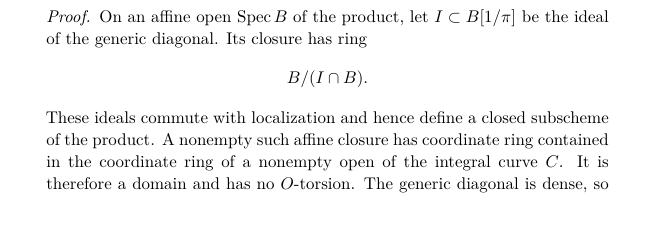
The ledger retains this scope. Its exact text or reader anchor is unavailable in this edition.
AND · joint registered proof inputs
These pointers have no operative linked edge in this map.
APP-STACKS-0539@NAG-002310:original-1APP-STACKS-053E@NAG-002310:original-2SUPPORT:NAG-001944:given_atlas_open_preimages_and_contractionNAG-002310 · The actual closure of the generic graph · Chapter argument