NAG-002328 · Accepted whole
Confluence and finite forests
Open in the English reader · PDF page 789
Statement · exact TeX
\begin{lemma}[Confluence and finite forests]
\label{v037:f5:pruningconfluence}
Every sequence of elementary pruning terminates. Any sequence
continued until no deletable vertex remains has the same labelled
terminal graph, up to an incidence isomorphism fixing its retained
vertices and its labelled legs.

Suppose $A$ is a subset of the unprotected vertices such that each
connected component $T$ of the induced subgraph on $A$ is a tree,
all its vertices belong to $R$, and
\[
                         b(T)+m(T)\leq2,
\]
where $b(T)$ counts edges from $T$ to its complement and $m(T)$
counts its marked legs. Contracting each such tree, transferring
its possible mark in the one-ended case and joining its two ends
in the two-ended case, is a sequence of elementary prunings.
In particular it does not change the terminal graph.
\end{lemma}
Full selected proof · exact TeX
\begin{proof}
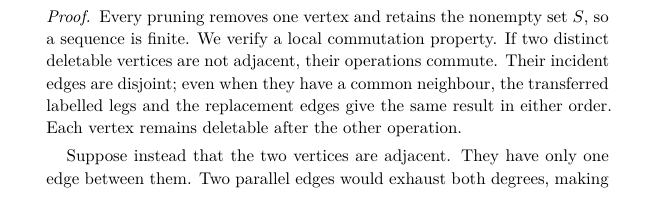
Every pruning removes one vertex and retains the nonempty set
$S$, so a sequence is finite. We verify a local commutation
property. If two distinct deletable vertices are not adjacent,
their operations commute. Their incident edges are disjoint;
even when they have a common neighbour, the transferred labelled
legs and the replacement edges give the same result in either
order. Each vertex remains deletable after the other operation.

Suppose instead that the two vertices are adjacent. They have
only one edge between them. Two parallel edges would exhaust
both degrees, making them the whole connected graph, contrary
to the existence of a protected vertex. For the same reason they
cannot both have degree one. If one is a leaf and the other has
degree two, deleting the leaf leaves a leaf with at most one
marked leg at the second vertex. Deleting the second vertex first
joins the original leaf directly to the remaining neighbour.
Both orders remove the pair and transfer the same possible leg
to that neighbour. If both vertices have degree two, neither has
a mark, and both orders suppress the same two-vertex path.
Their other neighbours may coincide: both orders then give the
same loop at that common neighbour. In all cases both second
deletions remain permissible and the results agree.

Induct on the number of vertices to prove confluence. For two
terminal sequences with the same first deletion, apply induction
to the smaller graph. For different first deletions, the preceding
commutation property gives a common graph after two deletions.
Induction applied to each of the two one-deletion graphs identifies
its terminal graph with the terminal graph of this common graph.
Thus the two original terminal graphs agree. This also proves
that their retained labels and transferred marked-leg labels agree.

For the forest assertion, each $T$ has $b(T)\geq1$, because the
whole graph is connected and its complement contains $S$.
A one-vertex tree is immediately deletable. If $T$ has more than
one vertex, it has at least two leaves: take the two ends of a
longest simple path. Since its total number of external ends and
marks is at most two, some leaf carries at most one of these
external ends or marks. Its one internal edge therefore gives
$\deg_G(v)+m(v)\leq2$.
Delete it. If it carries an external edge, that edge is joined
to its internal neighbour; if it carries a mark, that mark is
transferred to that neighbour. The remaining tree has the same
external ends and marked legs, and its vertices still belong to
$R$. Continue until the tree disappears. Its final operation is
exactly the prescribed one-ended or two-ended contraction,
including a loop when the two external ends have the same
neighbour. Different connected components of $A$ have no edge
between them, so this procedure applies to all of them.
Confluence proves the last assertion.
\end{proof}
Typeset reader excerpt
Typed proof inputs
- BASE-SETS · standing context or base (declared elementary base)
- CONTEXT:002327-pruning-definition · standing context or base (literal context)
- BASE-SETS · standing context or base
- BASE-SETS · standing context or base (requires)
- CONTEXT:002327-pruning-definition · standing context or base
- CONTEXT:002327-pruning-definition · standing context or base (requires)
Proof map
Verified map inputs · NAG-002328
No addressable selected proof input is recorded in this projection.
Standing context and base inputs
BASE-SETSCONTEXT:002327-pruning-definition
NAG-002328 · Confluence and finite forests · Chapter argument