NAG-002337 · Accepted whole
Lifting residual finiteness
Open in the English reader · PDF page 799
Statement · exact TeX
\begin{lemma}[Lifting residual finiteness]
\label{v037:f5:residualfiniteintegral}
Let $R_0\to A_0$ be a continuous homomorphism of admissible
$O$-algebras. Suppose that $A_0$ is topologically of finite type
over $R_0$ and that
\[
 A_0/K^{\circ\circ}A_0
       \quad\hbox{is finite over}\quad
 R_0/K^{\circ\circ}R_0.
\]
Then $A_0$ is a finite $R_0$-module.
\end{lemma}
Full selected proof · exact TeX
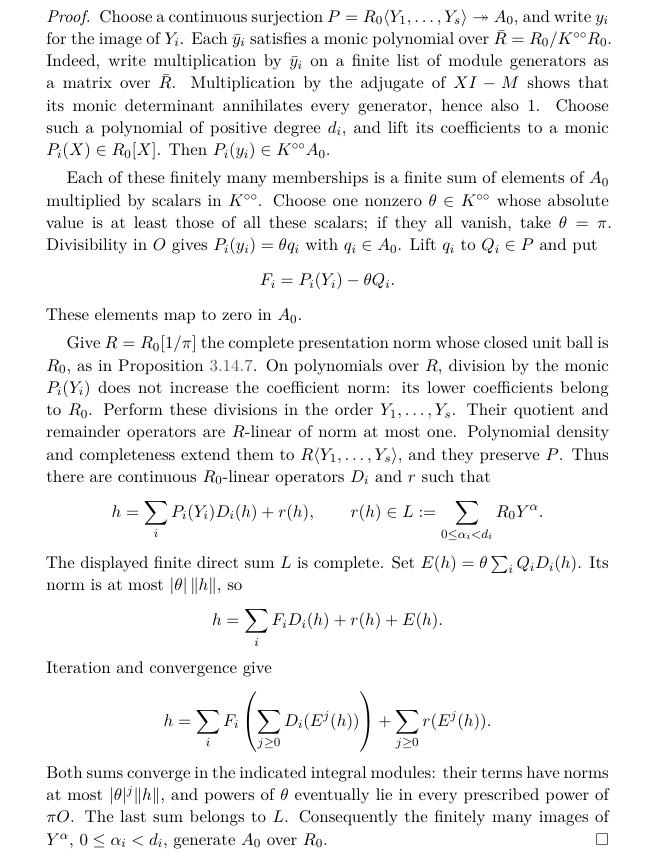
\begin{proof}
Choose a continuous surjection
$P=R_0\langle Y_1,\ldots,Y_s\rangle\twoheadrightarrow A_0$,
and write $y_i$ for the image of $Y_i$. Each $\bar y_i$ satisfies
a monic polynomial over $\bar R=R_0/K^{\circ\circ}R_0$.
Indeed, write multiplication by $\bar y_i$ on a finite list of
module generators as a matrix over $\bar R$. Multiplication by
the adjugate of $X I-M$ shows that its monic determinant
annihilates every generator, hence also $1$.
Choose such a polynomial of positive degree $d_i$, and lift its
coefficients to a monic $P_i(X)\in R_0[X]$. Then
$P_i(y_i)\in K^{\circ\circ}A_0$.

Each of these finitely many memberships is a finite sum of
elements of $A_0$ multiplied by scalars in $K^{\circ\circ}$.
Choose one nonzero $\theta\in K^{\circ\circ}$ whose absolute
value is at least those of all these scalars; if they all vanish,
take $\theta=\pi$. Divisibility in $O$ gives
$P_i(y_i)=\theta q_i$ with $q_i\in A_0$.
Lift $q_i$ to $Q_i\in P$ and put
\[
                 F_i=P_i(Y_i)-\theta Q_i.
\]
These elements map to zero in $A_0$.

Give $R=R_0[1/\pi]$ the complete presentation norm whose
closed unit ball is $R_0$, as in
Proposition~\ref{fnd:affineformalpresentations}.
On polynomials over $R$, division by the monic $P_i(Y_i)$
does not increase the coefficient norm: its lower coefficients
belong to $R_0$. Perform these divisions in the order
$Y_1,\ldots,Y_s$. Their quotient and remainder operators are
$R$-linear of norm at most one. Polynomial density and
completeness extend them to $R\langle Y_1,\ldots,Y_s\rangle$,
and they preserve $P$. Thus there are continuous $R_0$-linear
operators $D_i$ and $r$ such that
\[
 h=\sum_i P_i(Y_i)D_i(h)+r(h),\qquad
 r(h)\in L:=\sum_{0\leq\alpha_i<d_i}R_0Y^\alpha.
\]
The displayed finite direct sum $L$ is complete.
Set $E(h)=\theta\sum_i Q_iD_i(h)$. Its norm is at most
$|\theta|\,\|h\|$, so
\[
 h=\sum_i F_iD_i(h)+r(h)+E(h).
\]
Iteration and convergence give
\[
 h=\sum_i F_i\left(\sum_{j\geq0}D_i(E^j(h))\right)
                  +\sum_{j\geq0}r(E^j(h)).
\]
Both sums converge in the indicated integral modules: their
terms have norms at most $|\theta|^j\|h\|$, and powers of
$\theta$ eventually lie in every prescribed power of $\pi O$.
The last sum belongs to $L$. Consequently the finitely many
images of $Y^\alpha$, $0\leq\alpha_i<d_i$, generate $A_0$
over $R_0$.
\end{proof}
Typeset reader excerpt
Typed proof inputs
- BASE-RINGS · standing context or base (declared elementary base)
- CLAUSE:NAG-001918:attained_quotient_norm_and_unit_ball_forward · selected scope, text unavailable (accepted exact clause)
- CONTEXT:integral-section-data · standing context or base (literal context)
- NAG-000221 · selected whole (whole proof)
- NAG-001376 · selected whole (whole proof)
- BASE-RINGS · standing context or base
- BASE-RINGS · standing context or base (requires)
- CLAUSE:NAG-001918:attained_quotient_norm_and_unit_ball_forward · selected scope, text unavailable
- CLAUSE:NAG-001918:attained_quotient_norm_and_unit_ball_forward · selected scope, text unavailable (requires)
- CONTEXT:integral-section-data · standing context or base
- CONTEXT:integral-section-data · standing context or base (requires)
- NAG-000221 · selected whole
- NAG-000221 · selected whole (requires)
- NAG-001376 · selected whole
- NAG-001376 · selected whole (requires)
Reader cross-references
Proof map
Verified map inputs · NAG-002337
AND · joint registered proof inputs
- NAG-000221 · Result 1.1.2 · accepted whole
- NAG-001376 · Complete coefficient modules · accepted whole
Standing context and base inputs
BASE-RINGSCONTEXT:integral-section-data
Unlinked source pointers
These pointers have no operative linked edge in this map.
CLAUSE:NAG-001918:attained_quotient_norm_and_unit_ball_forward