NAG-002341 · Accepted whole
An integral basis when the discrete value group is unchanged
Open in the English reader · PDF page 804
Statement · exact TeX
\begin{lemma}[An integral basis when the discrete value group is unchanged]
\label{v037:f5:discreteunramifiedbasis}
Let $H$ be a complete discretely valued field and let $L/H$ be
a finite extension with its extending absolute value. If
$|L^\times|=|H^\times|$, then
\[
          [L:H]=[\widetilde L:\widetilde H].
\]
Every lift $b_1,\ldots,b_f\in L^\circ$ of a
$\widetilde H$-basis of $\widetilde L$ is an orthonormal
$H$-basis of $L$ and an $H^\circ$-basis of $L^\circ$.
No separability assumption on the residue extension is needed.
\end{lemma}
Full selected proof · exact TeX
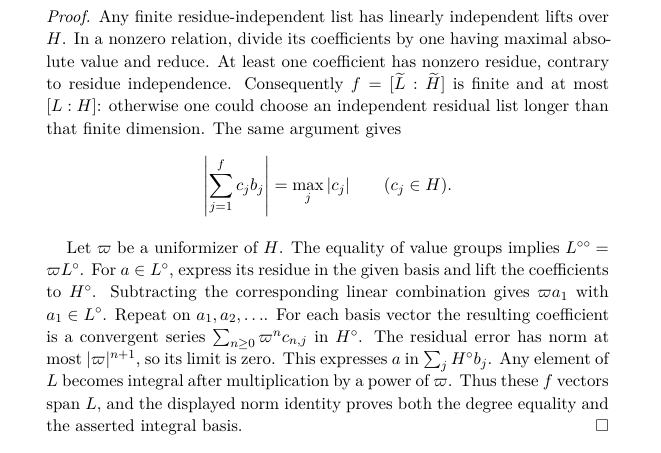
\begin{proof}
Any finite residue-independent list has linearly independent
lifts over $H$. In a nonzero relation, divide its coefficients
by one having maximal absolute value and reduce. At least one
coefficient has nonzero residue, contrary to residue independence.
Consequently $f=[\widetilde L:\widetilde H]$ is finite and
at most $[L:H]$: otherwise one could choose an independent
residual list longer than that finite dimension.
The same argument gives
\[
                 \left|\sum_{j=1}^f c_jb_j\right|
                            =\max_j|c_j|\qquad(c_j\in H).
\]

Let $\varpi$ be a uniformizer of $H$. The equality of value
groups implies $L^{\circ\circ}=\varpi L^\circ$.
For $a\in L^\circ$, express its residue in the given basis
and lift the coefficients to $H^\circ$. Subtracting the
corresponding linear combination gives $\varpi a_1$ with
$a_1\in L^\circ$. Repeat on $a_1,a_2,\ldots$.
For each basis vector the resulting coefficient is a convergent
series $\sum_{n\geq0}\varpi^n c_{n,j}$ in $H^\circ$.
The residual error has norm at most $|\varpi|^{n+1}$,
so its limit is zero. This expresses $a$ in
$\sum_jH^\circ b_j$. Any element of $L$ becomes integral
after multiplication by a power of $\varpi$.
Thus these $f$ vectors span $L$, and the displayed norm identity
proves both the degree equality and the asserted integral basis.
\end{proof}
Typeset reader excerpt
Typed proof inputs
- BASE-LINEAR · standing context or base
- BASE-LINEAR · standing context or base (requires)
- BASE-RINGS · standing context or base
- BASE-RINGS · standing context or base (requires)
- BASE-TOPOLOGY · standing context or base
- BASE-TOPOLOGY · standing context or base (requires)
Proof map
Verified map inputs · NAG-002341
No addressable selected proof input is recorded in this projection.
Standing context and base inputs
BASE-LINEARBASE-RINGSBASE-TOPOLOGY
NAG-002341 · An integral basis when the discrete value group is unchanged · Chapter argument