finite level residual prime lift
The ledger retains this scope. Its exact text or reader anchor is unavailable in this edition.
NAG-002352 · Accepted whole
5 Tropicalization, multiplicities and balancing
Open in the English reader · PDF page 973
\begin{proposition}[A residual fan bounds and meets the actual germ]
\label{v037:analytic:residualfan}
Let $K$ be complete and nontrivially valued, put
$O=K^\circ$ and $k=\widetilde K$, and let
$X=\mathcal M(B)$ be a generalized affinoid space.
Let $h_1,\ldots,h_n\in B^\times$, and suppose the nonempty
whole fibre $F_0=t_h^{-1}(0)$ belongs to
$\operatorname{Int}(X/K)$.
Let $D$ be its actual affinoid algebra, and let
$D_0\subset D$ be an actual admissible model, finite over
\[
       O\langle T_1^{\pm1},\ldots,T_n^{\pm1}\rangle,
                         \qquad T_i\longmapsto h_i.
\]
Set
\[
 \begin{aligned}
 \overline D_0&=D_0/K^{\circ\circ}D_0,
 & J&=\ker(k[T^{\pm1}]\longrightarrow\overline D_0),\\
 R&=k[T^{\pm1}]/J,
 & Z&=\operatorname{Spec}R.
 \end{aligned}
\]
Then $C=\operatorname{Trop}(Z)$ is the nonempty support of a
finite rational polyhedral fan of dimension at most $\dim_K X$.
There is a neighbourhood $V$ of $0$ such that
\[
                         t_h(X)\cap V\subset C.
\]
For every $u\in C$ and every finite list
$m_j\in\mathbf Z^n$ with $\langle m_j,u\rangle>0$, the strict
sector $\{v:\langle m_j,v\rangle>0\text{ for all }j\}$
contains points of $t_h(X)$ arbitrarily close to $0$.
\end{proposition}
\begin{proof}
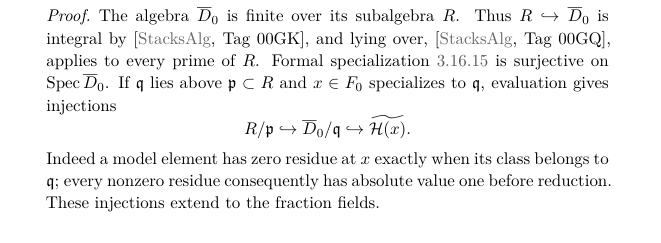
The algebra $\overline D_0$ is finite over its subalgebra $R$.
Thus $R\hookrightarrow\overline D_0$ is integral by
\cite[Tag 00GK]{StacksAlg}, and lying over,
\cite[Tag 00GQ]{StacksAlg}, applies to every prime of $R$.
Formal specialization
\ref{fnd:affineformalspecializationsurjective} is surjective
on $\operatorname{Spec}\overline D_0$.
If $\mathfrak q$ lies above $\mathfrak p\subset R$ and
$x\in F_0$ specializes to $\mathfrak q$, evaluation gives
injections
\[
 R/\mathfrak p\hookrightarrow
 \overline D_0/\mathfrak q\hookrightarrow
                  \widetilde{\mathcal H(x)}.
\]
Indeed a model element has zero residue at $x$ exactly when its
class belongs to $\mathfrak q$; every nonzero residue consequently
has absolute value one before reduction. These injections extend
to the fraction fields.

The finite-type algebra $R$ is Noetherian, by
\cite[Tag 00FO]{StacksAlg}, and has finitely many minimal primes,
by \cite[Tag 00FR]{StacksAlg}. For any such prime $\mathfrak p$,
the preceding injection and Theorem~\ref{fnd:affinoidabhyankarmaximum}
give
\[
 \dim(R/\mathfrak p)
    =\operatorname{trdeg}_k\operatorname{Frac}(R/\mathfrak p)
    \leq\operatorname{trdeg}_k\widetilde{\mathcal H(x)}
    \leq d_K(x)\leq\dim_KX,
\]
where the equality is \cite[Tag 00P0]{StacksAlg}.
Apply Theorem~\ref{cand:tropicalpuredimension} to each reduced
irreducible component of $Z$ and take a common refinement of
their finite fans. The tropicalization of their finite union is
their union, since every analytic seminorm has a prime kernel
containing one minimal prime by \cite[Tag 00E0(4)]{StacksAlg}.
This proves the fan and dimension
assertions. Nonemptiness also follows from specialization of
any point of the nonempty fibre.

Take a finite tropical basis $p_1,\ldots,p_a$ for $J$ from
Lemma~\ref{v037:analytic:finitetropicalbasis}. Lift each nonzero
coefficient to an element of $O$ of absolute value one, and let
$P_j(T)\in O[T^{\pm1}]$ be the resulting polynomial.
Its value $P_j(h)$ belongs to $K^{\circ\circ}D_0$.
By the definition of this ideal it is a finite sum
$\sum_\ell c_\ell d_\ell$, with $|c_\ell|<1$ and
$d_\ell\in D_0$. Model elements have absolute value at most one
at every point of $F_0$, as in
Theorem~\ref{fnd:affineformalspecializationsurjective}.
It follows that
\[
                    \max_{x\in F_0}|P_j(h)(x)|<1.
\]
Choose a real number $c_j<1$ strictly larger than this maximum.
The closed subset of $X$ on which $|P_j(h)|\geq c_j$ is compact
by Proposition~\ref{fnd:boundedspectrumcompact} and has moment
image avoiding $0$.
After shrinking a common neighbourhood $V$ of $0$, one therefore
has $|P_j(h)(x)|<c_j$ whenever $t_h(x)\in V$.
Shrink $V$ again so that
$e^{-\langle m,v\rangle}>c_j$ for every exponent $m$ occurring
in $p_j$ and every $v\in V$.
If $v\notin C$, the last assertion of
Lemma~\ref{v037:analytic:finitetropicalbasis} supplies an index
$j$ for which the least value of $\langle m,v\rangle$ among
these exponents occurs exactly once.
At a point $x$ with $t_h(x)=v$, that term is the unique largest
term of $P_j(h)(x)$, so
$|P_j(h)(x)|=e^{-\langle m,v\rangle}>c_j$.
This contradiction proves the asserted inclusion in $C$.

Finally let $u\in C$ and choose an actual analytic point of $Z$
with moment value $u$, with kernel $\mathfrak p$.
Choose $\mathfrak q$ above $\mathfrak p$ and $x\in F_0$
specializing to $\mathfrak q$, as in the first paragraph.
The subalgebra generated by the residues of the $h_i^{\pm1}$
in $\widetilde{\mathcal H(x)}$ is exactly $R/\mathfrak p$.
The chosen analytic point factors through this algebra.
If the list of inequalities is empty, the assertion is immediate.
Otherwise the chosen point induces a valuation ring in
\(\operatorname{Frac}(R/\mathfrak p)\). The residue injection already
constructed identifies this ring with a local subring of
\(\widetilde{\mathcal H(x)}\). By \cite[Tag 00IA]{StacksAlg}, a
valuation ring of that field dominates this local subring. Each
residue of \(h^{m_j}\) lies in its maximal ideal, because its value at
the chosen residual point is \(e^{-\langle m_j,u\rangle}<1\).
Lemma~\ref{fnd:gradeddegreeonevaluation} extends the dominating
valuation ring to a graded valuation ring \(W\) containing
\(\widetilde K^{\rm gr}\) and with that ring as its degree-one part.
Put \(g_j=h^{-m_j}\), and let \(\gamma_j\) be its degree-one initial
value at \(x\). Thus no \(\gamma_j\) belongs to \(W\).

For an arbitrary prescribed neighbourhood
of \(x\), choose an actual smaller rational
neighbourhood \(N\) by Lemma~\ref{fnd:strictrationalinteriorneighborhood}, with all
its defining inequalities strict at \(x\).
The strict inequalities give relative interior
and Proposition~\ref{fnd:affinoidinteriorcalculus} composes it with the original
analytic interior. Thus \(x\in\operatorname{Int}(N/K)\).
Take the bounded coordinate maps from the actual
rational presentations. The residue field at
\(x\) is unchanged by Proposition~\ref{fnd:rationalresiduefields}. For an inner
presentation of \(N/K\), the finite-generation
part of Theorem~\ref{fnd:gradedfixedabsolutepresentation} for the actual absolute
admissible weighted Tate quotient makes the
evaluated graded ring finite over
\(\widetilde K^{\rm gr}\): all new variables
vanish at their assigned degrees. Every
homogeneous element of that image therefore
belongs to \(W\). Indeed it satisfies a
homogeneous monic equation, and dividing by its
leading power would otherwise put \(1\) in the
maximal homogeneous ideal of \(W\).

Suppose the desired strict sector has no
point in \(N\). Then for each \(y\in N\)
one has \(|g_j(y)|\le1\) for at least one \(j\).
For each \(i\) form the actual domain
\[
 V_i=\{y\in N: |g_i/g_j(y)|\le1
                         \text{ for every }j\}.
\]
All ratios are units, so these are actual
denominator-one radius-one domains containing
\(x\). Total comparability in the graded
valuation ring orders the finitely many
\(\gamma_i\) by divisibility. Choose \(i\)
with \(\gamma_i/\gamma_j\in W\) for all \(j\).
The graded reduction image of the actual
\(V_i\) at \(x\) is finite over the image
generated by the reduction of \(N\) and
these degree-one ratios. For this use
present \(N\) by an absolute weighted Tate
algebra, append the ratios by the actual
coefficientwise quotient of Proposition~\ref{fnd:closedweightedpresentation}, and
invoke only the admissible Tate-presentation
clause of Theorem~\ref{fnd:gradedfixedabsolutepresentation}. Any surviving class of
an original coordinate comes from its class
in \(N\) by spectral contraction, and any
surviving appended class is the stated ratio.
The residue identification along \(V_i\to N\)
is the rational Proposition~\ref{fnd:rationalresiduefields}. Graded integral
closedness (Lemma~\ref{fnd:gradedvaluationintegrality}) puts the image of
\(V_i\) in \(W\). On \(V_i\), however,
\(|g_i(y)|\le |g_j(y)|\le1\) for some \(j\)
at each point. Thus \(g_i\) has spectral
seminorm at most one on \(V_i\), by the
spectral maximum formula \ref{fnd:generalizedspectralradiusformula}. Its class at \(x\)
is \(\gamma_i\in W\), a contradiction.
This proves realization of the strict signs in every neighbourhood of $x$.
Continuity of $t_h$ proves the assertion about values approaching
$0$. The choice of $x$ used the whole fibre; it did not restrict
to the fibre above one target Gauss point.
\end{proof}
The ledger retains this scope. Its exact text or reader anchor is unavailable in this edition.
AND · joint registered proof inputs
These pointers have no operative linked edge in this map.
CLAUSE:NAG-001959:fixed_absolute_admissible_tateCLAUSE:NAG-002352:finite_level_residual_prime_liftSTACKS-00E0STACKS-00FOSTACKS-00FRSTACKS-00GKSTACKS-00GQSTACKS-00P0NAG-002352 · A residual fan bounds and meets the actual germ · Chapter argument