NAG-002389 · Accepted whole
The real polyhedral integration calculation
5 Tropicalization, multiplicities and balancing
Open in the English reader · PDF page 1014
Statement · exact TeX
\begin{lemma}[The real polyhedral integration calculation]
\label{v037:integration:polyhedralcalculus}
Lattice-normalized integration of smooth top superforms with
compact support is well-defined and additive under finite
polyhedral subdivision. Let $F:\sigma\to\tau$ be an affine
isomorphism of $d$-dimensional polyhedra whose linear part maps
the tangent lattice $N_\sigma$ into $N_\tau$. If that lattice
map is injective, then
\[
 \int_\sigma F^*\alpha
       =[N_\tau:F(N_\sigma)]\int_\tau\alpha.
\]
A linear map of rank less than $d$ has zero pullback in
bidegree $(d,d)$.

Suppose $d\geq1$, and let $\beta$ have bidegree $(d-1,d)$
near a $d$-polyhedron $\sigma$, with compact tangential support
on $\sigma$. For each facet $\tau$ choose
a basis $v_1,\ldots,v_{d-1}$ of $N_\tau$ and a primitive
lift $u_{\sigma/\tau}\in N_\sigma$ pointing into $\sigma$.
Write $d\mu_\tau$ for the real measure giving this basis
covolume one. Then
\begin{equation}
\label{v037:eq:superstokes}
 \int_\sigma d'\beta
  =(-1)^{d(d+1)/2}\sum_{\tau\prec\sigma}
       \int_\tau
       \beta(v_1',\ldots,v_{d-1}';
             v_1'',\ldots,v_{d-1}'',u_{\sigma/\tau}'')
                         \,d\mu_\tau.
\end{equation}
The facet expression is independent of the chosen basis and
of the lift modulo $N_\tau$.
\end{lemma}
Full selected proof · exact TeX
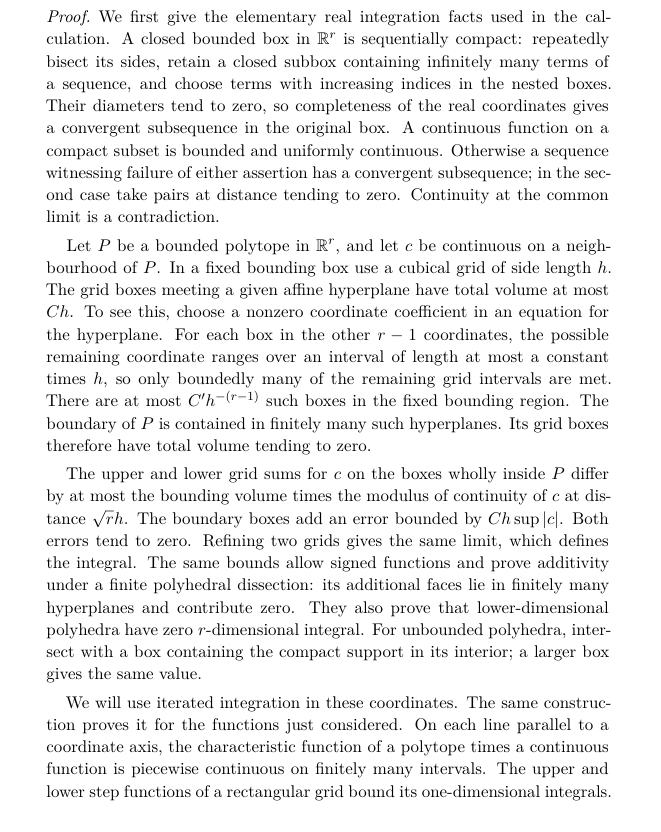
\begin{proof}
We first give the elementary real integration facts used in
the calculation. A closed bounded box in $\mathbb R^r$ is
sequentially compact: repeatedly bisect its sides, retain a
closed subbox containing infinitely many terms of a sequence,
and choose terms with increasing indices in the nested boxes.
Their diameters tend to zero, so completeness of the real
coordinates gives a convergent subsequence in the original box.
A continuous function on a compact subset is bounded and
uniformly continuous. Otherwise a sequence witnessing failure
of either assertion has a convergent subsequence; in the second
case take pairs at distance tending to zero. Continuity at the
common limit is a contradiction.

Let $P$ be a bounded polytope in $\mathbb R^r$, and let $c$
be continuous on a neighbourhood of $P$. In a fixed bounding
box use a cubical grid of side length $h$. The grid boxes
meeting a given affine
hyperplane have total volume at most $C h$. To see this,
choose a nonzero coordinate coefficient in an equation for
the hyperplane. For each box in the other $r-1$ coordinates,
the possible remaining coordinate ranges over an interval of
length at most a constant times $h$, so only boundedly many
of the remaining grid intervals are met. There are at most
$C' h^{-(r-1)}$ such boxes in the fixed bounding region.
The boundary of $P$ is contained in finitely many such
hyperplanes. Its grid boxes therefore have total volume
tending to zero.

The upper and lower grid sums for $c$ on the boxes wholly
inside $P$ differ by at most the bounding volume times the
modulus of continuity of $c$ at distance $\sqrt r h$.
The boundary boxes add an error bounded by $C h\sup|c|$.
Both errors tend to zero. Refining two grids gives the same
limit, which defines the integral. The same bounds allow
signed functions and prove additivity under a finite
polyhedral dissection: its additional faces lie in finitely
many hyperplanes and contribute zero. They also prove that
lower-dimensional polyhedra have zero $r$-dimensional integral.
For unbounded polyhedra, intersect with a box containing the
compact support in its interior; a larger box gives the same
value.

We will use iterated integration in these coordinates. The
same construction proves it for the functions just considered.
On each line parallel to a coordinate axis, the characteristic
function of a polytope times a continuous function is
piecewise continuous on finitely many intervals. The upper
and lower step functions of a rectangular grid bound its
one-dimensional integrals. Integrating these step functions
in the remaining variables gives exactly their rectangular
grid sums. Their difference tends to zero by the preceding
estimates. Thus both orders of integration have the same
limit. This argument also proves existence of the required
outer integrals; it does not assume an interchange theorem.

One-dimensional translation and scaling follow directly by
translating or scaling interval subdivisions. Interchanging
coordinates follows from the equality of iterated integrals.
A shear $x_i\mapsto x_i+c x_j$ preserves the integral, because
after fixing all other coordinates it is a translation in
$x_i$. Every invertible real matrix is a product of shears,
coordinate interchanges and nonzero diagonal scalings, by
Gaussian elimination. Hence ordinary real change of variables
for an invertible affine map with linear matrix $L$ has factor
$|\det L|$. All the intermediate regions are polyhedra, so
the preceding integral constructions apply at every step.

In integral bases, pullback of a top superform contributes
$(\det L)^2$, one determinant from each exterior factor.
The scalar change of variables contributes $|\det L|^{-1}$.
Their product is $|\det L|$. For a full-rank integral lattice
map this is $[N_\tau:F(N_\sigma)]$, by the integer basis
calculation in Lemma~\ref{cand:elementarylatticesplitting}.
A change of integral basis has determinant $\pm1$, proving
independence of the normalization. If the rank is less than
$d$, the pullback on $\bigwedge^d$ is zero. This proves the
first assertions.

For completeness, the one-dimensional derivative formula
also follows from the same integral. If $g$ is continuous,
the difference quotient of $G(t)=\int_a^t g(s)\,ds$ lies
between the minimum and maximum of $g$ on the intervening
interval; hence $G'=g$. A function with zero derivative is
constant by the mean value argument: a continuous function
on a closed interval attains its extrema by the compactness
just proved, an interior extremum of a differentiable function
has derivative zero, and subtraction of the line through
the endpoint values gives Rolle's argument. Applying this to
a $C^1$ function minus the primitive of its derivative gives
\[
                       \int_a^b h'(s)\,ds=h(b)-h(a).
\]

Apply this identity on the coordinate lines through a
polyhedron, followed by the established iterated integration.
For a coordinate $x_j$, almost every such line meets a bounded
convex polytope in an interval. Its endpoints lie on facets;
the projections of intersections of distinct facets have
dimension at most $r-2$ and have zero $(r-1)$-dimensional
integral by the grid estimate. On a facet written
$x_j=\ell(\widehat x_j)$ the endpoint sign is the sign of
the $j$-th outward normal component. Give the facet its
Euclidean measure in orthonormal affine coordinates; the
proved linear change of variables computes this measure in
any other affine parametrization. The graph's Euclidean
area factor is $\sqrt{1+|\nabla\ell|^2}$, obtained by taking
the determinant of the Gram matrix
$I+\nabla\ell\,\nabla\ell^{\mathsf t}$.
The absolute value of the corresponding unit-normal component
is its reciprocal. Thus the endpoint integral is exactly
the facet integral of that normal component times the
coefficient. Facets parallel to these lines have zero normal
component and give no term. Summing over $j$ proves the
divergence formula on a polytope for a $C^1$ vector field.
The argument applies to an unbounded polyhedron with compact
support by cutting with a box outside the support; all the
new facet terms vanish.

We now apply this coefficient formula to $\beta$. Put
$s_d=(-1)^{d(d-1)/2}$. In coordinates for any integral basis
of $N_\sigma$, write its tangential restriction uniquely as
\[
 \beta=s_d\sum_{j=1}^d(-1)^{j-1}b_j\,
       d'x_1\wedge\cdots\widehat{d'x_j}\cdots\wedge d'x_d
          \wedge d''x_1\wedge\cdots\wedge d''x_d.
\]
Direct differentiation gives
$d'\beta=(\sum_j\partial_j b_j)\omega_{N_\sigma}$.
At a facet, the chosen basis of $N_\tau$ followed by
$u_{\sigma/\tau}$ is an integral basis of $N_\sigma$:
the quotient is free of rank one and its indicated element
is primitive. This is again
Lemma~\ref{cand:elementarylatticesplitting}.
Use its affine coordinates $(t_1,\ldots,t_{d-1},s)$, with
the facet in $s=0$ and the polyhedron locally in $s\geq0$.
The divergence contribution of this facet is
$-b_d(t,0)\,dt_1\cdots dt_{d-1}$. On the other hand,
\[
 \beta(v_1',\ldots,v_{d-1}';
          v_1'',\ldots,v_{d-1}'',u_{\sigma/\tau}'')
                   =s_d(-1)^{d-1}b_d(t,0).
\]
The ratio of these two expressions is
$(-1)^d s_d=(-1)^{d(d+1)/2}$. A unimodular change of
cell coordinates has absolute determinant one; the two
exterior factors and the scalar change of variables above
therefore preserve this facet calculation. This proves
\eqref{v037:eq:superstokes} for all facets with one common
sign. A basis change in $N_\tau$ contributes its determinant
twice, and a change of the lift by a tangent vector gives
a repeated vector in the double-primed alternating factor.
These observations prove the last assertion.
\end{proof}
Standing context 1 · exact TeX
\begin{definition}[Lattice normalization for real superforms]
\label{v037:integration:conventions}
On an open subset of $N_{\mathbb R}$, a real superform of
bidegree $(p,q)$ is a smooth function with values in
$\bigwedge^pN_{\mathbb R}^{\prime *}\otimes
 \bigwedge^qN_{\mathbb R}^{\prime\prime *}$.
All one-form generators anticommute. The operators $d'$ and
$d''$ differentiate coefficients and wedge the corresponding
primed or double-primed differential on the left.
The involution $J$ exchanges the two copies and fixes functions.
In particular $d''=Jd'J$, as is checked on a coefficient and
on the constant one-form generators.

For an affine $d$-plane with tangent lattice $M$, choose an
integral basis and its affine coordinates $x_1,\ldots,x_d$.
Use the positive top generator
\[
 \omega_M=d'x_1\wedge d''x_1\wedge\cdots\wedge d'x_d\wedge d''x_d.
\]
The lattice-normalized integral of $c\omega_M$ on a polyhedron
is the ordinary real integral of $c$ in these coordinates.
A form is restricted to a polyhedron by restricting both
cotangent factors to its affine span. Its support on a weighted
complex is the closure, in that complex, of the points in the
relative interiors of its maximal cells where this restriction
is nonzero, after discarding cells of weight zero. Compact
support below refers to this support.
\end{definition}
Typeset reader excerpt
Typed proof inputs
- BASE-LINEAR · standing context or base
- BASE-LINEAR · standing context or base (requires)
- BASE-REAL · standing context or base
- BASE-REAL · standing context or base (requires)
- BASE-TOPOLOGY · standing context or base
- BASE-TOPOLOGY · standing context or base (requires)
- NAG-002179 · selected whole
- NAG-002179 · selected whole (requires)
Reader cross-references
Proof map
Verified map inputs · NAG-002389
Registered proof input
- NAG-002179 · Primitive vectors and saturated lattices · accepted whole
Standing context and base inputs
BASE-LINEARBASE-REALBASE-TOPOLOGY
NAG-002389 · The real polyhedral integration calculation · Chapter argument