NAG-002413 · Accepted whole
Purity is local on affinoid covers
5 Tropicalization, multiplicities and balancing
Open in the English reader · PDF page 1035
Statement · exact TeX
\begin{lemma}[Purity is local on affinoid covers]
\label{v037:integration:puritylocality}
Let $V_1,\ldots,V_s$ be a finite affinoid-domain cover of
a nonempty affinoid $X$. Then $X$ is pure of analytic
dimension $d$ if and only if every nonempty $V_i$ is so.
Consequently every nonempty affinoid domain of a good
Hausdorff space pure of analytic dimension $d$ is pure of
analytic dimension $d$.
\end{lemma}
Full selected proof · exact TeX
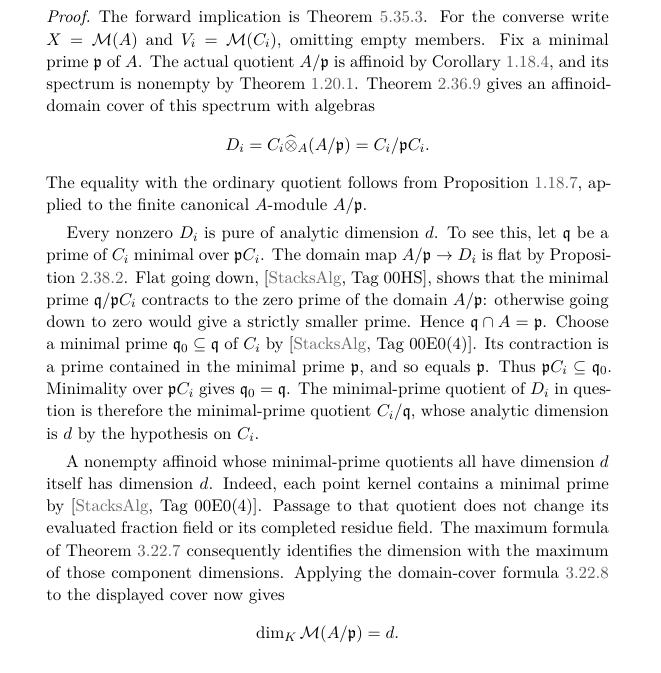
\begin{proof}
The forward implication is Theorem~\ref{v036:analytic:domainpurity}.
For the converse write $X=\mathcal M(A)$ and
$V_i=\mathcal M(C_i)$, omitting empty members.
Fix a minimal prime $\mathfrak p$ of $A$.
The actual quotient $A/\mathfrak p$ is affinoid by
Corollary~\ref{fnd:generalizedaffinoidquotients}, and its
spectrum is nonempty by
Theorem~\ref{fnd:generalizedpointunitcriterion}.
Theorem~\ref{fnd:generalizeddomainbasechange} gives an
affinoid-domain cover of this spectrum with algebras
\[
 D_i=C_i\widehat\otimes_A(A/\mathfrak p)
                         =C_i/\mathfrak pC_i.
\]
The equality with the ordinary quotient follows from
Proposition~\ref{fnd:generalizedfinitetensor}, applied to
the finite canonical $A$-module $A/\mathfrak p$.

Every nonzero $D_i$ is pure of analytic dimension $d$.
To see this, let $\mathfrak q$ be a prime of $C_i$
minimal over $\mathfrak pC_i$. The domain map
$A/\mathfrak p\to D_i$ is flat by
Proposition~\ref{fnd:generalizeddomainflatness}.
Flat going down, \cite[Tag 00HS]{StacksAlg}, shows that
the minimal prime $\mathfrak q/\mathfrak pC_i$ contracts
to the zero prime of the domain $A/\mathfrak p$:
otherwise going down to zero would give a strictly
smaller prime. Hence $\mathfrak q\cap A=\mathfrak p$.
Choose a minimal prime $\mathfrak q_0\subseteq\mathfrak q$
of $C_i$ by \cite[Tag 00E0(4)]{StacksAlg}.
Its contraction is a prime contained in the minimal prime
$\mathfrak p$, and so equals $\mathfrak p$.
Thus $\mathfrak pC_i\subseteq\mathfrak q_0$.
Minimality over $\mathfrak pC_i$ gives
$\mathfrak q_0=\mathfrak q$. The minimal-prime quotient
of $D_i$ in question is therefore the minimal-prime
quotient $C_i/\mathfrak q$, whose analytic dimension is
$d$ by the hypothesis on $C_i$.

A nonempty affinoid whose minimal-prime quotients all
have dimension $d$ itself has dimension $d$.
Indeed, each point kernel contains a minimal prime by
\cite[Tag 00E0(4)]{StacksAlg}. Passage to that quotient
does not change its evaluated fraction field or its
completed residue field. The maximum formula of
Theorem~\ref{fnd:affinoidabhyankarmaximum} consequently
identifies the dimension with the maximum of those
component dimensions. Applying the domain-cover formula
\ref{fnd:affinoiddimensiondomaincover} to the displayed
cover now gives
\[
                         \dim_K\mathcal M(A/\mathfrak p)=d.
\]
This holds for every minimal prime of $A$, proving purity.
All dimensions here are analytic; no generalized Krull
dimension comparison is used.

For the last assertion let $V$ be a nonempty affinoid
domain of the good Hausdorff space. Its compact underlying
space is covered by finitely many pure affinoid
neighbourhoods $W_j$ of points of $X$. By
Lemma~\ref{v037:integration:separatedintersections},
the sets $V\cap W_j$ are affinoid domains of $W_j$.
Their nonempty members are pure of dimension $d$ by
Theorem~\ref{v036:analytic:domainpurity}. They cover $V$,
so the implication just proved applies to $V$.
\end{proof}
Typeset reader excerpt
Typed proof inputs
- NAG-001496 · selected whole
- NAG-001562 · selected whole
- NAG-001565 · selected whole
- NAG-001572 · selected whole
- NAG-001591 · selected whole
- NAG-001592 · selected whole
- NAG-001832 · selected whole, export unavailable
- NAG-001846 · selected whole
- NAG-002293 · selected whole
- NAG-002411 · selected whole
- NAG-001496 · selected whole (requires)
- NAG-001562 · selected whole (requires)
- NAG-001565 · selected whole (requires)
- NAG-001572 · selected whole (requires)
- NAG-001591 · selected whole (requires)
- NAG-001592 · selected whole (requires)
- NAG-001832 · selected whole, export unavailable (requires)
- NAG-001846 · selected whole (requires)
- NAG-002293 · selected whole (requires)
- NAG-002411 · selected whole (requires)
Reader cross-references
Proof map
Verified map inputs · NAG-002413
AND · joint registered proof inputs
- NAG-001496 · Compactness of the bounded spectrum · accepted whole
- NAG-001562 · Actual quotients by arbitrary ideals · accepted whole
- NAG-001565 · Finite tensors with generalized affinoid targets · accepted whole
- NAG-001572 · Nonemptiness and the unit-ideal test · accepted whole
- NAG-001591 · Dimension as a maximum over analytic points · accepted whole
- NAG-001592 · Dimension of domains and affinoid covers · accepted whole
- NAG-001832 · Result 2.38.2 · accepted whole; PDF destination
- NAG-001846 · Affinoid domains under arbitrary affinoid base change · accepted whole
- NAG-002293 · Purity of affinoid domains · accepted whole
- NAG-002411 · Affinoid intersections in a separated good space · accepted whole
NAG-002413 · Purity is local on affinoid covers · Chapter argument