NAG-002434 · Accepted whole
Unchanged value group and a unit degree
Open in the English reader · PDF page 812
Statement · exact TeX
\begin{proposition}[Unchanged value group and a unit degree]
\label{v038:f5:unitdegreeunramified}
Let $L/H$ be a finite extension of degree $n$. Suppose that
\[
       |L^\times|=|H^\times|,\qquad |n|=1,
       \qquad \widetilde L/\widetilde H\text{ is separable}.
\]
Then
\[
                       [L:H]=[\widetilde L:\widetilde H].
\]
More precisely, $L$ is generated by a root of a monic polynomial
over $H^\circ$ with irreducible separable reduction. Lifts of any
$\widetilde H$-basis of $\widetilde L$ form an orthonormal
$H$-basis of $L$ and an $H^\circ$-basis of $L^\circ$.
\end{proposition}
Full selected proof · exact TeX
\begin{proof}
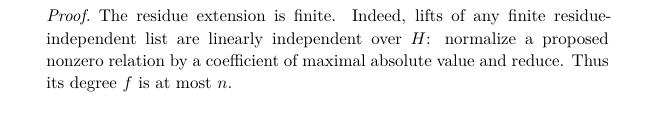
The residue extension is finite. Indeed, lifts of any finite
residue-independent list are linearly independent over $H$:
normalize a proposed nonzero relation by a coefficient of maximal
absolute value and reduce. Thus its degree $f$ is at most $n$.

Choose a primitive residue element $\bar b$ by
\cite[Tag 030N]{StacksAlg}. Lift its monic minimal polynomial
to $Q\in H^\circ[T]$, of degree $f$.
The simple-root construction in
Lemma~\ref{cand:completevaluationhenselian}, applied to $L$,
gives a root $b\in L^\circ$ with residue $\bar b$.
The powers $1,b,\ldots,b^{f-1}$ are residue-independent and hence
linearly independent over $H$. Since $Q(b)=0$, the intermediate
field $E=H(b)$ has degree $f$. The same normalization of a linear
combination proves
\[
          \left|\sum_{i=0}^{f-1}c_i b^i\right|=
                            \max_i|c_i| \qquad(c_i\in H).
\]
It follows that $E^\circ=\sum_i H^\circ b^i$,
$\widetilde E=\widetilde L$, and $|E^\times|=|H^\times|$.
The field $E$ is complete by Lemma~\ref{fnd:finiteextensionnorms}.
Consequently $L/E$ is immediate.

Put $m=[L:E]$, so $n=mf$. Both integers have absolute value at
most one, and $|n|=1$ forces $|m|=1$.
Lemma~\ref{v038:f5:contractivetrace} now gives $L=E$.
This proves the degree equality and the monic presentation.
For any other lifted residue basis, the reduction of its
change-of-basis matrix is invertible. Its determinant is a unit
of $H^\circ$, so the inverse matrix is integral by the adjugate
formula. The same reduction argument gives the asserted norm
identity and the two basis assertions.
\end{proof}
Standing context 1 · exact TeX
All valued fields in this section are complete for their specified
nontrivial real-valued non-Archimedean absolute values. For a valued
field $H$, write $H^\circ$, $H^{\circ\circ}$ and $\widetilde H$
for its valuation ring, maximal ideal and residue field. The trace is
the trace of the finite-dimensional multiplication operator.
Typeset reader excerpt
Typed proof inputs
- APP-STACKS-030N@NAG-002434:original-proof · named external application (new exact application of frozen Stacks authority)
- NAG-001450 · selected whole (sealed native whole)
- NAG-002049 · selected whole (sealed native whole)
- NAG-002433 · selected whole (sealed native whole)
- STACKS-030N · named external application (new exact application of frozen Stacks authority)
- APP-STACKS-030N@NAG-002434:original-proof · named external application
- APP-STACKS-030N@NAG-002434:original-proof · named external application (requires)
- NAG-001450 · selected whole
- NAG-001450 · selected whole (requires)
- NAG-002049 · selected whole
- NAG-002049 · selected whole (requires)
- NAG-002433 · selected whole
- NAG-002433 · selected whole (requires)
Reader cross-references
Proof map
Verified map inputs · NAG-002434
AND · joint registered proof inputs
- NAG-001450 · Finite-dimensional norms and finite field extensions · accepted whole Exact source window 108–111
- NAG-002049 · Simple roots over a complete valued field · accepted whole Exact source window 97–102
- NAG-002433 · A contractive normalized trace · accepted whole Exact source window 113–116
Unlinked source pointers
These pointers have no operative linked edge in this map.
APP-STACKS-030N@NAG-002434:original-proofSTACKS-030N
NAG-002434 · Unchanged value group and a unit degree · Chapter argument