NAG-002439 · Accepted whole
Result 4.55.2
Open in the English reader · PDF page 817
Statement · exact TeX
\begin{proposition}[An explicit immediate extension of degree $p$]
\label{v038:f5:explicitimmediateextension}
Fix a prime $p$, a real number $0<\rho<1$, and symbols
$q_0,q_1,\ldots$ with $q_{m+1}^p=q_m$. Put
\[
 K_m=\mathbf F_p((q_m)),\qquad |q_m|=\rho^{1/p^m},
 \qquad K=\widehat{\bigcup_{m\geq0}K_m},\qquad q=q_0.
\]
Then $K$ is a complete field with a nondiscrete real-valued
absolute value and
\[
        |K^\times|=\rho^{\mathbf Z[1/p]},\qquad
                         \widetilde K=\mathbf F_p.
\]
The polynomial $P(S)=S^p-S-q^{-1}$ is irreducible over $K$.
For a root $\alpha$ and $L=K(\alpha)$, the unique extending
absolute value makes $L/K$ a degree-$p$ immediate extension.
\end{proposition}
Full selected proof · exact TeX
\begin{proof}
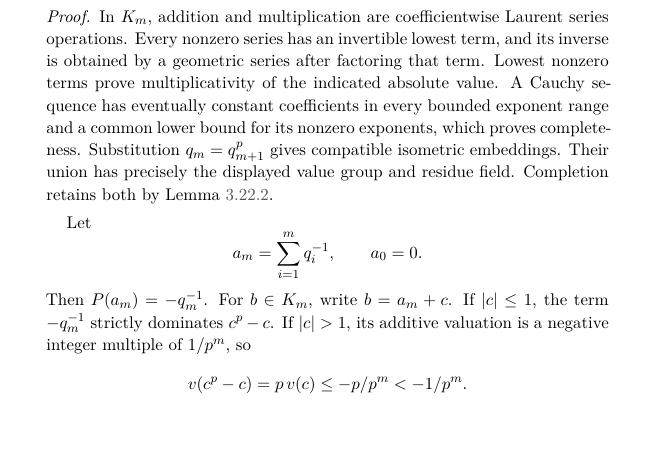
In $K_m$, addition and multiplication are coefficientwise Laurent
series operations. Every nonzero series has an invertible lowest
term, and its inverse is obtained by a geometric series after
factoring that term. Lowest nonzero terms prove multiplicativity
of the indicated absolute value. A Cauchy sequence has eventually
constant coefficients in every bounded exponent range and a
common lower bound for its nonzero exponents, which proves
completeness. Substitution $q_m=q_{m+1}^p$ gives compatible
isometric embeddings. Their union has precisely the displayed
value group and residue field. Completion retains both by
Lemma~\ref{fnd:valuedfielddimensioncalculus}.

Let
\[
                  a_m=\sum_{i=1}^m q_i^{-1},\qquad a_0=0.
\]
Then $P(a_m)=-q_m^{-1}$. For $b\in K_m$, write $b=a_m+c$.
If $|c|\leq1$, the term $-q_m^{-1}$ strictly dominates
$c^p-c$. If $|c|>1$, its additive valuation is a negative
integer multiple of $1/p^m$, so
\[
                    v(c^p-c)=p\,v(c)\leq-p/p^m<-1/p^m.
\]
Here $v(q)=1$ is used only to name the exponents; the absolute
value remains $|q|=\rho$. It follows in either case that
\[
                         |P(b)|\geq\rho^{-1/p^m}>1.
\]
If $P$ had a root $\beta\in K$, density would give $b\in K_m$
with $|b-\beta|<1$. But then
$P(b)=(b-\beta)^p-(b-\beta)$ would have norm less than one,
a contradiction.

Choose a root $\alpha$ in an algebraic closure supplied by
\cite[Tag 09GT]{StacksAlg}. All roots of $P$ are the distinct
elements $\alpha+c$, $c\in\mathbf F_p$. If the minimal
polynomial of $\alpha$ had degree $d$ with $0<d<p$, its
next-to-leading coefficient would be
$-d\alpha-\sum_{i=1}^d c_i\in K$ for some $c_i\in\mathbf F_p$.
Since $d\ne0$ in $\mathbf F_p$, this would give $\alpha\in K$.
Thus $P$ is irreducible of degree $p$.
Equip $L$ with its unique complete extending absolute value by
Lemma~\ref{fnd:finiteextensionnorms}.

Write $\beta_m=\alpha-a_m$. Its equation is
\[
                  \beta_m^p-\beta_m=q_m^{-1}.
\]
The right side has norm greater than one. Hence
$|\beta_m|=\rho^{-1/p^{m+1}}$.
The norm-one element $y_m=q_{m+1}\beta_m$ satisfies
\[
                 y_m^p-q_{m+1}^{p-1}y_m=1.
\]
Its residue therefore satisfies $\bar y_m^p=1$, and equals
one in the residue field of characteristic $p$.

Take $0\ne x\in L$. Write it in the basis
$1,\alpha,\ldots,\alpha^{p-1}$. Approximate its finitely many
coefficients by elements of one $K_m$, obtaining
$x_m=\sum_{j<p}d_j\alpha^j$ with $d_j\in K_m$ and
$|x-x_m|<|x|$. Expanding $\alpha=a_m+\beta_m$ writes
$x_m=\sum_{j<p}b_j\beta_m^j$ with $b_j\in K_m$.
The nonzero terms have pairwise different valuations:
\[
                  v(b_j\beta_m^j)=v(b_j)-j/p^{m+1},
                    \qquad v(b_j)\in p^{-m}\mathbf Z.
\]
Indeed their numerators modulo $p$ distinguish the indices
$0\leq j<p$. Let $j$ index the unique term of largest norm,
and put $h=b_jq_{m+1}^{-j}\in K^\times$.
Then $|h|=|x_m|=|x|$, while the residue of $x_m/h$ is
$\bar y_m^j=1$. The strict approximation gives the same
residue for $x/h$. Every nonzero element of $L$ consequently
has a value already in $K$, and every norm-one element has
residue in $\mathbf F_p$. This proves immediacy.
\end{proof}
Typeset reader excerpt
Typed proof inputs
- APP-STACKS-09GT@NAG-002439:actual-field-algebraic-closure · named external application (verified Stacks application)
- BASE-RINGS · standing context or base (declared elementary base)
- BASE-TOPOLOGY · standing context or base (declared elementary base)
- NAG-001450 · selected whole (whole proof)
- NAG-001586 · selected whole, export unavailable (whole proof)
- APP-STACKS-09GT@NAG-002439:actual-field-algebraic-closure · named external application
- APP-STACKS-09GT@NAG-002439:actual-field-algebraic-closure · named external application (requires)
- BASE-RINGS · standing context or base
- BASE-RINGS · standing context or base (requires)
- BASE-TOPOLOGY · standing context or base
- BASE-TOPOLOGY · standing context or base (requires)
- NAG-001450 · selected whole
- NAG-001450 · selected whole (requires)
- NAG-001586 · selected whole, export unavailable
- NAG-001586 · selected whole, export unavailable (requires)
Reader cross-references
Proof map
Verified map inputs · NAG-002439
AND · joint registered proof inputs
- NAG-001450 · Finite-dimensional norms and finite field extensions · accepted whole
- NAG-001586 · Result 3.22.2 · accepted whole; PDF destination
Standing context and base inputs
BASE-RINGSBASE-TOPOLOGY
Unlinked source pointers
These pointers have no operative linked edge in this map.
APP-STACKS-09GT@NAG-002439:actual-field-algebraic-closure