NAG-002442 · Accepted whole
Effective descent of an equivariant unramified model
Open in the English reader · PDF page 821
Statement · exact TeX
\begin{proposition}[Effective descent of an equivariant unramified model]
\label{v038:f5:unramifiedeffectivemodel}
Let $L/K$ be the finite unramified Galois lift of a finite
Galois residue extension, put $O'=L^\circ$, and write
$G=\operatorname{Gal}(L/K)$. Let $C/K$ be smooth, projective
and geometrically connected, and let $D$ be an unramified
marking datum on $C$.

Suppose a semistable algebraic model $\mathcal Y/O'$ of
$C_L$, marked by $D_{O'}$, has a semilinear $G$-action
whose generic action is the canonical coefficient action
on $C_L$ and whose action on the marking is the canonical
action on $D_{O'}$. Then there is a marked semistable
algebraic model $\mathcal X/O$ of $(C,D)$ and a compatible
$G$-equivariant isomorphism
\[
                     \mathcal X\times_O O'\simeq\mathcal Y.
\]
The projection $\mathcal Y\to\mathcal X$ is finite
\textup{\'etale} of constant rank $[L:K]$. Descent is unique
up to unique marked generic-identity isomorphism. Marked
generic-identity morphisms between two such equivariant
models descend uniquely if and only if they are
$G$-equivariant.
\end{proposition}
Full selected proof · exact TeX
\begin{proof}
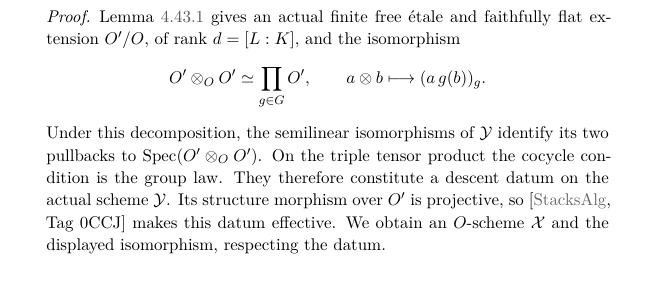
Lemma~\ref{v036:f5:unramifiedcoefficients} gives an actual
finite free \textup{\'etale} and faithfully flat extension
$O'/O$, of rank $d=[L:K]$, and the isomorphism
\[
 O'\otimes_O O'\simeq\prod_{g\in G}O',\qquad
              a\otimes b\longmapsto(a\,g(b))_g.
\]
Under this decomposition, the semilinear isomorphisms
of $\mathcal Y$ identify its two pullbacks to
$\operatorname{Spec}(O'\otimes_O O')$. On the triple
tensor product the cocycle condition is the group law.
They therefore constitute a descent datum on the actual
scheme $\mathcal Y$. Its structure morphism over $O'$
is projective, so \cite[Tag 0CCJ]{StacksAlg} makes this
datum effective. We obtain an $O$-scheme $\mathcal X$
and the displayed isomorphism, respecting the datum.

Fully faithful descent for schemes,
\cite[Tag 02W0]{StacksAlg}, descends the specified generic
isomorphism with $C_L$ and its inverse to an isomorphism
$\mathcal X_K\simeq C$. It also descends the equivariant
map $D_{O'}\to\mathcal Y$ to a map $D\to\mathcal X$.
The latter is a closed immersion by
\cite[Tag 02L6]{StacksAlg}. The morphism
$\mathcal X\to\operatorname{Spec}O$ is of finite
presentation and proper by \cite[Tags 02L0, 02L1]{StacksAlg}.
It is flat and at-worst-nodal of relative dimension one
by \cite[Tag 0C5E]{StacksAlg}. These descent assertions
apply over the valuation ring itself, without a
Noetherian hypothesis.

The special fibre is geometrically connected and reduced.
Indeed, for any extension $k'/k$ choose a common field
$E$ receiving $k'$ and $l=\widetilde L$. Such a field is
obtained from a maximal proper ideal of the nonzero
finite-dimensional $k'$-algebra $k'\otimes_k l$; an ideal
of maximal possible proper vector-space dimension is
maximal. The base change $\mathcal X_{k'}\times_{k'}E$
is the base change of $\mathcal Y_l$ to $E$, and is
connected and reduced. Projection onto $\mathcal X_{k'}$
is surjective: at any point its fibre algebra is the
nonzero finite-dimensional tensor of its residue field
with $E$, which has a field quotient by the same
argument. Thus $\mathcal X_{k'}$ is connected.
Its affine coordinate rings inject into their scalar
extensions to $E$, so their nilpotents are zero.
This proves both geometric assertions for every $k'$.

The marked points belong to the relative smooth locus.
At a point $z$ of $D$, choose a point $z'$ of $D_{O'}$
above it. Differentials commute with this base change,
as is seen from their universal property for derivations.
Consequently
\[
 (\Omega_{\mathcal X/O}\otimes\kappa(z))
                     \otimes_{\kappa(z)}\kappa(z')
       \simeq\Omega_{\mathcal Y/O'}\otimes\kappa(z').
\]
The vector space on the right has dimension one, because
$\mathcal Y$ is smooth of relative dimension one along
its marking. The vector space before scalar extension
therefore also has dimension one. The fibre of
$\mathcal X/O$ has local dimension one at $z$; its
marking is finite over the base, so $z$ is closed in
that fibre. Flatness and the differential criterion
\cite[Tag 01V9(4)]{StacksAlg} show that $\mathcal X/O$
is smooth at $z$.

It remains to recover projectivity. The projection
$q:\mathcal Y\to\mathcal X$ is the base change of
$\operatorname{Spec}O'\to\operatorname{Spec}O$.
It is finite free of rank $d$ on every affine open,
surjective, and \textup{\'etale} by
\cite[Tag 02GO]{StacksAlg}.
Because $O'$ is affine and $\mathcal Y/O'$ is
projective, $\mathcal Y$ has an ample invertible sheaf
by \cite[Tag 0B45]{StacksAlg}.
The finite locally free case of
\cite[Tag 0BD4(1)]{StacksAlg} gives an ample invertible
sheaf on $\mathcal X$. Together with properness over
the affine base, \cite[Tag 0B45]{StacksAlg} now makes
$\mathcal X/O$ projective. This norm argument uses
the finite locally free rank $d$; it involves no
division by $d$.

All the requirements of the stated model category
are now satisfied. Finally \cite[Tag 02W0]{StacksAlg}
gives uniqueness of descent and full faithfulness on
the indicated morphisms. The generic and marking
compatibilities can be tested after the same faithful
base change, so descend with the morphisms. Two
generic-identity morphisms between the descended models
are equal: their equalizer is closed by separatedness,
and contains the schematically dense generic fibre of
the flat source. On an affine open, this density is
the injection of its torsion-free coordinate ring
into its generic localization.
\end{proof}
Standing context 1 · exact TeX
\section{Semistable models after finite unramified extension}
\label{v038:f5:unramifiedexistencesection}

Let $K$ be a complete nontrivially real-valued field with its
specified absolute value, and put $O=K^\circ$ and $k=\widetilde K$.
Finite unramified extensions mean the lifts of finite separable
residue extensions constructed in Lemma~\ref{cand:residueextensionlift}.
Their absolute values extend the original one. We use the
projective flat finitely presented nodal models of
Definition~\ref{v036:f5:modelclass} and the unramified marking
data of Definition~\ref{v037:f5:unramifieddatum}.
Typeset reader excerpt
Typed proof inputs
- NAG-002262 · selected whole (sealed native whole)
- STACKS-02L1 · named external application (existing frozen Stacks authority and named consumer)
- STACKS-02L6 · named external application (existing frozen Stacks authority and named consumer)
- STACKS-02W0 · named external application (existing frozen Stacks authority and named consumer)
- STACKS-0B45 · named external application (existing frozen Stacks authority and named consumer)
- STACKS-0BD4 · named external application (existing frozen Stacks authority and named consumer)
- STACKS-0CCJ · named external application (existing frozen Stacks authority and named consumer)
- APP-STACKS-02L1@NAG-002442:original-431-site-6 · named external application
- APP-STACKS-02L1@NAG-002442:original-431-site-6 · named external application (requires)
- APP-STACKS-02L6@NAG-002442:original-431-site-4 · named external application
- APP-STACKS-02L6@NAG-002442:original-431-site-4 · named external application (requires)
- APP-STACKS-02W0@NAG-002442:original-431-site-13 · named external application
- APP-STACKS-02W0@NAG-002442:original-431-site-13 · named external application (requires)
- APP-STACKS-02W0@NAG-002442:original-431-site-3 · named external application
- APP-STACKS-02W0@NAG-002442:original-431-site-3 · named external application (requires)
- APP-STACKS-0B45@NAG-002442:original-431-site-10 · named external application
- APP-STACKS-0B45@NAG-002442:original-431-site-10 · named external application (requires)
- APP-STACKS-0B45@NAG-002442:original-431-site-12 · named external application
- APP-STACKS-0B45@NAG-002442:original-431-site-12 · named external application (requires)
- APP-STACKS-0BD4@NAG-002442:original-431-site-11 · named external application
- APP-STACKS-0BD4@NAG-002442:original-431-site-11 · named external application (requires)
- APP-STACKS-0CCJ@NAG-002442:original-431-site-2 · named external application
- APP-STACKS-0CCJ@NAG-002442:original-431-site-2 · named external application (requires)
- NAG-002262 · selected whole
- NAG-002262 · selected whole (requires)
Named external registrations
- APP-STACKS-02L1@NAG-002442:original-431-site-6
- APP-STACKS-02L6@NAG-002442:original-431-site-4
- APP-STACKS-02W0@NAG-002442:original-431-site-13
- APP-STACKS-02W0@NAG-002442:original-431-site-3
- APP-STACKS-0B45@NAG-002442:original-431-site-10
- APP-STACKS-0B45@NAG-002442:original-431-site-12
- APP-STACKS-0BD4@NAG-002442:original-431-site-11
- APP-STACKS-0CCJ@NAG-002442:original-431-site-2
Reader cross-references
Proof map
Verified map inputs · NAG-002442
Registered proof input
- NAG-002262 · Integral Galois descent for unramified coefficients · accepted whole
Exact named external applications
- APP-STACKS-02L1@NAG-002442:original-431-site-6
- Properness descends along the actual coefficient cover
- APP-STACKS-02L6@NAG-002442:original-431-site-4
- The descended actual marking is closed immersion after faithfully flat check
- APP-STACKS-02W0@NAG-002442:original-431-site-13
- Full faithfulness and uniqueness on actual generic-identity morphisms
- APP-STACKS-02W0@NAG-002442:original-431-site-3
- Descend the actual generic identification, inverse and marking map under the compatible datum
- APP-STACKS-0B45@NAG-002442:original-431-site-10
- Projectivity over affine O′ supplies an ample invertible sheaf
- APP-STACKS-0B45@NAG-002442:original-431-site-12
- Properness plus ample invertible sheaf over affine O gives projectivity
- APP-STACKS-0BD4@NAG-002442:original-431-site-11
- Part (1) along the finite locally free actual projection produces an ample invertible sheaf on the descended model
- APP-STACKS-0CCJ@NAG-002442:original-431-site-2
- Actual surjective finite locally free coefficient cover and ordinary projective morphism supply effective scheme descent
- APP:STACKS-01V9@NAG-002442:actual_closed_marking_point_smooth
- Part (4) at a closed marking point in its one-dimensional fibre, using flat finite presentation and fibre cotangent dimension one
- APP:STACKS-02GO@NAG-002442:actual_projection_etale
- Base change of the actual finite free étale valuation coefficient map
- APP:STACKS-02L0@NAG-002442:actual_model_finite_presentation
- Actual O′ finite faithfully flat coefficient cover detects finite presentation of the descended O-model
- APP:STACKS-0C5E@NAG-002442:actual_model_nodal
- Flat nodal relative dimension one descends for this actual coefficient cover
NAG-002442 · Effective descent of an equivariant unramified model · Chapter argument