NAG-002448 · Accepted whole
Norm rigidity from a graded algebraic initial form
5 Tropicalization, multiplicities and balancing
Open in the English reader · PDF page 1054
Statement · exact TeX
\begin{lemma}[Norm rigidity from a graded algebraic initial form]
\label{v038:pointed:rigidity}
Let $X$ be a good $K$-analytic space, let $x\in X$, and let
$f$ be an analytic unit on an ordinary neighbourhood of $x$.
If $\widetilde{f(x)}\in F_x$ is algebraic over $k$, there is
an ordinary neighbourhood $U$ of $x$ on which
\[
                         |f(y)|=|f(x)|\qquad(y\in U).
\]
For a finite tuple of units the same assertion holds
simultaneously when all its initial forms are algebraic over $k$.
No interior or purity hypothesis is required.
\end{lemma}
Full selected proof · exact TeX
\begin{proof}
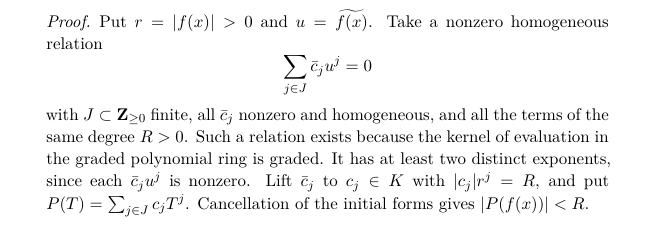
Put $r=|f(x)|>0$ and $u=\widetilde{f(x)}$. Take a
nonzero homogeneous relation
\[
                  \sum_{j\in J}\bar c_j u^j=0
\]
with $J\subset\mathbf Z_{\ge0}$ finite, all $\bar c_j$
nonzero and homogeneous, and all the terms of the same
degree $R>0$. Such a relation exists because the kernel
of evaluation in the graded polynomial ring is graded.
It has at least two distinct exponents, since each
$\bar c_j u^j$ is nonzero. Lift $\bar c_j$ to
$c_j\in K$ with $|c_j|r^j=R$, and put
$P(T)=\sum_{j\in J}c_jT^j$. Cancellation of the
initial forms gives $|P(f(x))|<R$.

Choose $c$ with $|P(f(x))|<c<R$. By continuity, after
shrinking to an ordinary neighbourhood $U$ of $x$,
\[
                            |P(f(y))|<c.
\]
Write $a=\min J$ and $b=\max J$; then $a<b$. For a
positive real $q$ near $r$, the sizes of the terms are
\[
                         |c_j|q^j=R(q/r)^j.
\]
If $q>r$, the unique largest size is the $j=b$ term;
if $q<r$, it is the $j=a$ term. Choose $\varepsilon>0$
so that the maximum of these finitely many sizes is
strictly larger than $c$ whenever
$0<|\log(q/r)|<\varepsilon$.
Continuity of $|f|$ allows us to shrink $U$ further to
$|\log(|f(y)|/r)|<\varepsilon$. If $|f(y)|\ne r$,
the non-Archimedean strong triangle inequality gives
\[
              |P(f(y))|=\max_{j\in J}|c_j||f(y)|^j>c,
\]
a contradiction. The finite-tuple assertion follows by
intersecting the finitely many resulting neighbourhoods.
\end{proof}
Typeset reader excerpt
Typed proof inputs
- BASE-REAL · standing context or base
- BASE-REAL · standing context or base (requires)
- BASE-RINGS · standing context or base
- BASE-RINGS · standing context or base (requires)
- BASE-TOPOLOGY · standing context or base
- BASE-TOPOLOGY · standing context or base (requires)
Proof map
Verified map inputs · NAG-002448
No addressable selected proof input is recorded in this projection.
Standing context and base inputs
BASE-REALBASE-RINGSBASE-TOPOLOGY
NAG-002448 · Norm rigidity from a graded algebraic initial form · Chapter argument