NAG-002474 · Accepted whole
Sequences in a fixed coefficient presentation
Proper direct image on historical ordinary compact tests
Open in the English reader · PDF page 1909
Statement · exact TeX
\begin{proposition}[Sequences in a fixed coefficient presentation]
\label{f8cont:sequence}
For a linear functional $T:\E^{p,q}(X)\to\R$, the following are equivalent:
\begin{enumerate}[label=(\roman*)]
\item $T$ is continuous for either topology of Theorem~\ref{f8cont:topology}.
\item For every $s$ and every sequence $\eta^{(k)}\in H_s$ converging to
zero in all coefficient $C^\infty$ seminorms, $T(R_s\eta^{(k)})\to0$.
\end{enumerate}
This is a criterion for scalar functionals. It does not characterize all
convergent sequences in the full final test space.
\end{proposition}
Full selected proof · exact TeX
\begin{proof}
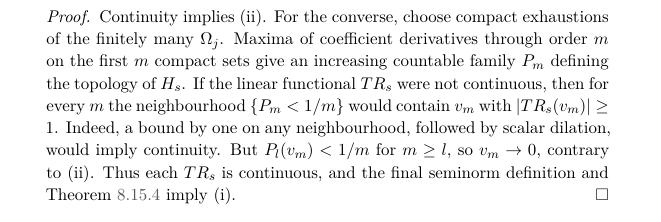
Continuity implies (ii). For the converse, choose compact exhaustions of
the finitely many $\Omega_j$. Maxima of coefficient derivatives through
order $m$ on the first $m$ compact sets give an increasing countable family
$P_m$ defining the topology of $H_s$. If the linear functional $TR_s$
were not continuous, then for every $m$ the neighbourhood
$\{P_m<1/m\}$ would contain $v_m$ with $|TR_s(v_m)|\geq1$.
Indeed, a bound by one on any neighbourhood, followed by scalar dilation,
would imply continuity. But $P_l(v_m)<1/m$ for $m\geq l$, so $v_m\to0$,
contrary to (ii). Thus each $TR_s$ is continuous, and the final seminorm
definition and Theorem~\ref{f8cont:topology} imply (i).
\end{proof}
Typeset reader excerpt
Typed proof inputs
- NAG-002473 · selected whole
Reader cross-references
Proof map
Verified map inputs · NAG-002474
Registered proof input
- NAG-002473 · Comparison of the two final topologies · accepted whole Exact source window 50–52
- fixed ordinary-stage continuity implies final continuity; the same test for either ordinary topology
NAG-002474 · Sequences in a fixed coefficient presentation · Chapter argument