NAG-002543 · Accepted whole
Finite locally free intersection lengths
Proper direct image on historical ordinary compact tests
Open in the English reader · PDF page 1913
Statement · exact TeX
\begin{proposition}[Finite locally free intersection lengths]\label{f9ds:lengthprojection}
Let $(A,\mathfrak m,k)$ be a Noetherian local ring and let $B$ be a
finite locally free $A$-algebra of constant rank $n\geq1$.
Let $a_1,\ldots,a_r$ be an $A$-regular sequence, and put
$I=(a_1,\ldots,a_r)$. Assume $A/I$ is nonzero and has finite length.
Then the sequence remains regular on $B$, and
\begin{equation}\label{eq:lengthprojection}
 \sum_{\mathfrak q\mid\mathfrak m}
 [\kappa(\mathfrak q):k]\,
 \length_{B_{\mathfrak q}}(B_{\mathfrak q}/IB_{\mathfrak q})
       =n\,\length_A(A/I).
\end{equation}
Every maximal ideal of $B$ is included. Residue degrees are full
degrees, including inseparable degrees; the quotient algebras are
not reduced before taking lengths.
\end{proposition}
Full selected proof · exact TeX
\begin{proof}
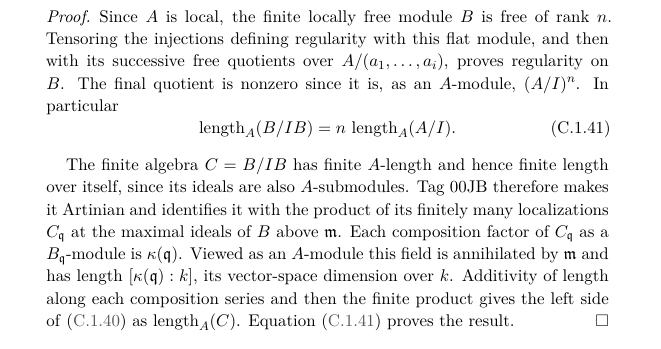
Since $A$ is local, the finite locally free module $B$ is free of
rank $n$. Tensoring the injections defining regularity with this
flat module, and then with its successive free quotients over
$A/(a_1,\ldots,a_i)$, proves regularity on $B$.
The final quotient is nonzero since it is, as an $A$-module,
$(A/I)^n$. In particular
\begin{equation}\label{eq:totalAlength}
 \length_A(B/IB)=n\,\length_A(A/I).
\end{equation}

The finite algebra $C=B/IB$ has finite $A$-length and hence finite
length over itself, since its ideals are also $A$-submodules.
Tag~00JB therefore makes it Artinian and identifies it with the product of its finitely many localizations
$C_{\mathfrak q}$ at the maximal ideals of $B$ above $\mathfrak m$.
Each composition factor of $C_{\mathfrak q}$ as a $B_{\mathfrak q}$-module
is $\kappa(\mathfrak q)$. Viewed as an $A$-module this field is
annihilated by $\mathfrak m$ and has length
$[\kappa(\mathfrak q):k]$, its vector-space dimension over $k$.
Additivity of length along each composition series and then the
finite product gives the left side of \eqref{eq:lengthprojection}
as $\length_A(C)$. Equation~\eqref{eq:totalAlength} proves the result.
\end{proof}
Typeset reader excerpt
Typed proof inputs
No explicit typed target in the exported bindings.
Proof map
Verified map inputs · NAG-002543
No addressable selected proof input is recorded in this projection.
NAG-002543 · Finite locally free intersection lengths · Chapter argument