NAG-002552 · Accepted whole
A finite algebra over a DVR
Proper direct image on historical ordinary compact tests
Open in the English reader · PDF page 1914
Statement · exact TeX
\begin{lemma}[A finite algebra over a DVR]\label{f9nm:dvrlength}
Let $(A,(\pi),k)$ be a DVR, and let $B$ be a commutative finite free
$A$-algebra of rank $n\ge1$. If $b\in B$ is a non-zero-divisor,
then $D=\det_A(m_b)$ is nonzero, $B/bB$ has finite $A$-length, and
\begin{equation}\label{eq:dvrlength}
 \ord_A D
 =\length_A(B/bB)
 =\sum_{\mathfrak q\in\Max B}
       [\kappa(\mathfrak q):k]\,
       \length_{B_{\mathfrak q}}(B_{\mathfrak q}/bB_{\mathfrak q}).
\end{equation}
All maximal ideals of $B$ lie above $(\pi)$. Terms with $b$ a unit
are zero. Full residue-field degrees and unreduced quotient rings
are used. The assertion does not require $B$ to be a domain or
reduced, or any residue extension to be separable.
\end{lemma}
Full selected proof · exact TeX
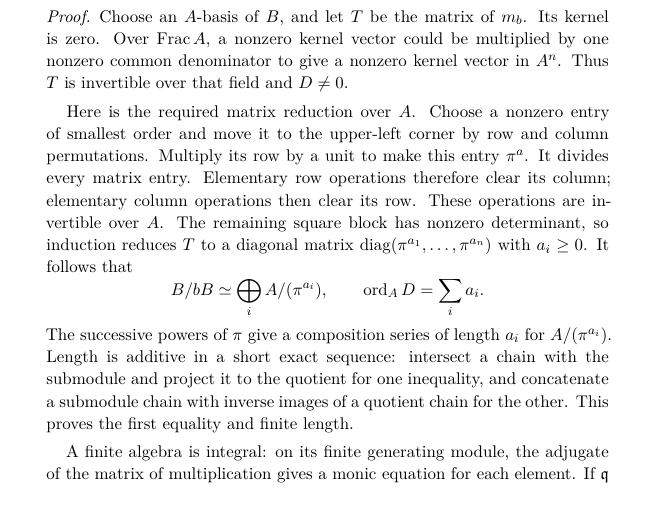
\begin{proof}
Choose an $A$-basis of $B$, and let $T$ be the matrix of $m_b$.
Its kernel is zero. Over $\operatorname{Frac}A$, a nonzero kernel
vector could be multiplied by one nonzero common denominator to give
a nonzero kernel vector in $A^n$. Thus $T$ is invertible over that
field and $D\ne0$.

Here is the required matrix reduction over $A$. Choose a nonzero
entry of smallest order and move it to the upper-left corner by
row and column permutations. Multiply its row by a unit to make
this entry $\pi^a$. It divides every matrix entry. Elementary row
operations therefore clear its column; elementary column operations
then clear its row. These operations are invertible over $A$.
The remaining square block has nonzero determinant, so induction
reduces $T$ to a diagonal matrix
$\operatorname{diag}(\pi^{a_1},\ldots,\pi^{a_n})$ with $a_i\ge0$.
It follows that
\[
 B/bB\simeq\bigoplus_i A/(\pi^{a_i}),\qquad
                  \ord_A D=\sum_i a_i.
\]
The successive powers of $\pi$ give a composition series of length
$a_i$ for $A/(\pi^{a_i})$. Length is additive in a short exact
sequence: intersect a chain with the submodule and project it to
the quotient for one inequality, and concatenate a submodule chain
with inverse images of a quotient chain for the other. This proves
the first equality and finite length.

A finite algebra is integral: on its finite generating module,
the adjugate of the matrix of multiplication gives a monic equation
for each element. If $\mathfrak q$ is maximal in $B$, integrality
makes its contraction maximal in $A$. Indeed, if a field is integral
over a subdomain, then that subdomain is a field: a monic equation
for the inverse of a nonzero element, multiplied by a suitable
power of the element, puts its inverse in the subdomain. Therefore
$\mathfrak q\cap A=(\pi)$, and $\kappa(\mathfrak q)/k$ is finite.

The ring $C=B/bB$ has finite length over itself, since every chain
of its ideals is a chain of its $A$-submodules. Tag 00JB decomposes
$C$ into its finitely many Artinian local factors. In a
$B_{\mathfrak q}$-composition series for $C_{\mathfrak q}$, every
simple factor is $\kappa(\mathfrak q)$. Its $A$-length is its full
$k$-dimension: the action factors through $k$, so its $A$-submodules
are precisely its $k$-subspaces. Adding the lengths of all factors
gives the second equality in \eqref{eq:dvrlength}. If $C=0$, the
sum is zero and the same equality holds. Neither step removes
nilpotents or counts embeddings instead of field dimensions.
\end{proof}
Typeset reader excerpt
Typed proof inputs
No explicit typed target in the exported bindings.
Proof map
Verified map inputs · NAG-002552
No addressable selected proof input is recorded in this projection.